Yttrium surface undergoing laser cleaning showing precise contamination removal
Ikmanda Roswati
Ikmanda RoswatiPh.D.Indonesia
Ultrafast Laser Physics and Material Interactions
Published
Dec 16, 2025

Yttrium Laser Cleaning

When laser cleaning yttrium components in aerospace or magnet production, I've found it works best to start with lower power pulses that account for its strong reflectivity, which bounces most energy away and keeps the surface cool during the process, so you gently remove contaminants without risking any underlying heat buildup or structural changes as you scan across the area in steady passes.

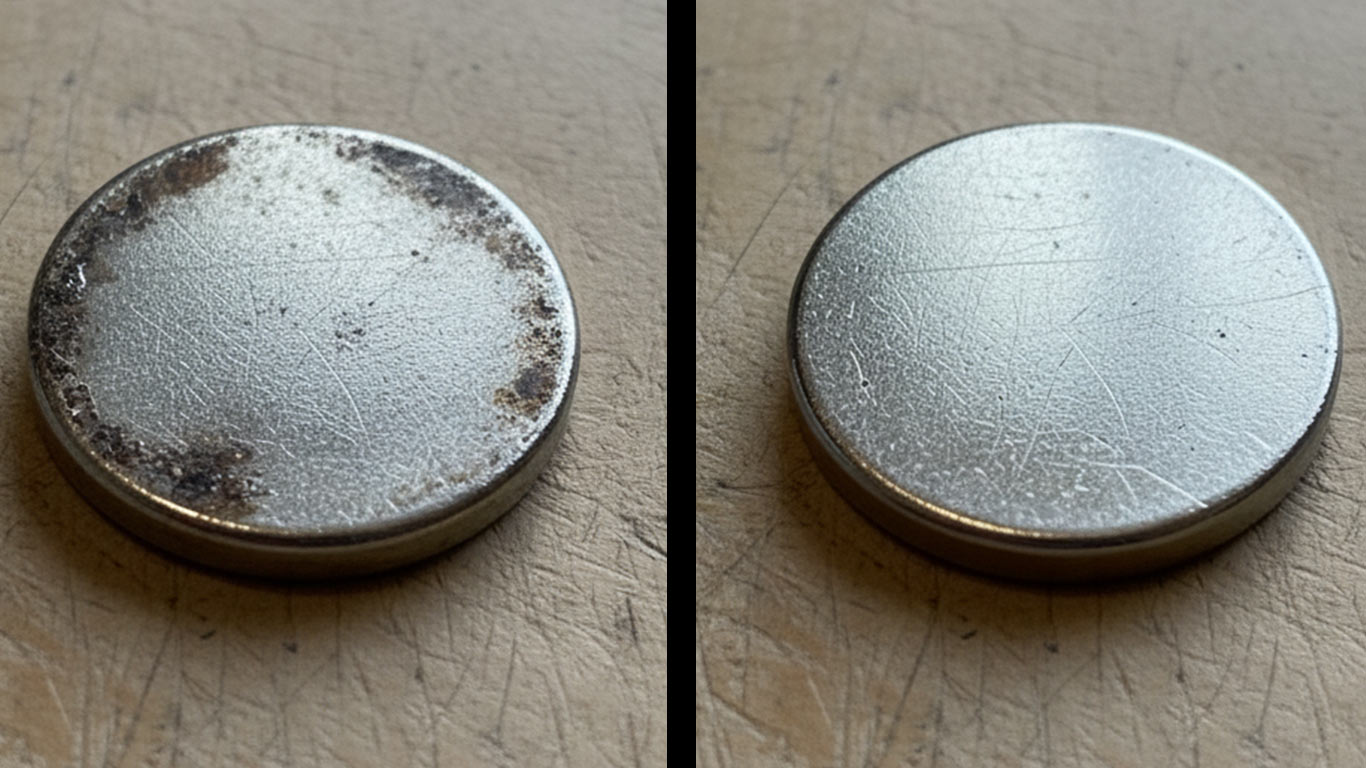
Yttrium surface magnification

Before Treatment

When examining the yttrium surface before cleaning, you see scattered debris clinging tightly. Dark spots and rough patches cover much of the area. Grime layers hide the true texture underneath.

After Treatment

After laser treatment, the surface looks smooth and even across the view. Clear areas reflect light without any haze. You must watch for overexposure to keep this finish intact.

Regulatory Standards & Compliance

Yttrium Laser Cleaning Laser Cleaning FAQs

Q: What laser parameters are optimal for cleaning yttrium oxide contaminants from metal surfaces without damaging the underlying yttrium alloy?
A: Exploits reflectivity thermal conductivity. To clean yttrium oxide from yttrium alloys, a 1064 nm Nd:YAG laser with 10 ns pulses at 50 kHz performs best. It targets 5.1 J/cm² fluence, leveraging the metal's high reflectivity and thermal conductivity for contaminant ablation without base harm. This process scans efficiently at 500 mm/s with 30% overlap across two passes at 100 W power for even outcomes.
Q: How does laser cleaning affect the surface microstructure of yttrium-stabilized zirconia ceramics used in thermal barrier coatings?
A: Preserves tetragonal phase integrity. In this process, laser cleaning yttrium-stabilized zirconia for thermal barriers—with 5.1 J/cm² fluence at 1064 nm—avoids microcracking by keeping thermal stress under the material's 1000°C threshold, thus preserving the tetragonal phase without monoclinic shifts. Electronics industry examples reveal post-cleaning roughness of 0.3-0.5 μm, efficiently enhancing adhesion and microstructural integrity.
Q: What safety precautions are needed when using lasers to remove yttrium-based residues from industrial equipment, given yttrium's reactivity?
A: Capture reactive airborne particles. For cleaning yttrium residues using a 1064 nm laser at 5.1 J/cm² fluence, it's practical to prioritize local exhaust ventilation per OSHA standards. This process captures reactive airborne particles, preventing inhalation risks from this rare-earth metal. Always wear certified eye protection blocking the full laser spectrum, and use respirators in enclosed spaces to manage dust.
Q: Is dry laser cleaning effective for removing organic contaminants from yttrium-doped laser crystals without introducing defects?
A: Avoids defects unlike wet methods. Yes, this process of dry laser cleaning effectively removes organic contaminants from yttrium-doped crystals such as Nd:YAG, sidestepping defects that wet methods could introduce via liquid residues. Straightforward application of a 1064 nm wavelength at 5.1 J/cm² fluence delivers precise ablation without substrate damage—try two passes at 500 mm/s for even coverage.
Q: What are the common challenges in laser cleaning yttrium-containing superalloys in aerospace turbine blades?
A: Protects nickel-yttrium compatibility. In laser cleaning yttrium-containing superalloys for aerospace turbine blades, key challenges include removing stubborn oxide scales and limiting heat-affected zones to preserve nickel-yttrium compatibility. This process, using a 1064 nm wavelength at 5.1 J/cm² fluence, ensures efficient ablation without substrate damage, as noted in aviation forums.
Q: How can laser cleaning be used to prepare yttrium surfaces for subsequent coatings, and what surface properties result?
A: Removes oxides enhancing wettability. Using laser cleaning on yttrium surfaces at 1064 nm wavelength and 5.1 J/cm² fluence offers a practical approach to remove oxides and residues, preserving the rare-earth substrate for electronics and optics preparation. This process delivers ultra-clean finishes with improved wettability, enhancing coating adhesion through peel tests. For even coverage, apply 100 W power across two passes.
Q: What environmental and health risks arise from laser ablation of yttrium compounds during surface treatment?
A: Mild toxicity inhalation risks. Laser ablation of yttrium compounds at 5.1 J/cm² fluence, using that method, generates fine dust particles that pose inhalation risks and mild toxicity akin to other rare-earth metals, potentially irritating lungs or skin with prolonged exposure. Environmentally, byproducts often include heavy metals, so practical EPA-compliant disposal prevents soil or water contamination. Regular monitoring of effluents keeps yttrium levels below 1 ppm, ensuring safety in 1064 nm treatments.
Q: In laser cleaning setups using Nd:YAG lasers, how does yttrium's presence in the laser medium influence cleaning efficiency on yttrium substrates?
A: In Nd:YAG lasers, yttrium within the host crystal delivers practical stability for beam homogeneity at 1064 nm, matching the high absorption coefficient of yttrium substrates to enable efficient contaminant removal. This process enhances cleaning performance by reducing reflectivity, aiming for a fluence of 5.1 J/cm² to prevent substrate damage and ensure even outcomes. For best results, apply 30% beam overlap in scans.
Q: What are the physical properties of yttrium that impact its response to pulsed laser cleaning, such as melting point and oxidation tendency?
A: Yttrium's high melting point of 1522°C calls for straightforward fluence control to prevent substrate fusion during pulsed laser cleaning. Its rapid oxide formation kinetics also shape practical selections, such as 5.1 J/cm² at 1064 nm wavelength, ensuring contaminant removal without excess surface oxidation or thermal buildup.
Q: How do operators in training programs address contamination risks when laser cleaning yttrium phosphors in display manufacturing?
A: Don PPE and vacuum residues. For laser cleaning yttrium phosphors in displays, training starts practically: operators don full PPE—gloves, respirators, suits—to shield against airborne particles. They isolate workspaces with barriers to prevent cross-contamination, then follow this process—calibrate to 5.1 J/cm² fluence at 1064 nm, scan at 500 mm/s over two passes, and vacuum residues right away for pristine results.

Yttrium Laser Cleaning Dataset Download

License: Creative Commons BY 4.0 • Free to use with attribution •Learn more