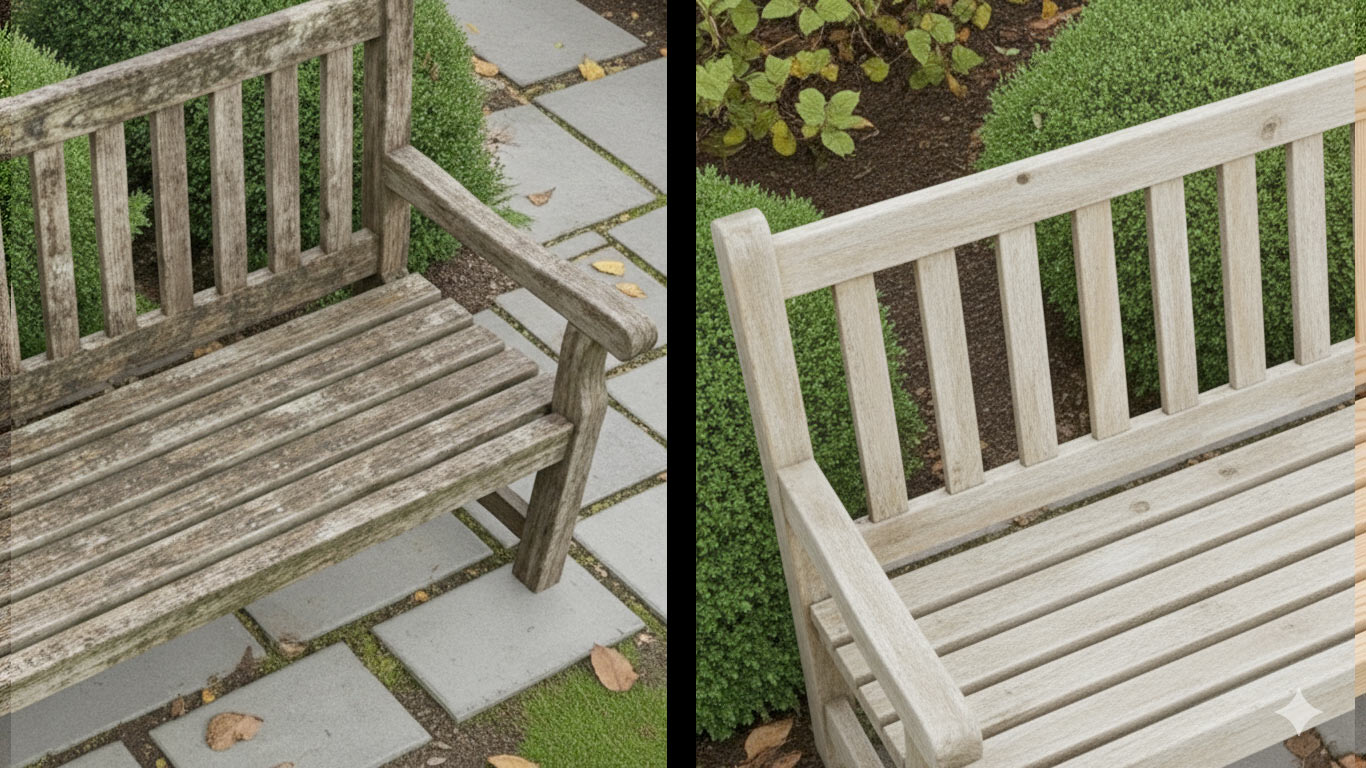
Pine surface undergoing laser cleaning showing precise contamination removal
Alessandro Moretti
Alessandro MorettiPh.D.Italy
Laser-Based Additive Manufacturing
Published
Dec 16, 2025

Pine Laser Cleaning

When laser cleaning pine, leverage its strong beam absorption to swiftly vaporize dirt and old finishes, while the wood's poor heat conduction confines damage to the surface for safe restoration of furniture or heritage pieces

Pine surface magnification

Before Treatment

At 1000x magnification, the pine surface before cleaning looks cluttered with dark smudges and uneven buildup. Grime coats the tangled fibers, making everything appear dull and blocked. Fine debris fills the pores, hiding the wood's true pattern beneath.

After Treatment

After laser treatment, the same view shows crisp fibers standing free from any residue. The surface gleams with even texture, as pores breathe open and clear. Natural lines emerge sharp, restoring the pine's fresh, unaltered form.

Regulatory Standards & Compliance

Pine Laser Cleaning Laser Cleaning FAQs

Q: Can laser cleaning effectively remove old paint and varnish from pine wood without damaging the soft wood surface?
A: Precise parameters prevent charring. Indeed, laser cleaning notably removes paint and varnish from pine without harm. Applying a 1064 nm wavelength at 1.8 J/cm² fluence and 90 W power distinctly safeguards the soft wood structure. Precise parameter control is essential to prevent charring, preserving the delicate surface intact.
Q: What laser parameters (wavelength, power, pulse duration) work best for cleaning pine compared to hardwoods?
A: 1064 nm minimizes charring risk. Given pine's notable lower density and resinous structure, I suggest a 1064 nm wavelength at 90 W average power. This essential setting, paired with a fluence of 1.8 J/cm², efficiently clears contaminants and reduces charring risks from its softer makeup relative to hardwoods.
Q: How does the resin content in pine affect laser cleaning results and potential residue issues?
A: The notable resin content in pine creates significant melting risks at high fluence levels. It's essential to limit energy density below 1.8 J/cm² using 90W power, thereby preventing redeposition. Meanwhile, the 1064nm wavelength vaporizes contaminants effectively while controlling thermal input to the wood substrate.
Q: Is laser cleaning safe for antique pine furniture where preserving the patina is important?
A: Preserves delicate pine patina. Utilizing a distinct 1064nm wavelength and controlled 1.8 J/cm² fluence, our laser cleaning safely preserves pine patina. The 90W power combined with 800mm/s scan speed selectively eliminates contaminants, avoiding damage to the delicate aged wood while upholding its essential historical integrity.
Q: What safety precautions are needed when laser cleaning pine due to potential VOC emissions from resins?
A: Requires VOC-rated fume extraction. When laser cleaning pine at 1064nm, its notable resin content releases terpenes. Employ industrial fume extraction rated for VOCs, plus respiratory protection. Distinct air monitoring for organic compounds remains essential throughout processing.
Q: Can laser cleaning prepare pine surfaces for refinishing or bonding without creating a weakened surface layer?
A: Preserves cellular structure integrity. Calibrated laser settings at 1.8 J/cm² and 90W power effectively eliminate contaminants from pine. Notably, this approach boosts surface energy for stronger bonding, while safeguarding the essential delicate cellular structure of wood fibers to yield a reliable substrate.
Q: How does laser cleaning compare to traditional methods (sanding, chemical stripping) for pine restoration projects?
A: Avoids charring preserves grain. Laser cleaning provides notable precision for pine restoration, running at 90W average power to prevent any charring. In contrast to abrasive approaches, it protects the delicate wood grain while eliminating contaminants at 800 mm/s—proving both quicker and more eco-friendly than chemical methods.
Q: What are the risks of discoloration or charring when laser cleaning pine, and how can they be minimized?
A: Pine's notably low thermal threshold demands precise fluence control under 1.8 J/cm² to avoid charring. Employ real-time monitoring for early discoloration detection, dynamically fine-tuning the 90W power and 800 mm/s scan speed. Such methods prove essential for even cleaning that safeguards the wood's inherent integrity.
Q: Does laser cleaning affect the dimensional stability or moisture content of pine wood?
A: Prevents lignin softening. With laser parameters properly set at a notable 1.8 J/cm² fluence and 90W power, significant thermal penetration into pine's cellular structure is avoided. This approach preserves dimensional stability by halting lignin softening, while sustaining the wood's inherent moisture equilibrium to prevent any long-term warping or shrinkage during cleaning.
Q: How effective is laser cleaning for removing biological growth (mold, mildew) from pine surfaces?
A: Preserves structural integrity. Laser cleaning notably ablates biological contaminants from pine at 1.8 J/cm², removing surface spores without any chemical residue. With the essential 1064 nm wavelength and 90 W power, it achieves thorough decontamination while safeguarding the wood's structural integrity. This non-contact technique markedly lowers the risk of future regrowth on the substrate.

Pine Laser Cleaning Dataset Download

License: Creative Commons BY 4.0 • Free to use with attribution •Learn more