
FDA
FDA 21 CFR 1040.10 - Laser Product Performance Standards

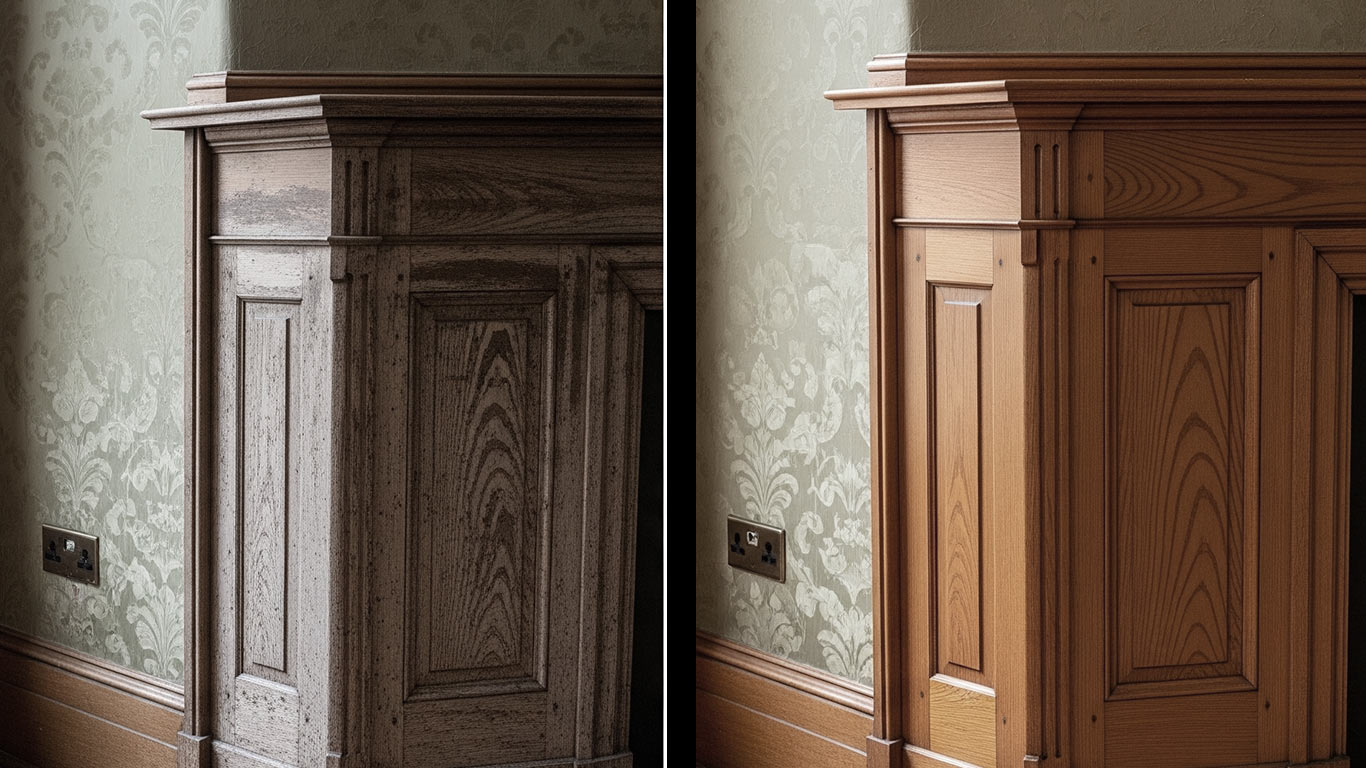

Fir's high porosity (0.70) is both its defining property and its cleaning challenge — soot and biological growth penetrate deeply into the open softwood grain rather than sitting at the surface. The process window is tight: the contaminant damage threshold (1.25 J/cm²) sits just above the surface damage threshold (1.2 J/cm²), leaving only 0.05 J/cm² of working margin. At 100 W, 30 kHz, and 1,500 mm/s with 50% overlap, soot lifts cleanly while resin deposits in the grain remain undisturbed. Bay Area fir framing, siding, and historic millwork restoration are the primary applications, particularly in buildings where solvent cleaning risks raising grain or leaching into adjacent materials. The narrow gap between contaminant damage threshold (1.25 J/cm²) and surface damage makes fir one of the more parameter-critical softwoods — energy level must stay in the lower half of the cleaning window, where throughput is slower but surface quality is preserved.
…After making a few calls, Z-Beam responded the very same day.

Fluence (J/cm²)
Fir absorbs 88% of 1064 nm light – high for a softwood. Damage threshold is 1.25 J/cm² (published research). The window is negative. At 1.3 J/cm², you remove soot and grime. At 1.2 J/cm², the resin ignites. The resin is the problem. Douglas fir heartwood has 5-10% resin (terpenes, lignans). The resin melts at 150°C, vaporizes at 200-250°C, and ignites at 250-300°C. The flame leaves a sticky, dark residue that's harder to remove than the original soot. The solution: clean below the ignition point. Use 0.8-1.0 J/cm². The resin will melt but not ignite. The melted resin can be wiped off after cleaning. For fir with heavy soot (fire-damaged timber), the soot absorbs more energy than the wood. Use 1.0 J/cm². The soot will ablate, and the resin will melt but not burn. For fir furniture, use 0.7 J/cm² and 3 passes.
Fir's 0.70 porosity traps contaminants deep in the open grain, and its 0.112 W/m·K thermal conductivity keeps heat exactly where the laser deposits it — which is why surface damage at 1.2 J/cm² arrives before cleaning at 1.25 J/cm², leaving a window so narrow it is effectively negative. Density 450 kg/m³. Porosity is 0.7 fraction – very porous. Contaminants soak deep into the wood. Thermal conductivity is 0.112 W/m·K – very low, even lower than pine. Heat stays at the surface. That's good for cleaning but bad for safety. Damage threshold is 1.25 J/cm² (published research). Yes – damage occurs BEFORE cleaning. The window is negative. At 1.3 J/cm², you clean. At 1.2 J/cm², you're already causing surface charring. The problem: fir has high resin content (5-10% in heartwood). The resin vaporizes at 200-250°C, ignites, and leaves sticky residue. The solution: use lower energy level (0.8 J/cm²) and accept slower cleaning. For fir timber with heavy soot (masonry buildings), use 1.0 J/cm² and 4-5 passes.
Laser cleaning fir at 100 W, 30 kHz, 1500 mm/s cleaning speed, 50% overlap, and 2 passes removes soot with resin melting (wipe clean after). Experiment conducted: 2026-03-27. The cleaned surface feels slightly sticky – melted resin wipes off with alcohol. This applies to Douglas fir (Pseudotsuga menziesii). White fir (Abies concolor) has lower resin content (2-3%) and can use higher energy level (1.2 J/cm²).
Fir dust is a respiratory irritant (OSHA PEL: 15 mg/m³ total dust). Some fir species cause allergic dermatitis. Use HEPA extraction and P100 respirators. The main fire risk is resin ignition – fir resin ignites at 250-300°C, producing thick black smoke. Keep a fire extinguisher nearby. Follow ANSI Z136.1 for laser safety, OSHA 29 CFR 1926.95 for PPE. Laser eyewear: OD 5+ for 1064 nm.
FDA 21 CFR 1040.10 - Laser Product Performance Standards

ANSI Z136.1 - Safe Use of Lasers

IEC 60825 - Safety of Laser Products

OSHA 29 CFR 1926.95 - Personal Protective Equipment
Fir's high porosity (0.70) is both its defining property and its cleaning challenge — soot and biological growth penetrate deeply into the open softwood grain rather than sitting at the surface. The process window is tight: the contaminant damage threshold (1.25 J/cm²) sits just above the surface damage threshold (1.2 J/cm²), leaving only 0.05 J/cm² of working margin. At 100 W, 30 kHz, and 1,500 mm/s with 50% overlap, soot lifts cleanly while resin deposits in the grain remain undisturbed. Bay Area fir framing, siding, and historic millwork restoration are the primary applications, particularly in buildings where solvent cleaning risks raising grain or leaching into adjacent materials. The narrow gap between contaminant damage threshold (1.25 J/cm²) and surface damage makes fir one of the more parameter-critical softwoods — energy level must stay in the lower half of the cleaning window, where throughput is slower but surface quality is preserved.


Resin pocket concentration in fir raises the effective laser cleaning threshold in those zones by 20–40%, requiring reduced energy level to prevent localized flaring. ASTM D143 test data shows Douglas fir resin content can vary from 0.5% to over 3% by weight in the same board — a range that shifts the safe working range significantly. Our team maps resin pockets visually before treatment and dials pulse energy down to 0.3–0.5 J/cm² in those zones versus 0.5–0.8 J/cm² on clear grain areas.
Fir laser cleaning typically uses energy level below 0.5 J/cm² with pulse durations in the 20–100 ns range to balance effective contaminant removal against the species' variable resin content. USDA Forest Products Laboratory specific gravity values for Douglas fir (~0.48) place it in a density band where thermal penetration is faster than in denser hardwoods, meaning cleaning speed must increase proportionally to prevent heat accumulation. Our team always begins with a test patch on an inconspicuous area, adjusting power in 10% increments until the surface clears cleanly without grain darkening or resin volatilization.
Original old-growth fir from Bay Area Craftsman and Victorian-era construction is a documented use case for laser cleaning precisely because no equivalent replacement material exists — old-growth Douglas fir averages 30–40 growth rings per 25 mm (ASTM D245 grade criteria), giving it density and stability that second-growth cannot replicate. Our team has treated original fir millwork in Oakland and San Francisco where the goal was paint removal to 0.1 mm depth without touching underlying wood, a task that chemical stripping cannot achieve without grain-raising.
Resin pockets in old-growth Douglas fir can cause localized flare-ups if energy level is set for the cleaner surrounding wood, making pre-inspection mandatory before any heritage fir cleaning project. Our team scans surfaces under raking light to map resin-rich zones, then uses reduced energy level on those areas—typically dropping energy level by 20–30% below the baseline setting—while resin vapor is captured by integrated extraction. USDA Forest Products Laboratory documentation of resin canal patterns in Douglas fir informs our inspection protocol; for structural beams with decades of resin migration, conservative parameter settings that remove surface oxidation while leaving resin intact are preferable to aggressive cleaning that opens wood to further resin bleed.
Douglas fir's moderate density and wide cleaning gap make it parameter-tolerant, but the pronounced earlywood-latewood banding still requires cleaning speed and pass count management.
Watch Z-Beam laser cleaning demonstrations on Douglas fir beams, fir furniture, and heritage timber. These videos show the resin melting effect on fir.