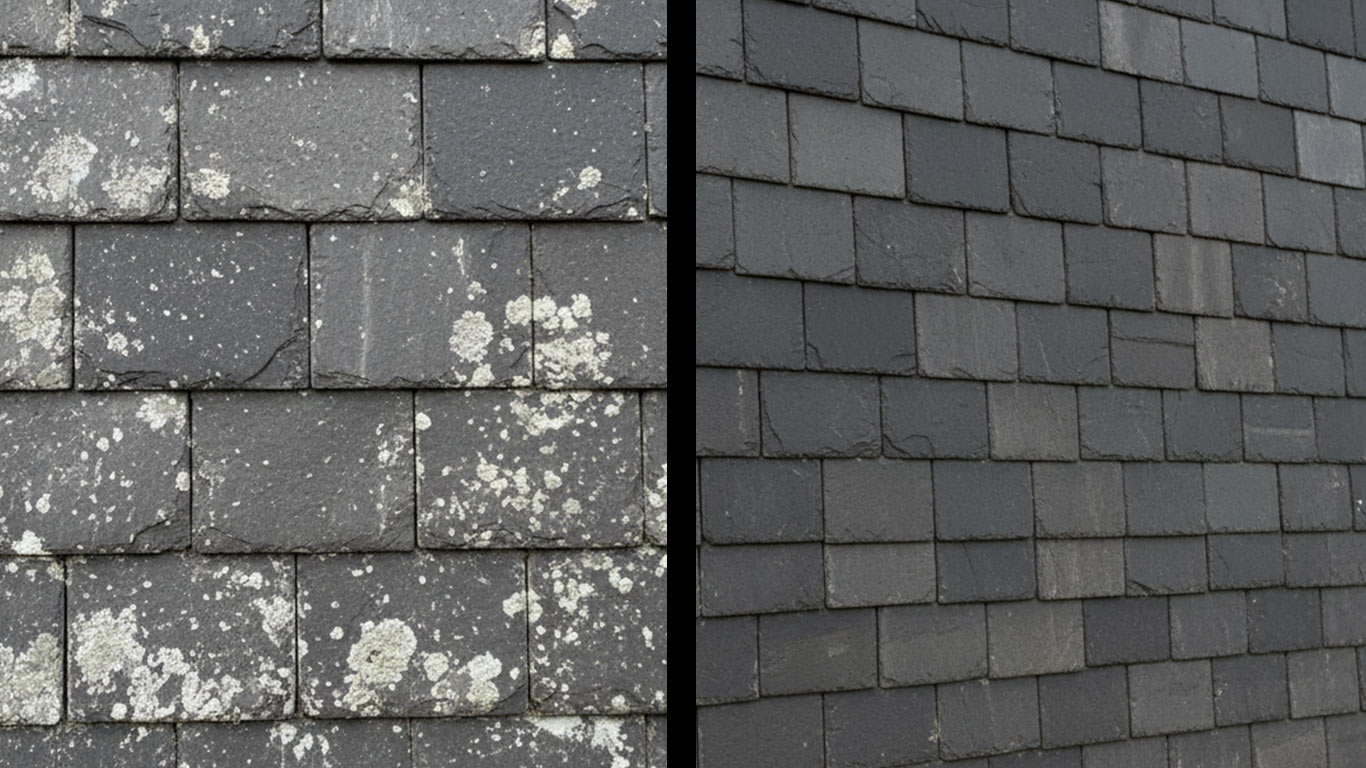
Slate surface undergoing laser cleaning showing precise contamination removal
Ikmanda Roswati
Ikmanda RoswatiPh.D.Indonesia
Ultrafast Laser Physics and Material Interactions
Published
Dec 16, 2025

Slate Laser Cleaning

In restoring delicate slate artifacts for cultural heritage projects, the biggest hurdle is clearing away grime without splitting its layered makeup, but I've noticed how its natural thermal stability stands up so well under careful laser treatments, helping you strip off surface buildup cleanly while protecting the stone's enduring strength for lasting preservation.

Slate surface magnification

Before Treatment

When viewing the contaminated slate surface at 1000x magnification, you'll notice thick layers of dust and grime everywhere. Dark smudges and irregular clumps stick firmly to the rough texture below. These buildups hide the stone's natural patterns completely.

After Treatment

After laser treatment, the same surface looks fresh and even under 1000x magnification. Fine grains of the stone stand out clearly now. A smooth finish emerges without any leftover marks.

Regulatory Standards & Compliance

Slate Laser Cleaning Laser Cleaning FAQs

Q: What laser parameters are recommended for cleaning dirt and moss from slate roofing tiles without causing thermal cracking?
A: For slate roofing tiles, thanks to their low thermal conductivity and mineral composition, a 1064 nm Nd:YAG laser performs best at 100 W average power with 10 ns pulses. This process targets a fluence of 12.7 J/cm² during scans at 500 mm/s to ablate dirt and moss without cracking. Use two passes and 50% beam overlap for even, practical cleaning.
Q: Is laser cleaning safe for historic slate surfaces, such as heritage building facades, and what are the risks of surface ablation?
A: Avoids micro-fractures in fine-grained slate. For historic slate facades, laser cleaning remains safe when parameters are conservative, such as 1064 nm wavelength and 12.7 J/cm² fluence. This process avoids excessive ablation that might trigger micro-fractures in fine-grained stone. Overexposure heightens risks, potentially eroding surface integrity, so it's practical to follow ICOMOS conservation standards and run non-destructive tests before and after for optimal preservation.
Q: How does the iron oxide content in slate affect its absorption of laser light during cleaning processes?
A: Heightens 1064 nm absorption. Iron oxide within slate boosts absorption of 1064 nm laser light straightforwardly, enhancing cleaning efficiency for iron-rich Welsh varieties over lighter Vermont slate, where quartz and mica lead to lower uptake. This variation calls for a practical fluence of 12.7 J/cm² to eliminate contaminants without damaging the stone. To fix color inconsistencies, adjust scan speed to 500 mm/s for uniform coverage.
Q: What are common issues encountered when using fiber lasers to remove graffiti from slate tiles, and how to mitigate them?
A: Overlapping scans and post-sealing. Removing graffiti pigments unevenly from slate tiles often results in patchy finishes. For straightforward uniformity, apply 50% beam overlap and 500 mm/s scan speed at 1064 nm wavelength. Persistent organic binder residues require two passes at 12.7 J/cm² fluence. Seal the porous stone afterward to prevent future stains.
Q: Compared to pressure washing, does laser cleaning provide better results for restoring the natural patina on weathered outdoor slate?
A: Spares layered structure delamination. Yes, laser cleaning offers a practical edge over pressure washing for restoring weathered outdoor slate's natural patina. It ablates embedded pollutants precisely with 12.7 J/cm² fluence at 1064 nm wavelength, protecting the stone's layers from water-induced delamination. In humid climates, this process efficiently ensures durable, flawless results.
Q: What safety precautions should operators take when using Q-switched lasers for industrial cleaning of slate floors?
A: Avoids thermal risks to slate. In this process, operators need laser safety goggles certified for 1064 nm and 532 nm harmonics to protect against eye exposure while Q-switching slate floors at 12.7 J/cm² fluence. It's practical to use respirators for blocking fine dust from vaporized contaminants, and ANSI Z136 standards guide safe, customized setups free of thermal damage to the stone.
Q: Can laser cleaning effectively remove biological growth like algae from slate without altering its chemical composition?
A: Preserves mineral composition integrity. Yes, short-pulse lasers at 1064 nm straightforwardly target algae biofilms on slate using 10 ns pulses and 12.7 J/cm² fluence, vaporizing growth without altering the stone's mineral composition. This process keeps charring risk low on the durable surface at 100 W power. Seal with biocide coatings post-cleaning to curb regrowth.
Q: What are the regulatory requirements for using laser systems to clean slate in construction sites, particularly regarding environmental impact?
A: Particulates below 50 μg/m³. EPA guidelines require airborne particulates from slate ablation to stay under 50 μg/m³, helping curb environmental impact. For construction sites, it's practical to deploy OSHA-certified mobile laser units at 12.7 J/cm² fluence and 100 W power. This process efficiently cuts dust while meeting noise limits below 85 dB and vibration thresholds.
Q: How do temperature variations in slate during laser cleaning affect its structural integrity, especially in cold climates?
A: Pause 1-2 minutes between passes. Slate's thermal expansion coefficient of 6-8 × 10^{-6}/°C leaves it vulnerable to internal stresses from rapid heating in this process of 1064 nm laser cleaning at 12.7 J/cm² fluence. Such heating raises delamination risks within its foliated layers—particularly in cold climates, where low ambient temperatures intensify contraction shocks. For practical protection of structural integrity, allow 1-2 minutes between passes to ensure even cooling.
Q: What equipment maintenance is required for lasers used in cleaning large slate quarry surfaces?
A: Clear dust recalibrate fluence. In this process, wipe the laser lens regularly with isopropyl alcohol to remove slate dust, which builds up fast on quarry surfaces from the stone's Mohs 3-6 hardness and may distort the 1064 nm beam. After each shift, recalibrate fluence to 12.7 J/cm² for hardness variations, efficiently keeping downtime below 10% in high-volume work at 100 W power settings.

Slate Laser Cleaning Dataset Download

License: Creative Commons BY 4.0 • Free to use with attribution •Learn more