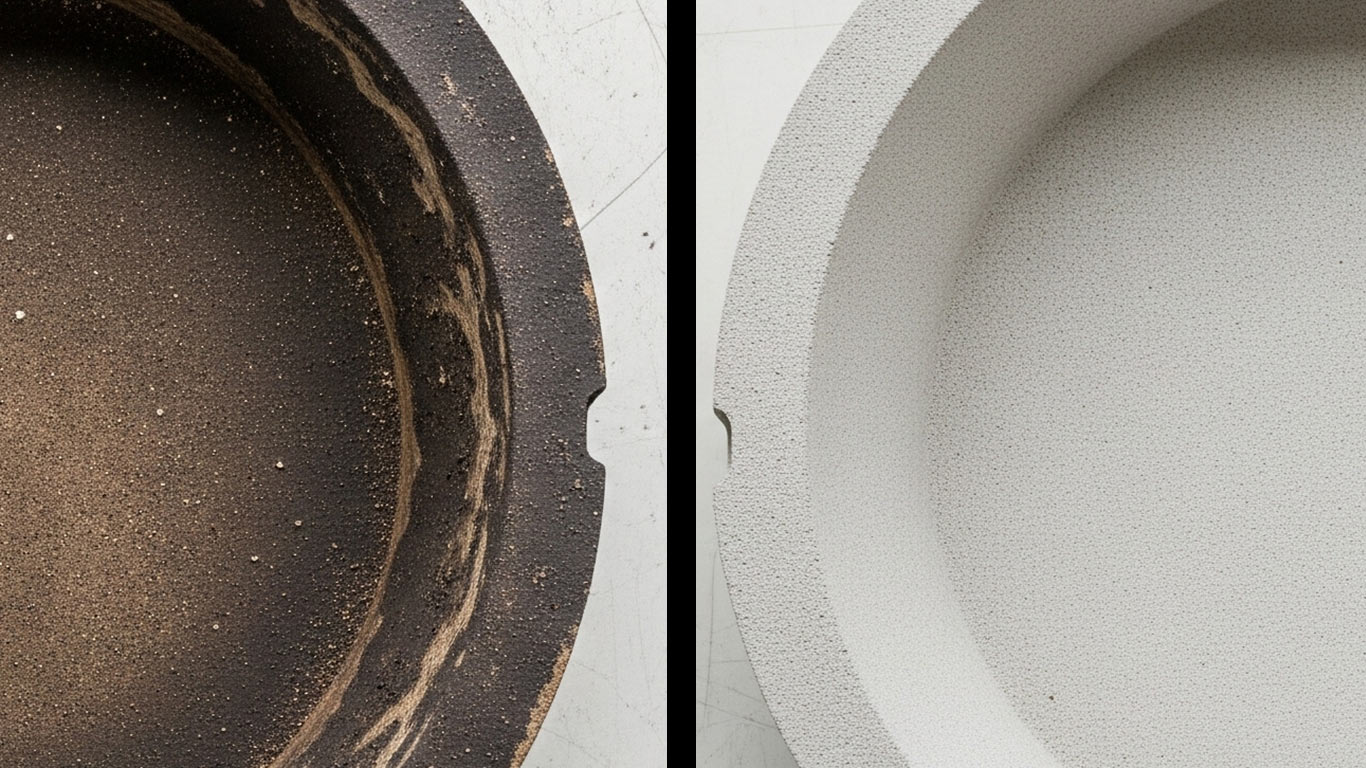
Alumina surface undergoing laser cleaning showing precise contamination removal
Alessandro Moretti
Alessandro MorettiPh.D.Italy
Laser-Based Additive Manufacturing
Published
Dec 16, 2025

Alumina Laser Cleaning

In demanding industrial applications, alumina stands out for its superior heat resistance, which maintains the material's stability and strength even under extreme thermal stress—unlike softer ceramics that tend to crack or warp—delivering reliable performance in precision-dependent uses such as aerospace components and medical instruments.

Alumina surface magnification

Before Treatment

I've seen the contaminated alumina surface under 1000x magnification, and it looks rough with scattered dark specks clinging tightly. Layers of grime build up unevenly, hiding the base material beneath a dull haze. This buildup creates irregular pits that catch the light oddly.

After Treatment

After laser treatment, the same surface appears smooth and uniform at 1000x, with no traces of those dark specks left behind. The haze lifts completely, revealing a clean, even texture that reflects light steadily

Regulatory Standards & Compliance

Alumina Laser Cleaning Laser Cleaning FAQs

Q: How does laser cleaning effectively remove contaminants from alumina surfaces?
A: Preserves hardness and integrity. In laser cleaning, pulsed lasers notably vaporize dirt, oxides, or residues from alumina, safeguarding the substrate's essential hardness and integrity in mere seconds.
Q: What makes alumina challenging to clean using traditional methods?
A: High hardness and chemical inertness. Alumina's notable hardness and chemical inertness resist chemical cleaners and abrasives, often causing incomplete removal or surface scratching, while lasers enable distinct, precise, non-contact cleaning.
Q: Why choose laser cleaning for restoring alumina ceramics?
A: Avoids mechanical stress, prevents cracks. By avoiding mechanical stress, this method tackles brittleness challenges head-on, preventing cracks from appearing during restoration. It highlights in a notable fashion alumina's essential thermal stability, suited to premium ceramics for electronics or medical applications, using sustainable dry processes that cut down on waste.
Q: Can laser cleaning improve the electrical insulation properties of alumina?
A: Indeed, laser cleaning distinctively removes contaminants that could compromise insulation, thereby enhancing alumina's essential dielectric strength without altering its composition.
Q: Is laser cleaning safe for handling alumina dust hazards?
A: Minimizes airborne particles via vaporization. Absolutely. Abrasive methods generate notable dust levels, whereas laser cleaning distinctly reduces airborne particles via localized vaporization, enhancing worker safety and regulatory compliance for this material.
Q: What are the cost benefits of using laser cleaning on alumina components?
A: extends expensive parts lifespan. Laser cleaning offers a notable edge in cutting long-term expenses by bypassing harsh chemicals and throwaway abrasives, while boosting the durability of pricey alumina components. Upfront costs quickly balance out through processing speeds up to 10 times faster than conventional techniques, with scant waste—making it essential for high-volume industrial settings demanding utmost purity.

Alumina Laser Cleaning Dataset Download

License: Creative Commons BY 4.0 • Free to use with attribution •Learn more