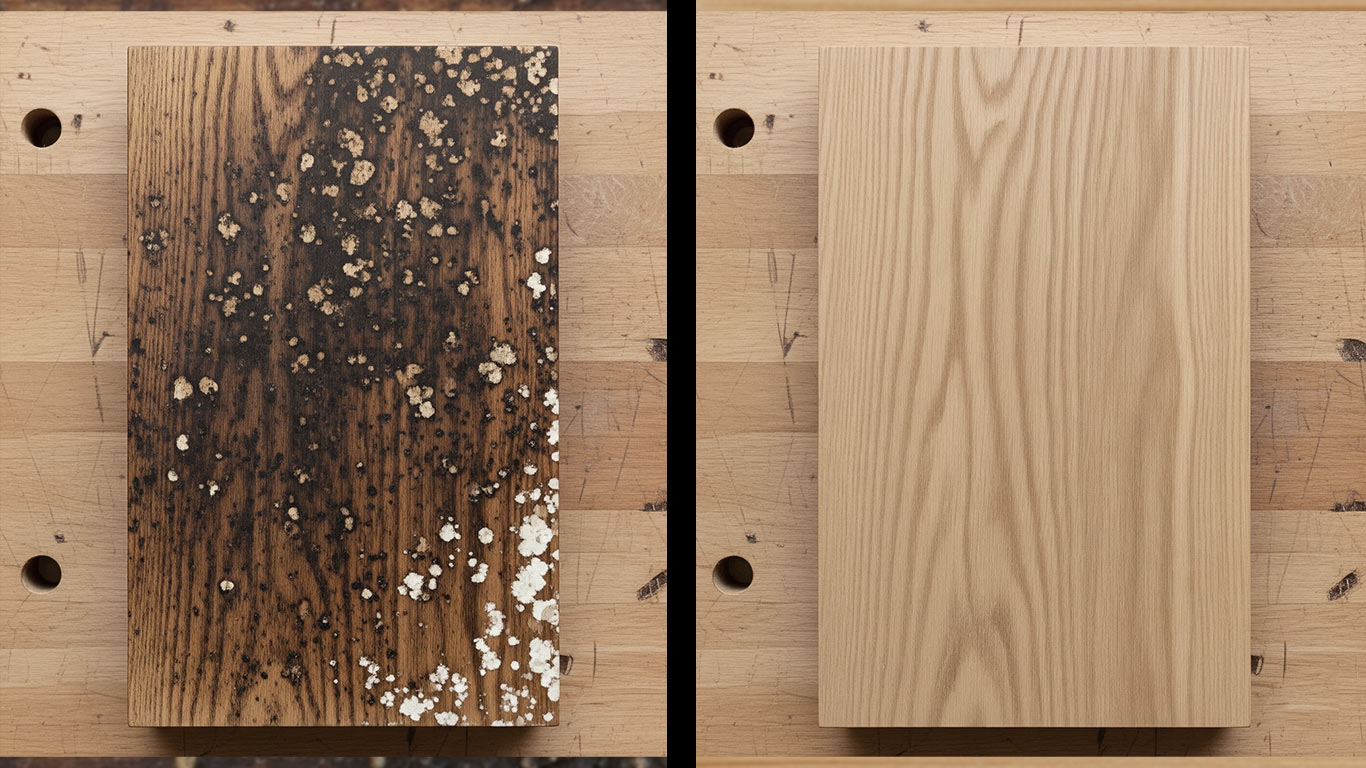
Beech surface undergoing laser cleaning showing precise contamination removal
Alessandro Moretti
Alessandro MorettiPh.D.Italy
Laser-Based Additive Manufacturing
Published
Dec 16, 2025

Beech Laser Cleaning

Beech, this hardwood, exhibits balanced strength and porosity, which suits laser cleaning for cultural heritage artifacts. Contaminants, they yield to precise ablation, dependent from the material's moderate resilience, yielding clean surfaces without excessive charring.

Beech surface magnification

Before Treatment

When examining Beech wood before cleaning, you must notice the thick layer of grime that clogs every fiber. Dirt particles cluster densely, blocking the smooth grain patterns entirely. This buildup creates a rough, uneven texture across the entire surface.

After Treatment

After laser treatment on Beech, you see the grime vanish completely, revealing crisp fiber details. The grain emerges sharp and uniform, with no residue left behind. This treatment restores a clean, polished look to the wood's natural structure.

Regulatory Standards & Compliance

Beech Laser Cleaning Laser Cleaning FAQs

Q: How does laser cleaning restore aged beech furniture?
A: Preserves wood grain integrity. The distinct benefit of laser cleaning comes from its precise pulses, which strip away dirt, varnish, and oxidation from beech while sparing the wood grain. This essential non-abrasive approach uncovers the natural beauty, upholding the wood's integrity during restoration.
Q: What makes beech wood ideal for laser cleaning applications?
A: Fine grain enables accurate targeting. Beech wood features a distinct fine grain and even texture, allowing precise laser targeting of surface contaminants. Its density plays an essential role in minimizing heat absorption, thus curbing charring risks during cleaning.
Q: Why is laser cleaning better than chemical methods for beech?
A: In contrast to chemicals that penetrate and discolor beech's porous structure, laser cleaning delivers a distinct, contactless, and eco-friendly alternative. It evaporates grime instantly, avoiding residue while ensuring an essential, safe restoration of the wood's original luster without swelling risks.
Q: Can laser cleaning fix moisture damage on beech flooring?
A: Addresses surface effects, not warping. Yes, but laser notably addresses surface effects like mold or moisture stains. It removes contaminants essential to preventing further decay, though underlying warping may require additional structural repairs for full restoration.
Q: Is beech susceptible to laser-induced burning during cleaning?
A: Minimal risk with low-fluence. With proper settings, risk stays minimal; low-fluence lasers gently ablate just the surface layers of beech, avoiding deep penetration. Experts make it essential to tweak wavelengths for beech's light hue, yielding clean results.
Q: How to prepare beech items for effective laser cleaning?
A: Calibrate for beech's hardness. First off, confirm the surface is dry and clear of loose debris—essential precaution. Trial laser settings on a small patch to adjust for beech's notable hardness, then advance methodically to prevent uneven results while preserving the wood's smooth finish.
Q: What are the benefits of laser cleaning for preserving beech's value?
A: Restores grain and enhances durability. It notably boosts beech's durability by eliminating pollutants that hasten decay, while restoring its appealing grain and inherent strength. This essential, non-invasive method prolongs the life of prized items like antique furniture, elevating aesthetic and market value without altering the wood's natural qualities.

Beech Laser Cleaning Dataset Download

License: Creative Commons BY 4.0 • Free to use with attribution •Learn more