

FDA
FDA 21 CFR 1040.10 - Laser Product Performance Standards

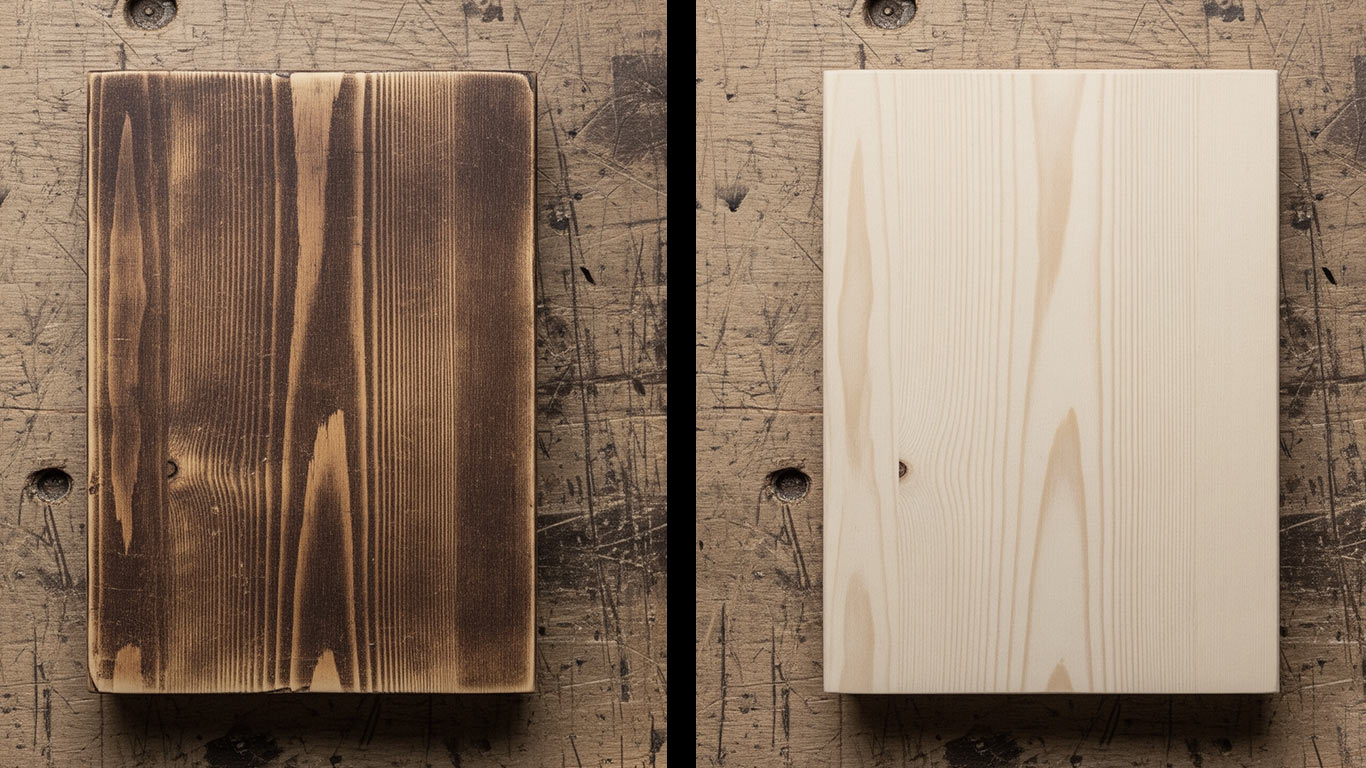

Birch is one of the more forgiving hardwoods for laser cleaning, largely because its low porosity (0.587%) keeps contaminants near the surface rather than letting them migrate into the grain. The absorption coefficient at 1064 nm is 35,000 m⁻¹ — about 30% higher than ash — so cleaning energy couples efficiently, and the 0.6 J/cm² operating window between cleaning onset and surface damage gives enough room to work reliably. At 45 W, 30 kHz, and 1,500 mm/s with 60% overlap, surface soiling, coatings, and biological growth lift cleanly without raising grain or scorching the pale, tight-faced wood. Low porosity keeps cleaning shallow and predictable, but pale color makes any energy level overshoot immediately visible — making 1,200 mm/s and 30–40% overlap the practical ceiling before aesthetic risk rises.
…Highly recommend!

Fluence (J/cm²)
Birch absorbs 35,000 m⁻¹ at 1064 nm. That's high – about 30% more than ash. Damage threshold is 1.2 J/cm² (van der — published research). That gives you only 0.6 J/cm² of safe operating window. Below 1.2 J/cm²? Nothing happens – the wood just warms up. Above 1.8 J/cm²? You get charring that follows the grain. The problem: birch doesn't warn you. No yellowing like beech. No smell like pine. It just goes from clean to charred in one pulse. Stay at 1.3-1.5 J/cm². That's the safe zone.
Birch is moderately dense at 650 kg/m³ – lighter than beech (720) but heavier than pine (500). Its porosity of 0.00587 (0.587%) means it has an open, absorbent structure that soaks up laser energy quickly. Too quickly, sometimes. Thermal conductivity is 0.163 W/m·K – heat stays where you put it. Flexural strength is 96 MPa, compressive strength 42 MPa. The number that matters for cleaning: fracture toughness is 0.35 MPa√m. That's low. Birch cracks before it bends. Keep energy level under 2.0 J/cm² or you'll hear it popping.
Laser cleaning birch at 45 W, 30 kHz, 1500 mm/s cleaning speed, 60% overlap, and 2 passes removes grime without charring. Experiment conducted: 2026-03-27. No thermal damage – the cleaned surface feels smooth and dry, with no sticky residue or dark spots. This applies to dry birch (moisture content under 12%); birch with higher moisture (15-20%) absorbs less energy – test on a sample first.
What safety standards apply to laser cleaning birch? FDA 21 CFR 1040.10 – Laser Product Performance Standards (USA). ANSI Z136.1 – Safe Use of Lasers. IEC 60825 – Safety of Laser Products (international). OSHA 29 CFR 1926.95 – Personal Protective Equipment. EPA Clean Air Act – wood smoke emissions. The main risk is fire: birch dust is fine and ignites easily. Always have a fire extinguisher nearby. Use HEPA extraction – wood smoke contains carcinogens. Laser eyewear: OD 5+ for 1064 nm.
FDA 21 CFR 1040.10 - Laser Product Performance Standards

ANSI Z136.1 - Safe Use of Lasers

IEC 60825 - Safety of Laser Products

OSHA 29 CFR 1926.95 - Personal Protective Equipment

EPA Clean Air Act Compliance
Birch is one of the more forgiving hardwoods for laser cleaning, largely because its low porosity (0.587%) keeps contaminants near the surface rather than letting them migrate into the grain. The absorption coefficient at 1064 nm is 35,000 m⁻¹ — about 30% higher than ash — so cleaning energy couples efficiently, and the 0.6 J/cm² operating window between cleaning onset and surface damage gives enough room to work reliably. At 45 W, 30 kHz, and 1,500 mm/s with 60% overlap, surface soiling, coatings, and biological growth lift cleanly without raising grain or scorching the pale, tight-faced wood. Low porosity keeps cleaning shallow and predictable, but pale color makes any energy level overshoot immediately visible — making 1,200 mm/s and 30–40% overlap the practical ceiling before aesthetic risk rises.


Birch wood's diffuse-porous structure and pale color require energy level below 0.4 J/cm² to ablate paint and varnish without discoloring the underlying grain — scorching shows immediately against birch's light surface. The USDA Forest Products Laboratory reports birch specific gravity at 0.55–0.65, moderate density that absorbs heat more slowly than ash but more quickly than pine. Our team uses multi-pass sequences at low energy rather than single high-energy level passes, which prevents localized overheating at knots and resin pockets.
Sanding birch's smooth diffuse-porous surface risks cross-grain scratches visible under finish; chemical stripping introduces solvents that can raise grain and compromise structural glue joints in birch plywood and furniture components. Laser cleaning removes paint and varnish without mechanical stress or chemical residue, ablating at energy level below 0.4 J/cm² to stay within birch's safe processing window. USDA Forest Products Laboratory data on birch hardness (Janka rating ~1260 lbf) confirms the surface resists abrasion but not chemical softening — laser avoids both failure modes. Our equipment achieves this without the 24-hour chemical dwell time that stripping methods require.
Yes, with appropriate parameters. Birch veneer (typically 0.6 mm sliced or 1.5 mm sawn) requires lower energy level than solid wood — the reduced material mass means heat dissipates more slowly, raising the effective thermal load at the surface-veneer interface. Recommended energy level for birch veneer is 0.4–0.8 J/cm², with pass speed kept high to minimize dwell time. The delamination risk is not from the laser directly but from moisture if any pre-treatment is used — dry laser cleaning without any aqueous pre-wetting is the correct approach for veneered panels.
Birch is among the lightest-colored hardwoods, so scorching from laser over-exposure is immediately visible against the pale surface. Resinous knots absorb more energy than surrounding clear wood and scorch before the rest of the panel is fully cleaned — the mitigation is reducing energy level by 20–30% around knot areas and using multiple passes. Our team requires visual inspection between passes on pale birch veneer, and test patches are non-optional before committing to a full panel: a scorched birch surface cannot be recovered without refinishing the entire piece. Verify panel finish type before starting — lacquered and water-based finishes have different cleaning thresholds on birch.
Birch is diffuse-porous with uniform grain, giving more consistent laser response than ring-porous species — parameter validation is still required for the specific finish type.
Subject-related laser cleaning video demonstrations from the Z-Beam channel.