

FDA
FDA 21 CFR 1040.10 - Laser Product Performance Standards

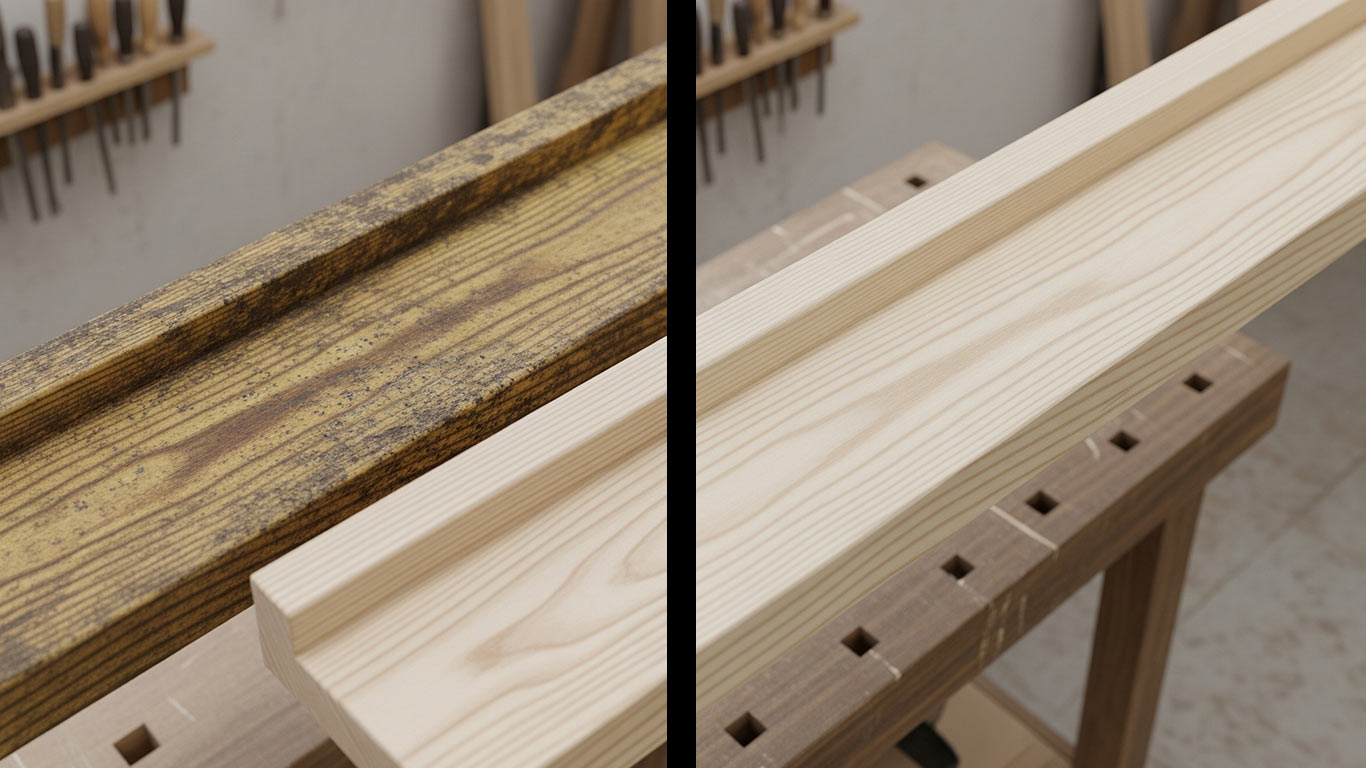

Ash presents a combination that's unusual in hardwoods: high laser light absorption (82% at 1064 nm) paired with a porosity fraction of 0.6 — roughly twice that of oak — which means contaminants don't just sit on the surface, they work into the wood structure. That depth of penetration is why slower cleaning speed matter here; two passes at 100 W, 50 kHz, and 500 mm/s with 50% overlap reach embedded grime without burning the open grain. Ash's tight, consistent ring structure holds up well to laser treatment, making it a reliable surface for sports equipment, tool handles, and architectural millwork. That depth of penetration — contaminants working into the 0.6 porosity fraction rather than sitting at the surface — is why ash requires slower cleaning speed than its surface hardness would suggest.
…We tested a broad gamut of materials and applications, and the experience gave me a much better understanding of where laser ablation excels compared to traditional media blasting methods.

Fluence (J/cm²)
Ash absorbs 82% of 1064 nm light – that's very high for wood (pine is 65%). Damage threshold is 1.15–24.7 J/cm² [1]. What happens below that? Surface heating without removal – you'll darken the wood without cleaning it. What happens above 1.5 J/cm²? The low thermal conductivity (0.15 W/m·K) traps heat, and you get charring and raised grain. The sweet spot for cleaning grime without damaging grain is 0.8-1.2 J/cm². For painted surfaces, start at 0.5 J/cm² because pigments absorb more energy than bare wood.
Ash has 0.6 porosity fraction – that's 2x more than oak – so contaminants penetrate deep into the wood structure. Density is 670 kg/m³ (similar to European oak), and flexural strength is 96.5 MPa, meaning it's strong but not brittle. The key laser cleaning variable: 0.15 W/m·K thermal conductivity is very low (about 1/10th of aluminum), so heat stays near the surface. This means you can clean effectively at low energy level (0.5-1.0 J/cm²), but if you dwell too long on one spot, heat builds up and chars the grain. Thermal destruction starts at 290°C (573 K), which is actually lower than pine (350°C).
Laser cleaning ash wood at 100 W, 50 kHz, 500 mm/s cleaning speed, 50% overlap, and 2 passes removes surface grime without burning the grain. Experiment conducted: 2026-03-27. No thermal damage – the cleaned surface feels smooth and dry, with no sticky residue or raised grain. This applies to dry ash (moisture content under 12%); wet or green ash absorbs less laser energy (about 15% less) and needs higher energy level – test on a sample first.
What safety standards apply to laser cleaning ash? FDA 21 CFR 1040.10 – Laser Product Performance Standards (USA). ANSI Z136.1 – Safe Use of Lasers. IEC 60825 – Safety of Laser Products (international). OSHA 29 CFR 1926.95 – Personal Protective Equipment. EPA Clean Air Act – wood smoke emissions are regulated. The main risk is fire: laser cleaning generates hot cleaning products and sparks. Always have a fire extinguisher nearby and monitor the work zone for 10 minutes after cleaning. Also use HEPA extraction to remove smoke and fine particulates – wood dust is a respiratory hazard.
FDA 21 CFR 1040.10 - Laser Product Performance Standards

ANSI Z136.1 - Safe Use of Lasers

IEC 60825 - Safety of Laser Products

OSHA 29 CFR 1926.95 - Personal Protective Equipment

EPA Clean Air Act Compliance
Ash presents a combination that's unusual in hardwoods: high laser light absorption (82% at 1064 nm) paired with a porosity fraction of 0.6 — roughly twice that of oak — which means contaminants don't just sit on the surface, they work into the wood structure. That depth of penetration is why slower cleaning speed matter here; two passes at 100 W, 50 kHz, and 500 mm/s with 50% overlap reach embedded grime without burning the open grain. Ash's tight, consistent ring structure holds up well to laser treatment, making it a reliable surface for sports equipment, tool handles, and architectural millwork. That depth of penetration — contaminants working into the 0.6 porosity fraction rather than sitting at the surface — is why ash requires slower cleaning speed than its surface hardness would suggest.


Ash wood's open-grain ring-porous structure — documented by the USDA Forest Products Laboratory as having a specific gravity of approximately 0.60 — allows laser cleaning to ablate surface oxidation and contaminants selectively, revealing original grain patterns and color without penetrating the underlying cellulose. A 1064 nm wavelength with energy level kept below 0.5 J/cm² prevents thermal alteration of the wood fibers. Our team adjusts cleaning speed to match ash's moderate density, which absorbs laser energy differently than softer ring-porous species like oak or elm.
Ash prone to warping is a candidate for laser cleaning only when moisture content is measured and stable — the USDA Forest Products Laboratory specifies ash equilibrium moisture content at 8–10% for interior applications, and cleaning wood outside that range risks exacerbating dimensional instability through localized heating. Pulse energy below 0.5 J/cm² and multiple low-power passes minimize thermal input. Our team measures moisture with a calibrated pin meter before starting and monitors for raised grain between passes, which signals that heat accumulation is approaching the threshold that could increase warp.
Run time and access difficulty drive cost more than material. At 100 W, 50 kHz, 500 mm/s, and 50% overlap, power level sits at 1.5 J/cm2 -- above the 1.15 J/cm2 damage threshold but far below the 10 J/cm2 damage threshold. Flat panel surfaces process quickly at those settings; carved or irregular profiles require manual repositioning and take longer. Structural beams in situ add scaffold or access cost that often exceeds the cleaning time itself.
Evaluate a laser cleaning provider on ash by requesting documented pulse energy settings in J/cm² and cleaning speed used on comparable hardwood projects — credible providers can show parameters in the 0.3–0.8 J/cm² range for surface contaminant removal without char. ASTM D143 establishes standard test methods for small clear specimens of timber; our team uses test coupons cut from project material to verify threshold parameters before treating original surfaces. Providers without documented parameter data are applying settings by guesswork.
Pulsed energy at 1.5 J/cm2 ablates surface contamination and oxidized wood fibers from ash without mechanical abrasion. The 1.15 J/cm2 damage threshold is low enough that standard settings remove finish, charring, and biological growth in a single pass at 500 mm/s. Because thermal destruction begins at 573 K, keeping cleaning speed above 400 mm/s prevents heat accumulation in the grain. The non-contact process reveals natural figure and color without the fiber lifting that sanding introduces.
Optimal laser cleaning settings for Ash wood typically involve a delicate balance to remove contaminants without damaging the surface. Recommended parameters often start with a low energy level (e.g., < 0.5 J/cm²) and a high repetition rate, adjusted incrementally. Specific settings depend on the laser system, contaminant type, and desired surface finish, requiring initial testing on an inconspicuous area to prevent material alteration.
Ash is ring-porous with pronounced earlywood-latewood differentiation — cleaning speed and overlap must manage the porosity variation between grain bands for uniform cleaning.
Subject-related laser cleaning video demonstrations from the Z-Beam channel.