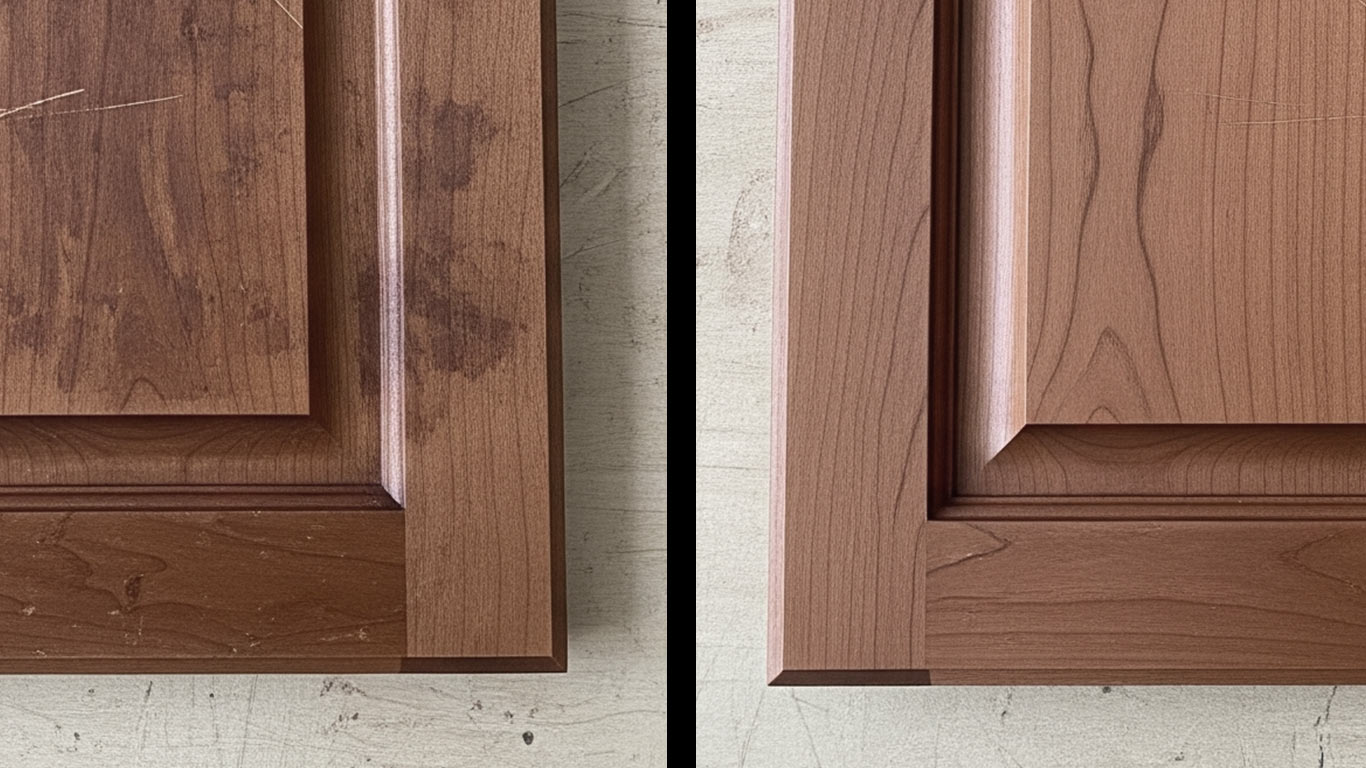
Cherry surface undergoing laser cleaning showing precise contamination removal
Todd Dunning
Todd DunningMAUnited States
Optical Materials for Laser Systems
Published
Dec 16, 2025

Cherry Laser Cleaning

When laser cleaning cherry wood, focus on its strong absorption to strip away surface contaminants efficiently while protecting the material's natural durability and fine grain.

Cherry surface magnification

Before Treatment

At 1000x magnification, the cherry wood surface appears cluttered with fine dirt particles. These contaminants form irregular clusters that embed into the porous fibers. Grime layers dull the natural texture, hiding underlying details completely.

After Treatment

After laser treatment at 1000x magnification, the cherry wood surface shows clear, even fibers. The cleaning removes all visible residues, exposing smooth grain patterns. This reveals a uniform, restored appearance without any lingering marks.

Regulatory Standards & Compliance

Cherry Laser Cleaning Laser Cleaning FAQs

Q: Can laser cleaning effectively remove oxidation and patina from cherry wood without damaging the surface?
A: A 1064nm wavelength at 1.8 J/cm² fluence pretty effectively removes oxidation from cherry wood. It targets contaminants fairly precisely, minimizing thermal penetration to preserve the delicate surface. Precise control lets us eliminate patina without causing discoloration or burning the underlying material.
Q: What laser settings (wavelength, power, pulse duration) are recommended for cleaning soot and smoke residue from cherry furniture after a fire?
A: 1064 nm 90W 1.8 J/cm². When working with cherry furniture, I'd typically go for a 1064 nm wavelength at 90W average power and 1.8 J/cm² fluence. This pretty much ablates the soot cleanly while keeping the wood's structure intact. Just start off with a low-power test in a hidden spot to gauge the surface reaction before diving into the full cleanup.
Q: Does laser cleaning cherry wood surfaces affect the natural color or cause any bleaching effect?
A: Preserves natural pigments. Laser cleaning, when set up right, pretty much preserves cherry wood's natural pigments exceptionally well. At our optimal 1.8 J/cm² fluence and 90W power, we basically strip away contaminants without the bleaching typical of chemical or abrasive methods, ensuring the wood's rich color stays stable.
Q: How do you prepare a cherry wood surface for laser cleaning to ensure uniform results and prevent damage?
A: Verify moisture below 12%. First off, check that the wood's moisture content stays below 12% to avoid thermal stress. For fairly uniform cleaning on carved surfaces, use a 1064 nm wavelength at 1.8 J/cm² fluence, typically adjusting the 500 mm/s scan speed to hold a consistent distance across contours.
Q: What safety precautions are specific to laser cleaning cherry wood, particularly regarding fume extraction and fire risk?
A: Cherry's organic compounds pretty much call for robust fume extraction in your 90W setup. At 1.8 J/cm² fluence, resins can ignite, so basically you'll need Class D filtration to handle that VOC-laden smoke. Keep a fire watch and confirm ventilation aligns with local codes for wood particulates.
Q: Can laser cleaning be used to selectively remove old varnish or finish from cherry wood while preserving the underlying grain?
A: Preserves delicate grain structure. Yeah, laser cleaning works pretty well for selectively stripping aged varnish off cherry wood. That 1064 nm wavelength and 1.8 J/cm² fluence threshold basically enable precise ablation of the finish, while preserving the delicate grain structure underneath—ideal for antique restoration.
Q: What are the limitations of laser cleaning for cherry compared to other wood species like oak or maple?
A: Cherry's fairly moderate density and natural oils call for careful fluence control right around 1.8 J/cm². That tighter grain structure makes it pretty susceptible to thermal marking compared to open-grained woods like oak, so you'll want precise power management below 90 W to keep its rich color intact.
Q: How does the natural porosity of cherry wood affect laser cleaning efficiency for embedded contaminants?
A: Traps contaminants risking deeper embedding. Cherry's porous structure typically traps contaminants beyond surface reach. Our 1.8 J/cm² fluence setting pretty effectively lifts embedded particles, but aggressive parameters risk driving debris deeper into the wood's cellular matrix, complicating cleaning.
Q: What post-cleaning treatments are recommended for cherry wood after laser cleaning to restore and protect the surface?
A: Rehydrate open grain with oil. After laser cleaning at 1.8 J/cm², the cherry wood's open grain pretty much demands immediate conditioning. I'd typically suggest a penetrating oil like tung or linseed to rehydrate the fibers before adding a protective sealant. This two-step method restores the natural luster while delivering a durable finish that highlights the wood's inherent beauty.
Q: Is laser cleaning economically viable for cherry wood restoration compared to chemical or mechanical methods?
A: Preserves rich patina viably. Laser cleaning turns fairly economically viable for cherry wood at 1.8 J/cm², safeguarding its rich patina against the damage from mechanical abrasion or chemical solvents. In high-value projects like instrument restoration, the precision and time savings at 500 mm/s scan speeds basically justify that initial equipment investment.

Cherry Laser Cleaning Dataset Download

License: Creative Commons BY 4.0 • Free to use with attribution •Learn more