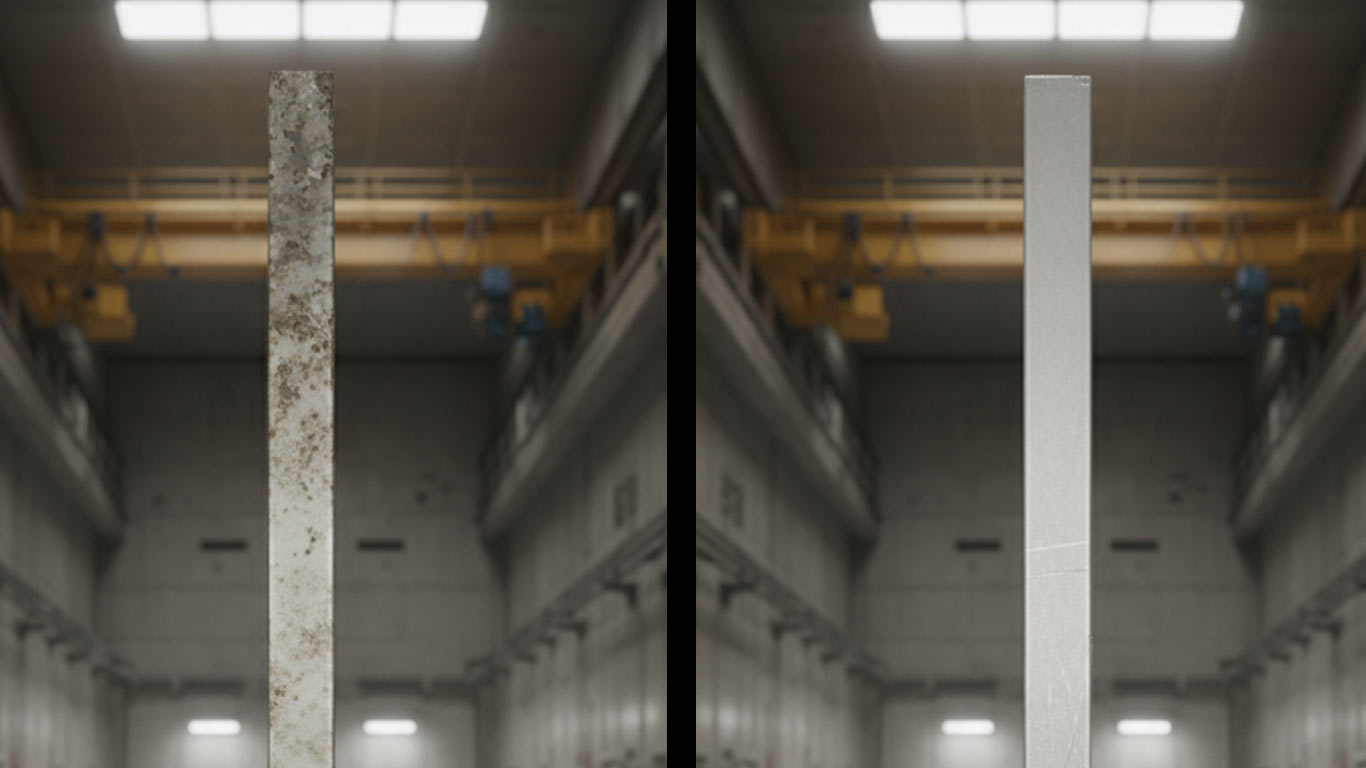
Europium surface undergoing laser cleaning showing precise contamination removal
Todd Dunning
Todd DunningMAUnited States
Optical Materials for Laser Systems
Published
Dec 16, 2025

Europium Laser Cleaning

In contrast to other rare-earth elements that exhibit broader emission spectra, Europium delivers a sharp red luminescence that improves color purity in optical components and electronics, supporting precise cleaning processes that restore fluorescence without compromising surface integrity

Europium surface magnification

Before Treatment

The contaminated surface displays a mottled layer of dark residue and scattered debris across its uneven texture. Rough patches and clinging particles obscure the base material beneath this dull coating. Tiny irregularities dot the view, giving it a worn and irregular appearance.

After Treatment

The clean surface reveals a smooth and uniform expanse free from any residue or debris. Polished facets reflect light evenly over the entire area now. The base material exposes its inherent luster and flawless contours clearly.

Regulatory Standards & Compliance

Europium Laser Cleaning Laser Cleaning FAQs

Q: Is europium-doped glass a major concern for laser cleaning of historical artifacts or electronics?
A: Induces permanent color centers. Europium-doped glass presents pretty significant discoloration risks during laser cleaning, stemming from strong Eu³⁺ ion absorption—especially at 532 nm. A fluence threshold of 1.2 J/cm² means even fairly moderate power can trigger permanent color centers. This remains a key worry for historical optics and electronics relying on europium phosphors.
Q: What laser wavelength is safest for cleaning surfaces containing europium compounds without causing fluorescence or damage?
A: 532nm avoids f-f transitions. For cleaning europium compounds, I'd typically go with 532 nm green lasers at 1.2 J/cm² fluence. This wavelength sidesteps strong f-f electron transitions in the rare-earth ion, cutting resonant absorption that triggers intense red photoluminescence. The fairly low thermal conductivity of 13.9 W/(m·K) demands this controlled ablation to avoid thermal damage.
Q: Does europium oxide scale on rare earth metal components require special laser cleaning considerations compared to other oxides?
A: Requires careful fluence control. Europium oxide features a pretty low ablation threshold of 1.2 J/cm², so fluence control is essential. Its fairly soft 0.167 HV hardness and high thermal expansion of 35 × 10⁻⁶/K mean excessive power can readily cause subsurface damage to the underlying rare earth component.
Q: Are there specific safety hazards when laser cleaning europium-containing phosphors from CRT monitors or fluorescent lamps?
A: Low oxidation resistance inhalation hazard. Laser ablation of europium phosphors at 1.2 J/cm² typically generates highly respirable nanoparticles. With europium's fairly low oxidation resistance (180°C), these aerosols create a significant inhalation hazard. To mitigate this toxic exposure risk, you must use a P100 respirator and robust fume extraction.
Q: How does laser cleaning affect the luminescent properties of europium-doped materials used in security markings?
A: Preserves photoluminescent integrity. Properly tuned laser cleaning at 1.2 J/cm² basically preserves europium's luminescence by selectively removing surface contaminants. With the 532 nm wavelength and controlled thermal input, it fairly well prevents damage to the host matrix, ensuring the security feature's photoluminescent integrity stays fully functional.
Q: What are the signs of improper laser cleaning on europium-containing alloys or coatings?
A: Orange fluorescence indicates oxidation. Keep an eye out for pretty dark gray discoloration or boosted orange fluorescence, signaling thermal oxidation above 180°C. Surface pitting typically points to fluence exceeding the 1.2 J/cm² limit, while haze indicates incomplete contaminant removal.
Q: Can laser cleaning effectively remove contaminants from europium-based superconductors without degrading their electrical properties?
A: Preserves critical current density. Yes, with pretty precise 532nm wavelength control at 1.2 J/cm² fluence, laser cleaning effectively removes contaminants from europium superconductors. This approach basically minimizes thermal stress below 180°C, preserving the critical current density by preventing surface defect formation.
Q: Why does europium sometimes create different colored residues during laser cleaning compared to other rare earth elements?
A: Europium's dual oxidation states set it apart, yielding varied colored oxides under laser heating. The Eu³⁺ form creates pretty pale pink compounds, whereas Eu²⁺ produces darker, more intense shades. This variation stands out more than in other rare earths, owing to europium's fairly low oxidation resistance starting around 180°C.
Q: What waste disposal regulations apply to europium-contaminated debris from laser cleaning operations?
A: Document reactive rare earth waste. The europium debris from your 532 nm laser cleaning typically counts as non-hazardous waste in most US jurisdictions, since its compounds lack RCRA-listed toxicity. That said, the fairly low oxidation resistance of 180°C renders ablated particles highly reactive. Just document the waste stream's composition and dispose at a licensed facility for rare earth metals.
Q: How do we verify complete contaminant removal from europium surfaces without damaging the substrate?
A: Monitor 614 nm emission attenuation. Leverage europium's inherent luminescence under 532 nm excitation to verify purity. Track the signature red emission peak around 614 nm; dimming signals leftover contaminants. This contactless approach operates fairly below the 1.2 J/cm² ablation threshold, basically keeping the soft substrate intact while confirming cleanliness.

Europium Laser Cleaning Dataset Download

License: Creative Commons BY 4.0 • Free to use with attribution •Learn more