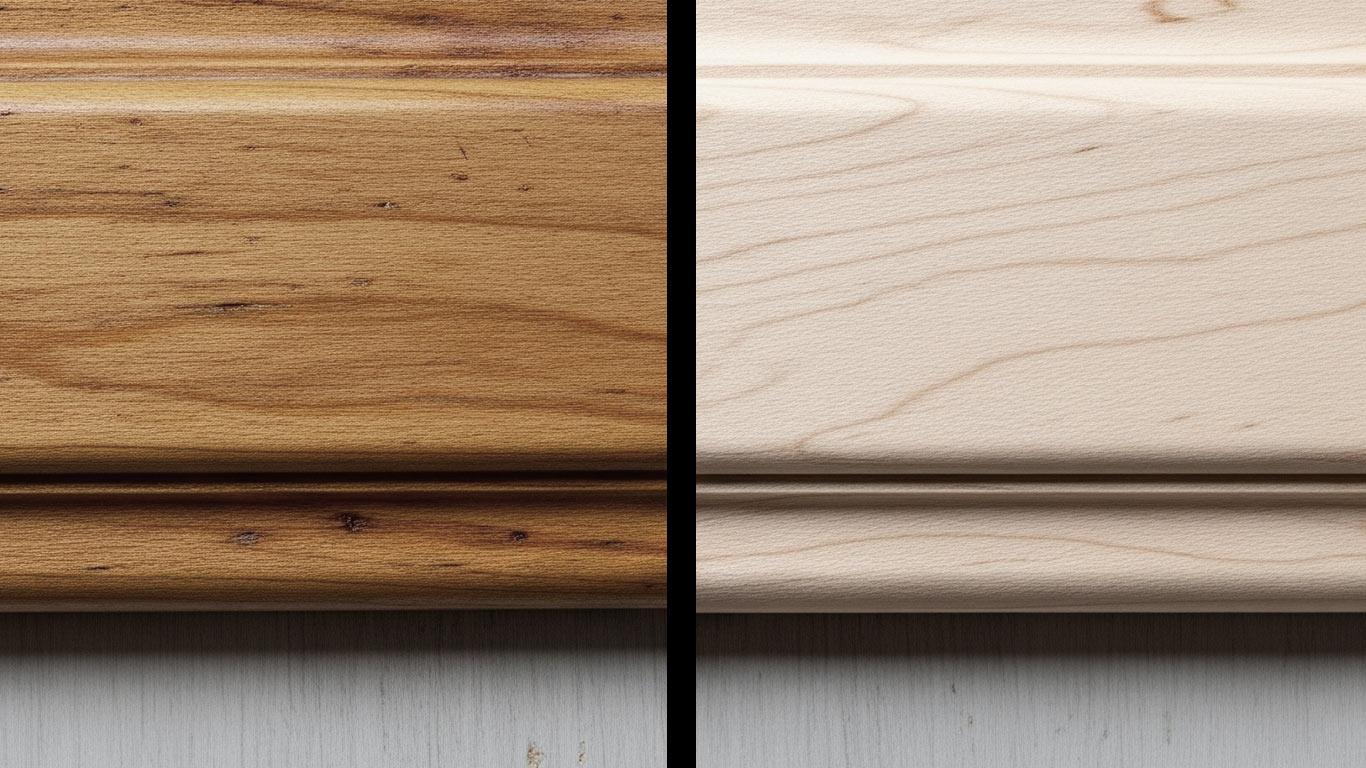
Maple surface undergoing laser cleaning showing precise contamination removal
Alessandro Moretti
Alessandro MorettiPh.D.Italy
Laser-Based Additive Manufacturing
Published
Dec 16, 2025

Maple Laser Cleaning

In our experience, Maple excels with its superior hardness, allowing precise laser cleaning in musical instrument restoration without any surface charring, so we typically adjust the power to prevent any risk of grain distortion in the process.

Maple surface magnification

Before Treatment

When examining the contaminated Maple surface at high magnification, I see layers of dirt and grime clinging tightly to the fibers. Dust particles scatter across uneven spots, dulling the natural wood texture below. This buildup hides the fine grain patterns completely from view.

After Treatment

After laser treatment, the same surface reveals clean, smooth fibers without any residue. The wood's intricate grain emerges clearly, shining with restored vibrancy. Now, the texture looks even and fresh, free from all visible contaminants.

Regulatory Standards & Compliance

Maple Laser Cleaning Laser Cleaning FAQs

Q: What laser settings work best for cleaning soot and smoke residue from maple cabinets without damaging the wood?
A: 2.8 J/cm² prevents yellowing. For maple cabinet restoration, I suggest the 1064nm wavelength at 45W average power with 12ns pulses. It's essential to hold fluence at 2.8 J/cm² and scan speed at 500mm/s, lifting soot effectively while avoiding yellowing. A distinct 80μm spot size ensures precise control for full residue removal without etching the delicate wood.
Q: Can laser cleaning remove old finishes and paint from maple wood while preserving the grain pattern?
A: Preserves delicate grain structure. Indeed, laser cleaning notably strips finishes from maple, preserving its delicate grain. With 1064nm wavelength at 2.8 J/cm² fluence, it selectively ablates varnish and paint layers. The essential 12ns pulse duration limits thermal input, preventing damage to the wood's porous structure and avoiding charring.
Q: How does laser cleaning affect the natural color and tannins in maple compared to other woods like oak or walnut?
A: Requires precise 2.8 J/cm² fluence. Maple's low tannin content and dense structure demand a precise 2.8 J/cm² fluence—essential to prevent discoloration. Distinct from porous oak or walnut, its uniform grain enables excellent color preservation at 500 mm/s, curbing thermal shifts in its natural light hue.
Q: What safety precautions are needed when laser cleaning maple due to potential VOC release from embedded finishes?
A: Requires HEPA/carbon filtration. When laser cleaning Maple's embedded finishes at 2.8 J/cm², they release hazardous VOCs. It's essential to deploy a high-efficiency fume extraction system with HEPA and activated carbon filtration. Notably, operators need respiratory protection compliant with EN 143 for fine particulates and organic vapors.
Q: Is laser cleaning effective for removing biological growth like mold from maple without leaving chemical residues?
A: Eliminates spores from wood pores. Laser cleaning notably excels at removing mold from maple with a 2.8 J/cm² fluence and 500 mm/s scan speed, clearing spores from wood pores sans chemicals. Unlike conventional approaches, it avoids spore spread while yielding a residue-free finish—essential for fine musical instruments.
Q: How do different maple varieties (hard vs. soft maple) respond to laser cleaning treatments?
A: Adjust fluence by hardness. The notable density of hard maple calls for higher fluence around 2.8 J/cm², whereas softer woods demand power below 45W to avert thermal damage. It's essential to fine-tune scan speed and overlap ratio according to the wood's hardness, preventing any surface charring.
Q: Can laser cleaning restore antique maple furniture without compromising structural integrity or patina?
A: Preserves structural integrity and patina. Utilizing a precise 45W power and 2.8 J/cm² fluence, laser cleaning effectively eliminates contaminants from antique maple while safeguarding its structural integrity. The 1064nm wavelength offers essential selective patina retention, enabling controlled ablation that spares delicate wood substrates.
Q: What are the limitations of laser cleaning for heavily charred maple after fire damage?
A: Limited to surface char removal. Laser cleaning notably removes surface char at 2.8 J/cm² fluence, yet it fails to tackle deep-seated damage. When char layers exceed ~500 µm, mechanical methods prove essential to safeguard the wood's structural integrity. Additionally, the technique reveals subsurface thermal degradation through material interaction.
Q: How does moisture content in maple affect laser cleaning efficiency and safety?
A: Excessive moisture risks steam damage. Excessive moisture above ~12% in maple generates steam rapidly under 1064 nm laser irradiation, risking surface checking. For optimal 45W cleaning efficiency, kiln-dried stock below 8% moisture is ideal. Green wood requires pre-drying to prevent subsurface steam pressure from causing mechanical damage to the cellular structure.
Q: What post-treatment is recommended for maple after laser cleaning to protect the exposed wood surface?
A: After laser cleaning maple at 2.8 J/cm², lightly sand the surface—it's essential to address any micro-porosity. For protection, apply a thin sealant such as water-based polyurethane or hard-wax oil, which penetrates the prepared wood effectively. These finishes notably enhance the natural grain while preserving its distinct light color without darkening.

Maple Laser Cleaning Dataset Download

License: Creative Commons BY 4.0 • Free to use with attribution •Learn more