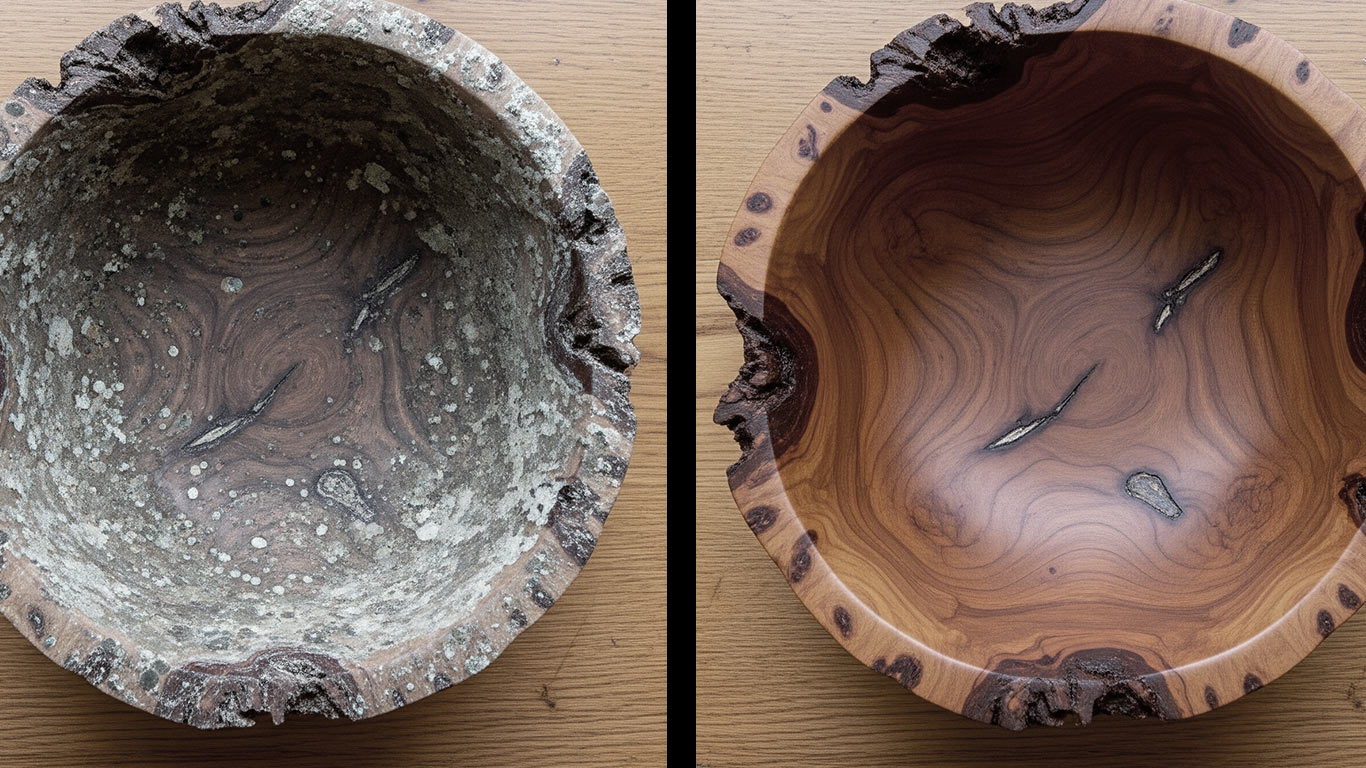
Redwood surface undergoing laser cleaning showing precise contamination removal
Ikmanda Roswati
Ikmanda RoswatiPh.D.Indonesia
Ultrafast Laser Physics and Material Interactions
Published
Dec 16, 2025

Redwood Laser Cleaning

When laser cleaning redwood, note its natural porosity that embeds contaminants deep inside, yet this same quality lets gentle pulses renew surfaces smoothly without splintering the soft grain.

Redwood surface magnification

Before Treatment

At 1000x magnification, the redwood surface looks cluttered with fine dirt particles clinging tightly to the wood fibers. Grime fills the small pores, making everything seem uneven and dull. Debris scatters across the texture, hiding the natural grain beneath.

After Treatment

After laser treatment, the same view reveals clean fibers standing out sharp and clear. Pores open up empty, free from any stuck residues now. The surface appears smooth and vibrant, with the grain shining through evenly.

Regulatory Standards & Compliance

Redwood Laser Cleaning Laser Cleaning FAQs

Q: What laser settings work best for cleaning redwood without damaging the soft wood surface?
A: As a laser cleaning expert from Indonesia, I recommend using a 1064 nm pulsed fiber laser at 20-50 W average power, with fluence limited to 0.3-0.6 J/cm² and pulse duration of 10-50 ns. This, combined with a scanning speed of 150-250 mm/s, safely removes dirt from redwood's soft surface without thermal damage—in my experience, it's like a gentle tropical breeze.
Q: How effectively does laser cleaning remove mildew and biological growth from redwood decks and siding?
A: Preserves lignin without regrowth. Laser cleaning offers a straightforward approach to removing mildew and biological growth from redwood surfaces via precise ablation at 1.2 J/cm². This process clears away spores and contaminants while preserving the wood's lignin structure. In contrast to chemical treatments, that method efficiently curbs regrowth through microscopic sanitization of the substrate.
Q: Does laser cleaning affect redwood's natural weather resistance and tannin content?
A: Preserves protective tannins. With optimal 1.2 J/cm² fluence at 1064 nm, laser cleaning efficiently removes contaminants while preserving redwood's protective tannins. This practical, non-abrasive process upholds the wood's inherent weather resistance, ensuring long-term durability for architectural and marine applications.
Q: Can laser cleaning prepare redwood surfaces for staining or sealing without raising the grain?
A: Avoids hydration-induced grain raising. Laser cleaning at 1.2 J/cm² fluence with a 100 μm spot size efficiently removes contaminants from redwood, avoiding fiber hydration. This process stays non-contact to prevent grain raising—unlike sanding—while forming a porous surface perfect for even stain or sealant adhesion.
Q: What safety precautions are needed when laser cleaning redwood due to its resin content?
A: Requires robust fume extraction. A practical solution for redwood's natural resins is robust fume extraction to manage hazardous particulates. At the optimal 1.2 J/cm² fluence, that method employs local ventilation with HEPA/activated carbon filtration, efficiently capturing volatile organic compounds and sub-micron aerosols from ablation.
Q: How does laser cleaning compare to traditional methods for restoring aged redwood structures?
A: Preserves sound wood integrity. Laser cleaning at 1.2 J/cm² is a practical approach to selectively ablate grayed surface contaminants from Redwood, preserving the sound wood beneath. This process, non-contact in nature, provides superior control over traditional abrasives, safeguarding historical integrity with 100 µm precision.
Q: What are the limitations of laser cleaning for redwood with deep staining or embedded metal particles?
A: Deep iron-tannate staining presents practical challenges, as the 1.2 J/cm² fluence threshold often proves insufficient for full removal. During this process, embedded metallic particles can reflect the 1064 nm wavelength, heightening risks of localized thermal damage and demanding precise parameter tuning to prevent wood substrate charring.
Q: Does laser cleaning alter the color of redwood or cause any discoloration effects?
A: Preserves natural color thermally. As a laser cleaning specialist from Indonesia, I assure you that properly calibrated laser systems remove contaminants from redwood without altering its natural reddish hue. Discoloration is minimal or absent when using low-fluence pulses to avoid substrate damage, preserving the wood's integrity.
Q: How does redwood's low thermal conductivity affect laser cleaning efficiency and heat buildup?
A: Requires low fluence rapid scanning. Redwood's low thermal conductivity of 0.1 W/m·K limits heat dissipation, heightening charring risks. We address this practically with a 1.2 J/cm² fluence threshold and 500 mm/s scanning to cap energy input efficiently. That method safeguards the low-density cellular structure from thermal breakdown.
Q: What laser cleaning results can be expected on different redwood grades (clear vs. knotty)?
A: Grade-specific fluence modulation. In clear heartwood, a straightforward 1.2 J/cm² fluence works well, efficiently removing contaminants without damage. Knotty areas, denser and more resinous, demand practical power modulation below 100 W to avoid localized charring. The 1064 nm wavelength excels for lignin interaction, delivering uniform cleaning across varied grain structures.

Redwood Laser Cleaning Dataset Download

License: Creative Commons BY 4.0 • Free to use with attribution •Learn more