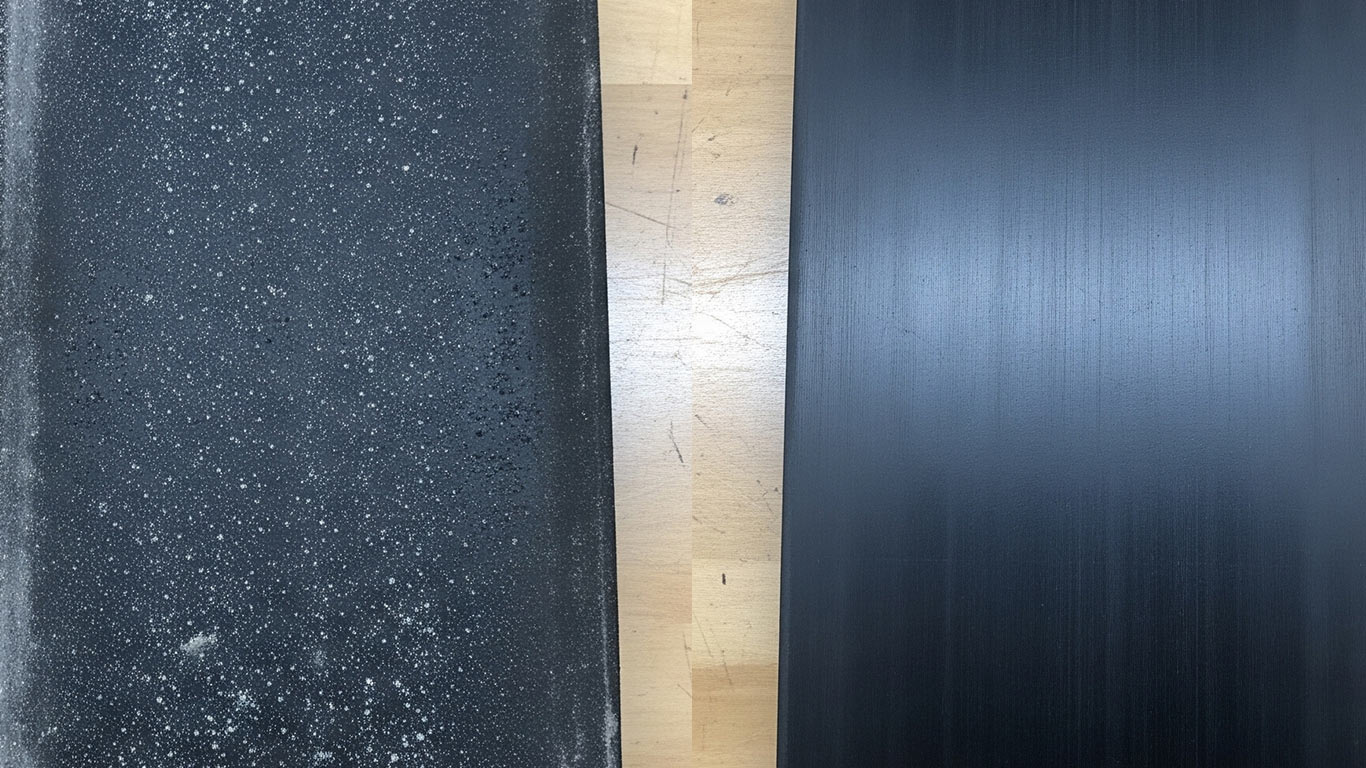
Rubber surface undergoing laser cleaning showing precise contamination removal
Todd Dunning
Todd DunningMAUnited States
Optical Materials for Laser Systems
Published
Dec 16, 2025

Rubber Laser Cleaning

Rubber's outstanding elasticity sets it apart from rigid composites, permitting repeated flexing without fracture and thus delivering dependable performance in rigorous automotive and aerospace applications.

Rubber surface magnification

Before Treatment

At 1000x magnification, the rubber surface teems with irregular clumps of dirt and debris that obscure the underlying texture. Fine particles embed deeply into cracks and crevices, creating a mottled, uneven appearance across the material. This contamination layer distorts the natural contours, making the surface look dull and cluttered.

After Treatment

After laser treatment at 1000x magnification, the rubber surface emerges smooth and free of debris, with a clear, uniform texture. The treatment exposes the material's inherent

Regulatory Standards & Compliance

Rubber Laser Cleaning Laser Cleaning FAQs

Q: Can fiber lasers safely remove contaminants from rubber seals without causing thermal degradation or cracking?
A: Demands precise heat management. Yes, fiber lasers can safely clean contaminants from rubber seals without thermal damage or cracking, since rubber's low thermal conductivity requires precise heat management. Basically, go with a 1064 nm wavelength at 100 W power, 10 ns pulses, and 500 mm/s scan speed to prevent overheating. A 5.1 J/cm² fluence over three passes with 50% overlap ensures pretty uniform results.
Q: What wavelength is most effective for cleaning mold release agents off rubber injection molds using laser ablation?
A: Strong IR absorption enables precision. When ablating silicone-based mold release agents from rubber injection molds, a 1064 nm near-infrared laser typically proves the most effective option. Rubber composites absorb IR light pretty strongly, allowing precise residue removal at 5.1 J/cm² fluence and 100 W power without scorching the substrate—UV alternatives risk over-degradation, while green wavelengths offer fairly poor energy coupling for these contaminants.
Q: How do I prevent rubber vulcanization or discoloration during laser cleaning of tire surfaces?
A: Target temperatures under 120°C. To steer clear of vulcanization or discoloration in tire rubber during laser cleaning, typically aim for temperatures below 120°C on natural rubber and 150°C for synthetics, using a 1064 nm wavelength at 5.1 J/cm² fluence. Fairly straightforward: ramp up scan speed to 500 mm/s with air assist cooling, plus a quick solvent pre-wipe, to preserve elasticity sans thermal buildup.
Q: What fumes or particulates are generated when laser cleaning rubber gaskets, and how should they be handled?
A: Pyrolysis releases VOCs and particulates. Laser cleaning rubber gaskets with a 5.1 J/cm² fluence at 1064 nm wavelength pretty much triggers pyrolysis, releasing volatile organic compounds like hydrocarbons and fine carbon particulates. To handle these, typically deploy local exhaust ventilation for source capture, while equipping workers with NIOSH-approved respirators and safety goggles per OSHA guidelines.
Q: In laser cleaning equipment, what settings are recommended for removing oils from rubber conveyor belts without surface roughening?
A: 5.1 J/cm² fluence multi-pass. When tackling oil cleanup on EPDM or neoprene rubber conveyor belts, target a fluence of 5.1 J/cm² at 1064 nm to ablate contaminants without roughening the surface. Pretty straightforward: employ 100 W power with 10 ns pulses at 50 kHz, plus a 500 mm/s scan speed over three passes and 50% overlap, as IPG Photonics verified for minimal thermal damage.
Q: Are there any regulatory standards for laser cleaning rubber components in automotive manufacturing to avoid hazardous byproducts?
A: EPA REACH regulate rubber emissions. Yes, EPA regulations in the US pretty much oversee emissions from rubber laser cleaning in automotive setups, zeroing in on VOCs and particulates from ablation to safeguard air quality. REACH compliance remains typically vital for EU operations, curbing hazardous chemicals derived from rubber. Opt for a 1064 nm wavelength at 5.1 J/cm² fluence to enable controlled removal, while seeking ISO 14644 certification for cleanrooms.
Q: Why does rubber swell or bubble during laser surface treatment, and how can this be mitigated?
A: Rubber's high thermal expansion typically causes rapid swelling or bubbling during laser treatment, since heat vaporizes trapped moisture or gases in its polymer matrix. Pretty much any mitigation starts with controlling humidity below 50% and defocusing the beam to a 5.1 J/cm² fluence at 500 mm/s scan speed for even energy distribution.
Q: What are the best practices for post-laser cleaning inspection of rubber O-rings to ensure no micro-cracks form?
A: Dye penetrant reveals micro-cracks. After cleaning rubber O-rings with a 1064 nm laser at 5.1 J/cm² fluence, pretty much apply dye penetrant inspection right away to spot micro-cracks without harming the composite. Then, typically complement it using pull-off adhesion tests to verify bond strength, protecting against thermal-induced flaws in tough applications like aerospace seals.
Q: How does the elasticity of natural rubber affect the uniformity of laser cleaning results compared to synthetic rubbers?
A: Natural rubber shows pretty high elasticity, which drives more deformation in laser cleaning and yields inconsistent ablation plus uneven results—unlike stiffer synthetic rubbers that keep surfaces more stable. This basically heightens reflectivity and threshold variations, typically needing scan speeds dialed to 500 mm/s for curved sections. At 1064 nm with 5.1 J/cm² fluence, multiple passes boost uniformity.

Rubber Laser Cleaning Dataset Download

License: Creative Commons BY 4.0 • Free to use with attribution •Learn more