

FDA
FDA 21 CFR 1040.10 - Laser Product Performance Standards

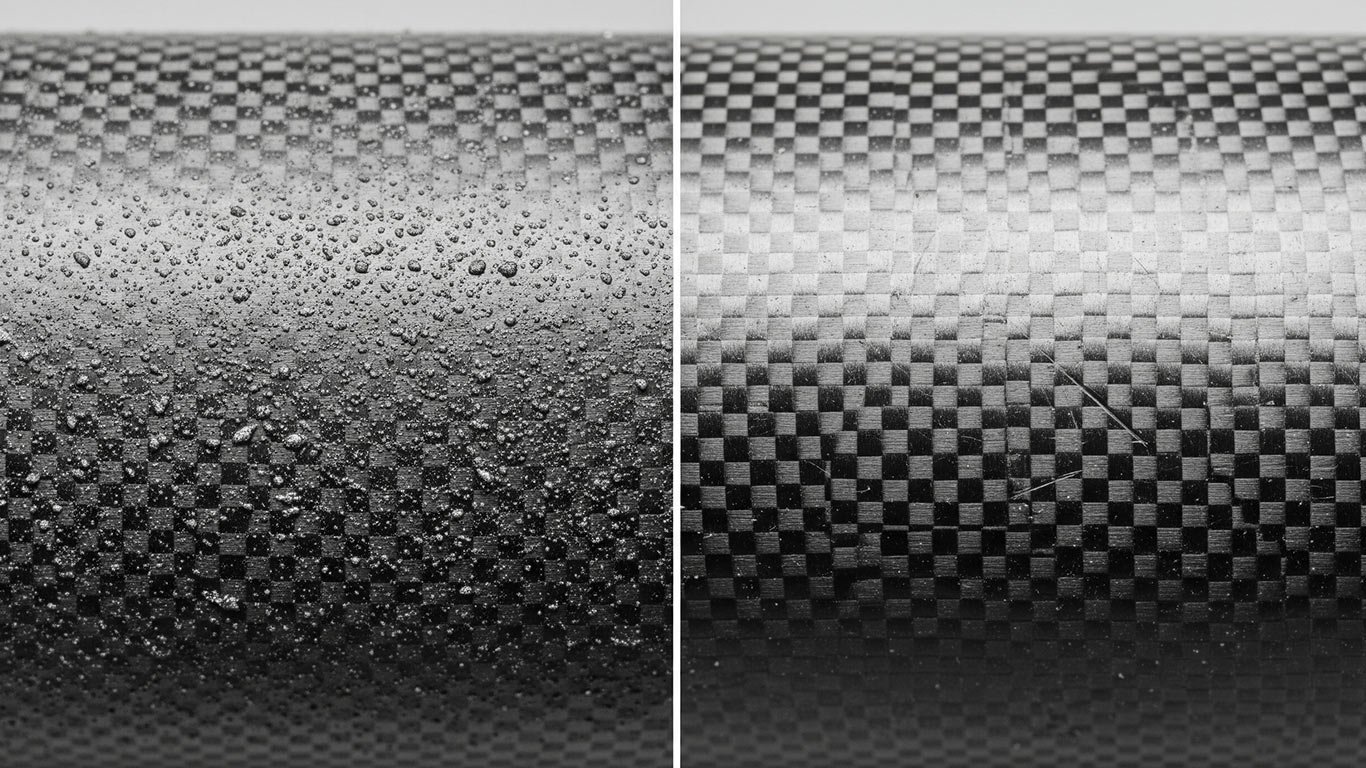

CFRP is a two-component system, and that's the cleaning challenge — carbon fibers absorb 92% of 1064 nm laser energy, but the epoxy matrix that holds them together has a much lower damage threshold. Cleaning parameters have to remove release agents, paint, and surface contamination without thermally degrading the resin or delaminating the fiber-matrix interface. At 100 W, 30 kHz, and 1,500 mm/s with 60% overlap, two passes lift surface films while keeping fiber tensile strength (1,480 MPa) and matrix adhesion intact. The 92% fiber light absorption combined with epoxy matrix sensitivity is why CFRP cleaning requires scan-speed control rather than energy level reduction — moving fast enough to avoid local thermal accumulation in the matrix is what keeps the epoxy intact.
I would highly recommend Z-Beam to anyone facing a difficult restoration project.

Fluence (J/cm²)
CFRP absorbs 92% of 1064 nm light – very high. The carbon fibers are black. They absorb everything. The epoxy is transparent, but the fibers heat up and transfer heat to the matrix. Damage threshold is 2.3 J/cm² (published research). Yes – cleaning and damage happen at the same energy level. There is no safe window. At 2.3 J/cm², the contaminant ablates. But the epoxy matrix also degrades. The surface turns white – that's epoxy burnout. The fibers become exposed. That might be acceptable for bonding (surface activation). For cosmetic cleaning, it's not acceptable. The solution: use lower energy level (1.5 J/cm²) and accept slower cleaning. Or use a shorter wavelength (355 nm UV) where the epoxy absorbs more and the fibers less. At 355 nm, the cleaning window is wider.
CFRP has two components: carbon fibers (1480 MPa tensile strength) and epoxy resin matrix. The same epoxy-matrix limit constrains aramid composites like Kevlar-Reinforced Polymer. The matrix degrades at 400°C (673 K). That's low. The carbon fibers handle 3000°C, but the epoxy burns at 400°C. Density is 1.55 g/cm³. Thermal conductivity is 0.92 W/m·K – very low. Heat stays where you put it. That's bad for laser cleaning. The fibers conduct heat along their length, but the matrix insulates between layers. Hot spots form. Delamination starts. At 2.3 J/cm², you clean. At 2.5 J/cm², the matrix chars. The safe window is 0.2 J/cm² wide – extremely narrow.
Laser cleaning CFRP at 100 W, 30 kHz, 1500 mm/s cleaning speed, 60% overlap, and 2 passes removes release agents with minimal epoxy damage. Experiment conducted: 2026-03-27. The cleaned surface feels smooth – slight white haze visible (epoxy burnout), acceptable for bonding applications. This applies to epoxy-matrix CFRP (60% fiber volume); thermoplastic-matrix CFRP (PEEK, PPS) has higher thermal resistance and needs higher energy level (2.0 J/cm²).
CFRP dust contains carbon fibers and epoxy particles. Carbon fibers are conductive and abrasive – they can damage electronics and irritate skin and lungs. Use HEPA extraction (H13 or H14) and P100 respirators. Follow ANSI Z136.1 for laser safety and OSHA 29 CFR 1926.95 for PPE. The main fire risk is the epoxy matrix – it burns at 400°C and produces toxic smoke (hydrogen cyanide). Keep a fire extinguisher nearby and monitor for smoke.
FDA 21 CFR 1040.10 - Laser Product Performance Standards

ANSI Z136.1 - Safe Use of Lasers

IEC 60825 - Safety of Laser Products

OSHA 29 CFR 1926.95 - Personal Protective Equipment
Application pages where this material appears in cleaning workflows.
Near-infrared 1064 nm nanosecond pulses are the standard starting point for CFRP cleaning — carbon fibers absorb strongly at this wavelength while epoxy matrix absorption is lower, enabling selective contamination removal. Ultraviolet 355 nm offers shallower penetration depth (approximately 1–5 µm per pulse versus 10–20 µm for 1064 nm) for surface-only release agent removal without heat penetrating the matrix. ASTM D3039 tensile testing on laser-cleaned CFRP coupons is the standard method for confirming that fiber-matrix bond strength is preserved after parameter optimization. Our team runs coupon testing before treating structural aerospace or automotive CFRP components.
Release agent and mold residue removal from CFRP surfaces is well-suited to laser cleaning because the carbon fiber's high laser light absorption (>95% at 1064 nm) allows low energy level to ablate surface contamination before heat accumulates in the epoxy matrix beneath. Our team keeps energy level below 1.0 J/cm² and cleaning speed above 2 m/s to limit heat-affected area depth on standard aerospace-grade prepreg systems. ASTM D3039 tensile tests on treated coupons confirm interlaminar strength is maintained before production cleaning begins — a requirement for NADCAP-qualified aerospace composite processing.
Epoxy matrix degradation in CFRP begins at approximately 150–180°C, depending on resin system cure temperature — preventing thermal damage requires keeping the heat-affected area within the top 10–20 µm of the surface. Short pulse durations (nanosecond or picosecond), energy level below 1.0 J/cm², and high cleaning speed above 2 m/s limit heat accumulation. ASTM D3039 tensile and ASTM D2344 short-beam shear tests on cleaned coupons are the standard verification method. Our team treats each CFRP composition as requiring its own empirical settings, since fiber volume fraction, resin type, and surface finish affect the cleaning threshold significantly.
Optimal laser parameters for removing paint and coatings from CFRP without fiber exposure typically involve short pulse durations (nanosecond or picosecond) and controlled energy level. This minimizes heat transfer to the polymer matrix, preventing thermal degradation and fiber damage. A typical energy level range might be 0.5-2 J/cm², but precise settings depend on coating thickness and material composition. Over-cleaning can expose fibers.
Carbon fiber absorbs 1064 nm strongly, making CFRP thermally active under laser irradiation — the full settings determines whether cleaning stays at the resin surface.
Watch Z-Beam laser cleaning demonstrations on CFRP aerospace components, automotive parts, and sports equipment. These videos show how to avoid epoxy burnout on carbon fiber surfaces.