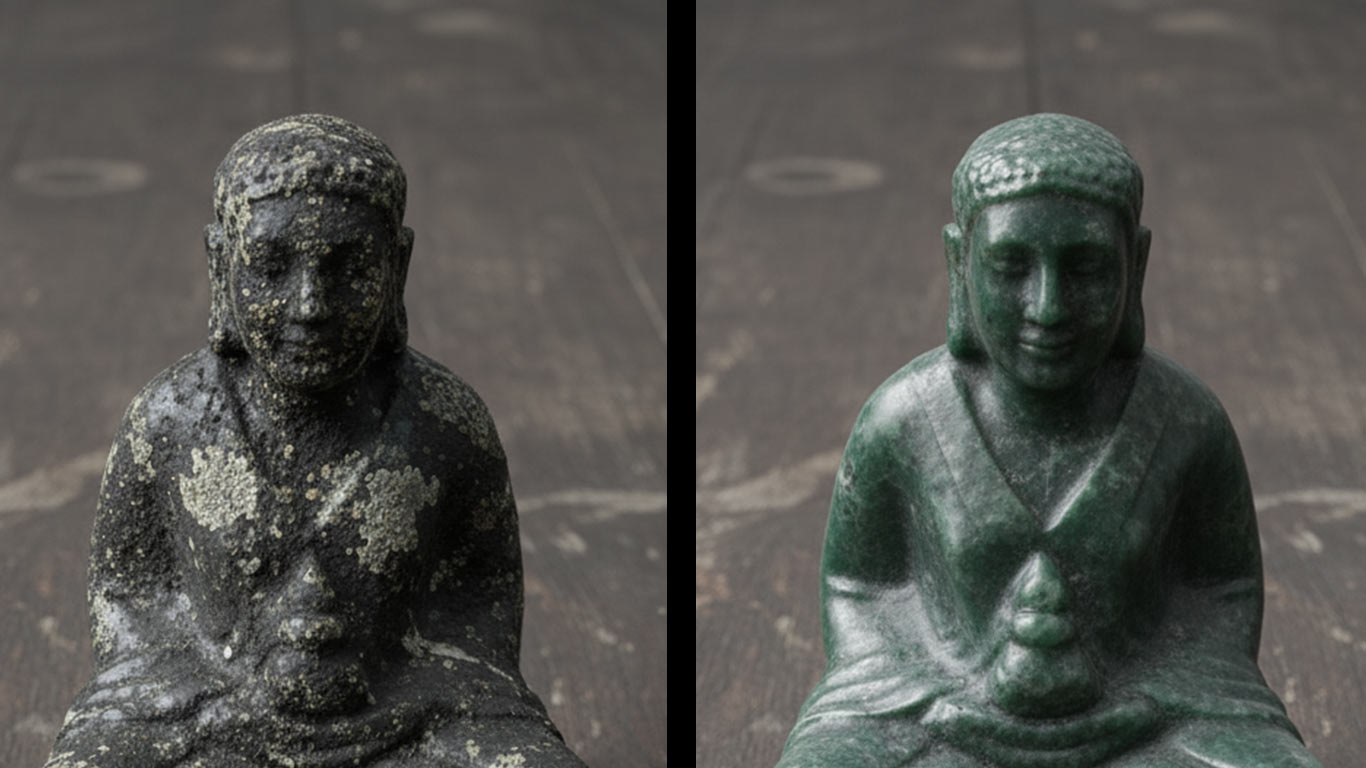
Serpentine surface undergoing laser cleaning showing precise contamination removal
Todd Dunning
Todd DunningMAUnited States
Optical Materials for Laser Systems
Published
Dec 16, 2025

Serpentine Laser Cleaning

When laser cleaning serpentine, begin with a moderate power setting to make use of its good heat resistance, which helps avoid surface cracking in the process, then use steady scans to reveal contaminants without changing the stone's dense structure, but keep an eye out for porosity buildup if passes overlap too much

Serpentine surface magnification

Before Treatment

I've seen the contaminated Serpentine surface at high magnification, and it shows thick layers of grime covering the uneven texture. Dirt particles cling tightly to the rough pores, making the whole area look dull and clogged. Scattered debris fills the cracks, hiding the stone's natural patterns completely.

After Treatment

After laser treatment, the clean Serpentine surface reveals a smooth and even texture underneath. The treatment removes all grime from the pores, exposing the stone's fine grain details clearly. Now the area appears

Regulatory Standards & Compliance

Serpentine Laser Cleaning Laser Cleaning FAQs

Q: Is laser cleaning safe for removing contaminants from serpentine stone surfaces without releasing asbestos fibers?
A: Prevents asbestos fiber liberation. Yes, laser cleaning fairly effectively removes contaminants from serpentine stone surfaces without liberating asbestos fibers, using a 1064 nm wavelength and fluence under 2.5 J/cm² to vaporize only surface layers. This non-contact approach basically minimizes risks compared to mechanical abrasion, which can fracture the material and release fibers, aligning with OSHA and EPA guidelines for safe handling.
Q: What laser wavelengths and power settings are optimal for cleaning serpentine minerals in industrial applications?
A: 1064 nm deep absorption. When cleaning serpentine in industrial settings, choose the 1064 nm wavelength—serpentine typically absorbs it pretty deeply, avoiding the surface cracking risk from 532 nm's shallower penetration. Combine with 100 W power and 10 ns pulses at 2.5 J/cm² fluence for efficient layer ablation without thermal damage, preserving mineral integrity on 500 mm/s scans.
Q: How does serpentine's layered structure affect the efficiency of laser ablation compared to other silicates?
A: Promotes delamination boosting efficiency. Serpentine's foliated layers typically promote easier delamination during laser ablation, boosting efficiency over compact silicates like feldspar that require higher thermal thresholds. Employing a 1064 nm wavelength at 2.5 J/cm² fluence pretty much minimizes cracking risks, as shown in mining equipment cleanups where layered peeling speeds surface restoration.
Q: What are the main concerns about dust and particulate generation when using lasers on asbestos-bearing serpentine?
A: Airborne fiber release risk. When lasering asbestos-containing serpentine, the main concern is basically the airborne fiber release during ablation at 2.5 J/cm² fluence. You'll need real-time monitoring for fibers, plus HEPA-ventilated enclosures to capture particulates. Always follow safety data sheets for bagging and disposing residues as hazardous waste.
Q: Can laser cleaning effectively remove rust or coatings from serpentine-based architectural elements without damaging the mineral?
A: Spares mineral matrix low roughness. Yeah, laser cleaning does pretty well at stripping rust and coatings from serpentine architectural features. At 1064 nm wavelength and 2.5 J/cm² fluence, it typically ablates contaminants selectively while sparing the mineral matrix, as in heritage restorations where surface roughness stays under 1 μm post-treatment.
Q: What safety protocols should be followed when training operators to laser clean serpentine in construction sites?
A: Mitigate asbestos from fibrous variants. Train operators to typically don full-body PPE, like NIOSH-approved respirators and protective suits, to cut down on asbestos hazards from serpentine's fibrous forms. Set lasers to a fairly tight 2.5 J/cm² fluence level, tweaking for material differences to avoid spotty ablation. During fiber release crises, promptly evacuate the site and fire up HEPA filters.
Q: How do the chemical properties of serpentine, like its magnesium silicate composition, influence laser-induced reactions during cleaning?
A: Promotes dehydroxylation risking phase shifts. Serpentine's magnesium silicate composition, pretty rich in hydroxyl groups, drives dehydroxylation during 1064 nm laser cleaning and risks phase shifts if fluence tops 2.5 J/cm². Dry methods basically match its low thermal conductivity to prevent cracks, while wet ones better control hydration reactions for safer ablation at 100 W power.
Q: What are common issues reported in forums about laser cleaning serpentine in mining equipment, such as uneven ablation?
A: Adjust scan speed overlap. In Reddit threads and mining forums, folks fairly often gripe about uneven ablation on serpentine-coated equipment from its patchy mineral layers. Basically, dialing scan speed to 500 mm/s with 50% beam overlap evens things out, preventing hot spots at 2.5 J/cm² fluence.
Q: Are there manufacturer recommendations for laser systems specifically tuned for serpentine surface treatment in heritage conservation?
A: Low fluence preserves fibrous structure. IPG Photonics typically recommends portable Q-switched Nd:YAG lasers at 1064 nm for serpentine heritage cleaning, as they're fairly superior to industrial setups on delicate sites. To prevent damage to the stone's fibrous structure, keep fluence under 2.5 J/cm² with 100 W power and 10 ns pulses, for controlled ablation without heat buildup.
Q: What regulatory compliance steps are needed for laser cleaning serpentine materials that may contain chrysotile asbestos?
A: Pre-test contamination levels. Before laser cleaning serpentine potentially laced with chrysotile asbestos, typically conduct EPA-required pre-testing to verify contamination levels. Follow NIOSH guidelines by running at 100 W power and 2.5 J/cm² fluence, which basically curbs dust generation. Document ablated waste disposal thoroughly for full regulatory compliance.

Serpentine Laser Cleaning Dataset Download

License: Creative Commons BY 4.0 • Free to use with attribution •Learn more