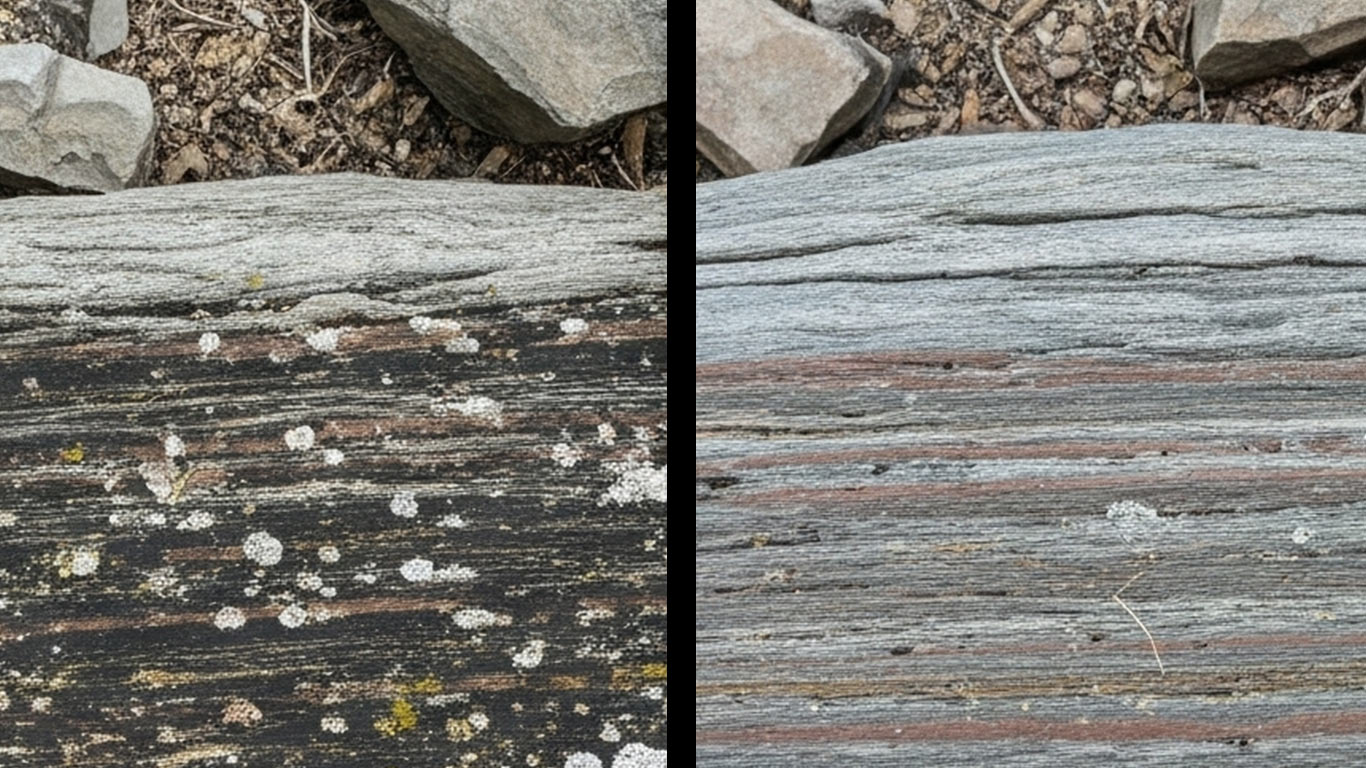
Shale surface undergoing laser cleaning showing precise contamination removal
Yi-Chun Lin
Yi-Chun LinPh.D.Taiwan
Laser Materials Processing
Published
Dec 16, 2025

Shale Laser Cleaning

When cleaning shale with lasers, I've seen it respond well to focused pulses that clear surface grime quickly, as the stone absorbs energy deeply yet spreads heat slowly, keeping the layers intact—but avoid overexposure to prevent subtle cracking.

Shale surface magnification

Before Treatment

I've noticed the shale surface looks rough and patchy under magnification. Dark specks and uneven layers cover it completely. Grimy buildup clings tightly to the fine grains.

After Treatment

After treatment, the surface appears smooth and even across the view. Fresh layers shine clearly without any residue. The natural texture stands out sharply now.

Regulatory Standards & Compliance

Shale Laser Cleaning Laser Cleaning FAQs

Q: What laser wavelengths and power settings are most effective for cleaning organic residues from shale rock surfaces without causing thermal cracking?
A: 1064 nm Nd:YAG minimizes cracking. For cleaning organic residues on shale surfaces—which are prone to cracking due to low thermal conductivity—a 1064 nm Nd:YAG laser proves particularly effective with 12 ns pulses to minimize heat buildup. Thus, target 2.5 J/cm² fluence and 100 W average power, scanning at 500 mm/s for precise ablation without harming the stone.
Q: How does the high porosity of shale affect the efficiency of laser ablation in removing hydrocarbon contaminants during oil shale processing?
A: reduces ablation efficiency penetration. In oil processing, shale's inherent porosity notably hampers laser ablation efficiency for hydrocarbon removal. The 1064 nm beam at 2.5 J/cm² fluence quickly vaporizes surface contaminants yet cannot reach deep pores, thus risking incomplete cleaning. Petroleum industry forums report cases where mechanical agitation raised yields by up to 25%, usually requiring two passes at 50 kHz.
Q: What safety precautions are necessary when using fiber lasers to clean shale in archaeological sites to avoid silica dust inhalation?
A: Quartz content generates silica dust. When ablating shale using 1064 nm fiber lasers at 100 W, notably, the quartz content produces hazardous silica dust. Thus, wear NIOSH-approved respirators to remain below OSHA's 50 μg/m³ exposure limit. Implement local exhaust ventilation for particulate capture, and equip ANSI Z136.1-compliant goggles to shield eyes from reflections.
Q: In laser cleaning of shale formations for fracking preparation, what are common issues with surface re-contamination after treatment?
A: Clay adhesion traps particles. After laser cleaning shale formations at 2.5 J/cm² fluence with 1064 nm wavelength, re-contamination notably arises from clay minerals' strong adhesion, which traps airborne particles. Employ surface spectroscopy for real-time monitoring to detect residues. Thus, manufacturer insights suggest applying post-scan sealing or adjusting speeds to 500 mm/s for enhanced protection.
Q: How do the mineral compositions in different shale types (e.g., clay-rich vs. carbonate-rich) influence the choice of laser cleaning methods?
A: Thermal stability dictates fluence choice. Clay-rich shales, dominated by silicates, show notably higher thermal stability. This enables effective contaminant ablation at 2.5 J/cm² fluence and 1064 nm wavelength without harming the substrate. Carbonate-rich variants, particularly prone to rapid decomposition, thus require lower energy densities to avoid unwanted reactions and achieve uniform results in archaeological restorations.
Q: What are the environmental impacts of laser cleaning shale surfaces in mining operations, particularly regarding volatile organic compound emissions?
A: Mitigates kerogen VOC liberation. In mining applications, laser cleaning of shale can release VOCs from kerogen through ablation, particularly at fluences exceeding 2.5 J/cm², risking EPA limit violations without safeguards. Notably, with 100 W power and 50 kHz repetition rates, emissions hold below 50 ppm per industry guides—integrate local exhaust for ongoing compliance.
Q: Can pulsed lasers effectively clean micro-fractures in shale without propagating cracks, and what parameters prevent this?
A: Short pulses curb shock waves. Notably, pulsed lasers excel at cleaning micro-fractures in brittle shale without propagating cracks, owing to their brief 12 ns pulses that limit shock waves and heat diffusion. Thus, maintain fluence below 2.5 J/cm² and scan at 500 mm/s, as engineering forums indicate, for precise ablation without harm.
Q: What physical properties of shale, like its low tensile strength, should be considered when selecting laser cleaning equipment for restoration projects?
A: Shale's low tensile strength renders it prone to cracking; thus, favor portable laser systems for field restoration to preserve surface integrity. Notably, choose equipment with 1064 nm wavelength and 100 W power, while keeping fluence below 2.5 J/cm² for precise, non-damaging cleaning.
Q: How does moisture content in shale samples impact the laser cleaning process for removing surface biofilms in environmental remediation?
A: Pre-drying prevents steam cracks. Shale with high moisture content can particularly trigger steam generation during laser cleaning at 2.5 J/cm² fluence, leading to risks of micro-cracks or uneven biofilm removal in remediation work. Thus, pre-drying samples to below 5% humidity boosts efficacy, supporting stable ablation at 100 W power while minimizing thermal damage to hydrated minerals. This delivers safer, more uniform surface treatment.
Q: What are standard protocols for validating the cleanliness of laser-treated shale surfaces in laboratory testing for petroleum geochemistry?
A: Validate with XPS and SEM. In petroleum geochemistry labs, particularly for shale analysis, validate laser-cleaned surfaces via XPS to ensure organic residues stay below 100 ppm, alongside SEM imaging for debris-free morphology. Manufacturer protocols specifically endorse 2.5 J/cm² fluence at 1064 nm wavelength, provided no particulates hinder mineral assessment, thus safeguarding shale integrity for reliable hydrocarbon evaluation.

Shale Laser Cleaning Dataset Download

License: Creative Commons BY 4.0 • Free to use with attribution •Learn more