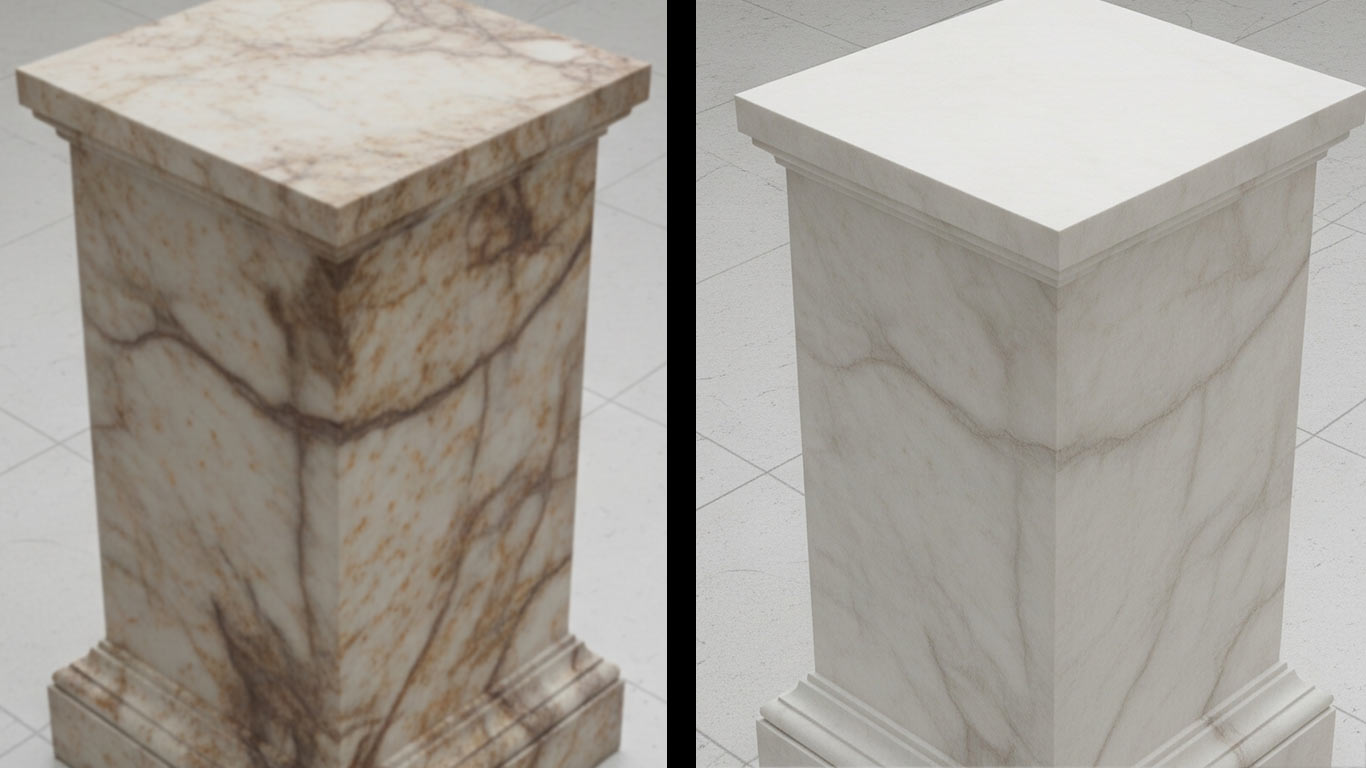
Alabaster surface undergoing laser cleaning showing precise contamination removal
Alessandro Moretti
Alessandro MorettiPh.D.Italy
Laser-Based Additive Manufacturing
Published
Dec 16, 2025

Alabaster Laser Cleaning

When laser cleaning alabaster in art conservation, I've found it responds best to low-energy pulses that gently lift surface grime while preserving its soft, porous structure—so you start with slow scans to avoid thermal stress on delicate sculptures, and always follow up with a cool-down to keep the finish intact without cracking.

Alabaster surface magnification

Before Treatment

At 1000x magnification, the alabaster surface looks rough and uneven, covered by a thick layer of grime that clings to every crevice. Dark streaks and fine particles scatter across it, hiding the stone's natural texture beneath a dull haze. This contamination makes the whole area appear patchy and worn from years of exposure.

After Treatment

At 1000x magnification, the alabaster surface now appears smooth and even, free from any clinging grime or debris after the laser passes over

Regulatory Standards & Compliance

Alabaster Laser Cleaning Laser Cleaning FAQs

Q: How does laser cleaning safely remove dirt from alabaster sculptures?
A: Precise non-contact ablation. Laser cleaning employs precise, non-contact ablation to vaporize surface contaminants, safeguarding the essential soft alabaster substrate from damage while preserving its delicate texture and notable translucency in just a few sessions.
Q: What makes alabaster ideal for restoration using laser technology?
A: Softness and low conductivity. Alabaster's essential softness, paired with its low thermal conductivity, proves notable for laser use, which delicately clears grime while dodging the fracture hazards of mechanical techniques.
Q: Why is alabaster prone to staining and how can laser cleaning help?
A: Removes stains without chemicals. Due to its porous structure, alabaster readily absorbs oils and pollutants, resulting in notable discoloration. Laser cleaning, an essential method, precisely targets and removes these stains at the molecular level, without chemicals that could heighten porosity.
Q: Can laser cleaning restore the translucency of aged alabaster?
A: Revives natural translucency. Indeed, laser cleaning precisely eliminates surface buildup and oxidation layers, thereby restoring alabaster's essential light-diffusing qualities. This distinct method boosts its visual charm without modifying the material's core makeup.
Q: Is laser cleaning suitable for fragile alabaster artifacts?
A: Non-abrasive prevents chipping. Absolutely; its non-abrasive quality is essential for preventing chipping or further fragility issues, which are notable in traditional cleaning, rendering it ideal for museum-grade restorations of delicate pieces.
Q: How to prevent water damage in alabaster after laser cleaning?
A: Apply breathable sealant. After cleaning, it's essential to apply a breathable sealant for protection against moisture uptake, given alabaster's notable vulnerability to dissolution; routine laser maintenance can tackle any subsequent soiling before deep penetration.

Alabaster Laser Cleaning Dataset Download

License: Creative Commons BY 4.0 • Free to use with attribution •Learn more