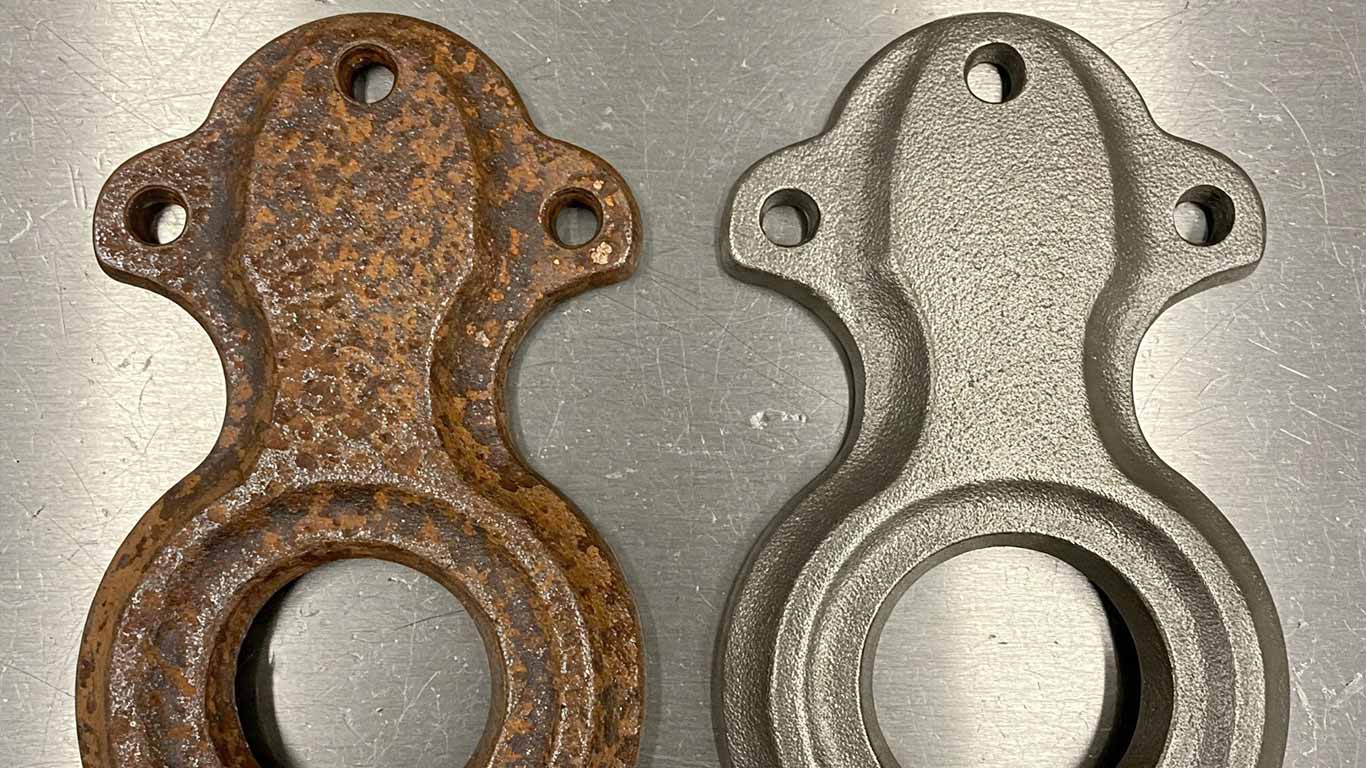
Iron surface undergoing laser cleaning showing precise contamination removal
Ikmanda Roswati
Ikmanda RoswatiPh.D.Indonesia
Ultrafast Laser Physics and Material Interactions
Published
Dec 16, 2025

Iron Laser Cleaning

When laser cleaning iron, you'll want to start with steady power levels to make the most of its solid strength and heat tolerance that keeps the base material intact while removing rust or grime, but make sure you avoid overexposure in the middle stages since it can lead to uneven surface heating if not monitored closely.

Iron surface magnification

Before Treatment

At 1000x magnification, the iron surface looks mottled with dark streaks and clinging dirt that obscure its base texture.
Rough patches rise unevenly, trapping tiny specks of debris in every crevice.
This buildup creates a hazy, irregular view that hides the metal's true form.

After Treatment

After laser treatment, the same view reveals a smooth, even iron surface free from all those streaks.
Clean lines emerge clearly, with no rough spots or trapped debris in sight.

Regulatory Standards & Compliance

Iron Laser Cleaning Laser Cleaning FAQs

Q: What are the best laser settings (wavelength, power, pulse duration) for removing rust from iron without damaging the base metal?
A: Nanosecond 1064nm prevents microstructure alteration. For rust removal from iron, nanosecond pulses at a 1064 nm wavelength offer a straightforward solution. Applying a fluence of about 5.1 J/cm² efficiently ablates oxides, while 50% overlap avoids heat buildup that might alter the base metal's microstructure. That method achieves selective removal without substrate damage.
Q: After laser cleaning iron, why does a dark, sometimes blue or black, oxide layer sometimes appear?
A: That dark blue or black layer forms a thin magnetite (Fe₃O₄) passivation film from residual heat. It's protective, yet often not practical in applications. For prevention, raise scan speed beyond 500 mm/s or introduce argon assist gas—this process efficiently reduces thermal input and blocks oxide from reforming on the fresh iron surface.
Q: How does laser cleaning affect the surface roughness and profile of iron substrates?
A: Laser cleaning offers a practical approach, typically lowering iron's surface roughness to 1-2 µm Ra for a more even profile than abrasive blasting. Using this process at 5.1 J/cm², we can fine-tune the anchor pattern to boost coating adhesion, while faster scan speeds deliver a micro-polishing result.
Q: Is laser cleaning effective for removing mill scale from rolled steel, and what are the challenges?
A: Requires multiple passes spalling. Laser cleaning straightforwardly removes stubborn mill scale from rolled steel. This process applies high peak power pulses of about 100 W at 1064 nm wavelength, inducing differential ablation to spall the oxide layer. Multiple passes are usually needed for complete removal without damaging the substrate.
Q: What are the specific safety hazards when laser cleaning iron, especially concerning fumes and particulates?
A: Generates iron oxide nanoparticles. This process of laser cleaning iron at 1064 nm generates hazardous iron oxide nanoparticles and potential heavy metal fumes. A practical 100 W system demands robust HEPA filtration plus respiratory PPE to avert metal fume fever from sub-micron particulates.
Q: Can laser cleaning induce hydrogen embrittlement in high-strength iron alloys?
A: Minimal embrittlement risk unlike pickling. Laser cleaning offers a straightforward alternative with minimal hydrogen embrittlement risk for high-strength iron alloys, unlike acid pickling. This process employs thermal ablation at 5.1 J/cm² fluence to efficiently remove oxides without introducing hydrogen, as long as excessive power is avoided to prevent surface melting and contaminant entrapment.
Q: How do you verify the cleanliness of an iron surface after laser cleaning, and what standards apply?
A: Verifies with ISO 8501-1 tests. In a straightforward way, we assess iron cleanliness through visual contrast and adhesion tape tests, per ISO 8501-1 standards. This process applies a 1064 nm wavelength and 5.1 J/cm² fluence to remove oxides effectively, while safeguarding the substrate for later applications.
Q: Why is cast iron sometimes more difficult to laser clean than mild steel?
A: Graphite flakes poor absorption. Cast iron has graphite flakes that absorb the 1064 nm wavelength poorly. This process lets the laser target the iron matrix selectively, creating a porous, graphite-heavy surface that looks dark. For a practical fix to reduce this residue, raise the fluence beyond 5.1 J/cm² to ablate both phases more evenly.
Q: What is the risk of creating micro-cracks on the surface of iron components during laser cleaning?
A: Nanosecond pulses mitigate thermal stress. Thermal stress from rapid heating cycles presents the straightforward main risk of micro-cracks, especially in hardened steels. Practically speaking, we advise nanosecond pulses at 10 ns with a controlled 50% overlap ratio. This process avoids excessive heat buildup, staying below the material's stress threshold.

Iron Laser Cleaning Dataset Download

License: Creative Commons BY 4.0 • Free to use with attribution •Learn more