


Oak Laser Cleaning
Oak's open ring-porous structure (porosity 0.55) sets it apart from closed-grain hardwoods like [Maple](/materials/maple-laser-cleaning): soot, biological growth, and finish residu...


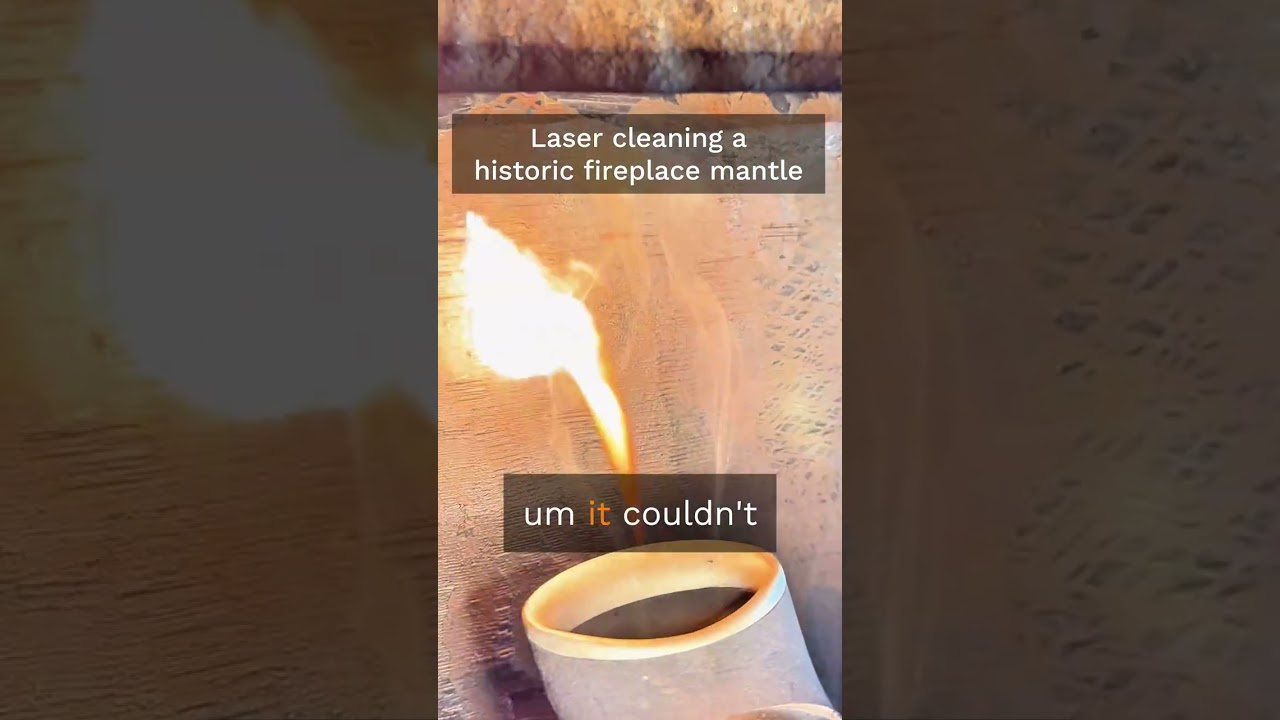
Laser cleaning removes baked-on creosote and tar glaze from a wood fireplace mantle after chemical strippers quit, because the beam burns the carbon layer off instead of trying to dissolve it. That is why solvents fail here: they soften varnish but skate across the hard, sooty crust that years of heat cycling bake onto oak and pine alike, so another coat of stripper just re-softens old stain along with the grime. A tuned pass lifts the black glaze off in thin layers and stops at bare or stained wood underneath, so the mantle keeps its original patina instead of going down to raw grain. It won't restore wood that already scorched or cracked from direct flame contact, and it won't cut through a heavy wax or oil finish without a first pass to clear that coat away. Species matters too: softer pine chars faster than dense oak, so a setting safe for one can scorch trim milled from the other on the same mantle. Homes running a full heritage restoration usually clean the mantle before the surrounding masonry, since soot from an untreated firebox just redeposits on a mantle finished too early.
Short GRD_rEGmAnw shows pulsed laser clearing 80-year creosote and tar from a wood fireplace mantle in 45 seconds after chemical strippers failed.
Oak's open ring-porous structure (porosity 0.55) sets it apart from closed-grain hardwoods like [Maple](/materials/maple-laser-cleaning): soot, biological growth, and finish residu...

Birch is one of the more forgiving hardwoods for laser cleaning, largely because its low porosity (0.587%) keeps contaminants near the surface rather than letting them migrate into...

Fir's high porosity (0.70) is both its defining property and its cleaning challenge — soot and biological growth penetrate deeply into the open softwood grain rather than sitting a...

Cherry's fine, uniform grain and rich warm tone are the entire point — any cleaning method that raises grain, bleaches color, or leaves chemical residue defeats the purpose. High 1...

Pine's high resin content is both its most useful and most hazardous property for laser cleaning. Above 180°C, oleoresin begins volatilizing into α-pinene, β-pinene, and terpinolen...
The crew classifies the soot as dry powder or wet oily residue, then walks a labeled brick coupon at sub-1 J/cm² fluence where the carbon layer vaporizes while the masonry stays cool. Structural wood gets the same pass only after species tests, because the margin between lifting surface char and scorching fiber is narrower than on brick. HEPA capture keeps laser-generated soot particulate under California's five-milligram respirable dust limit, and wet synthetic fires still trigger the tighter PAH exposure line for tar-like volatiles.
Bridge crews reach for HEPA before solvent when lead or chromate primers hide under aged topcoats, because BAAQMD cold-cleaner rules cap stripper VOC well below what commercial products carry. A pulsed 1064 nm pass removes organic films without a liquid hazmat stream, yet [oak](/materials/oak-laser-cleaning) and [concrete](/materials/concrete-laser-cleaning) test coupons on the same job do not inherit plate-[steel](/materials/steel-laser-cleaning) damage margins. Grit-profile recoats that demand ISO 8503 anchor tooth stay out of scope even when the visible coat is gone.
Hard coatings laser cleaning starts with XRF on the insert, TiAlN and CrTiAlN flank strips need coupon fluence, not one 1064 nm setting for all five chemistries. Hot alkaline baths leach cobalt from WC-Co; laser leaves dry nitride dust sized to Cal/OSHA 0.5 mg/m³ chromium and 0.02 mg/m³ cobalt ceilings.
Greasy steel and aluminum weld coupons need extraction bracketed before the pulsed pass. Cutting-fluid residue pyrolyzes at the lowest degrease energy band of any contaminant family on those joint faces, coupon work, not a production shell throughput claim.

