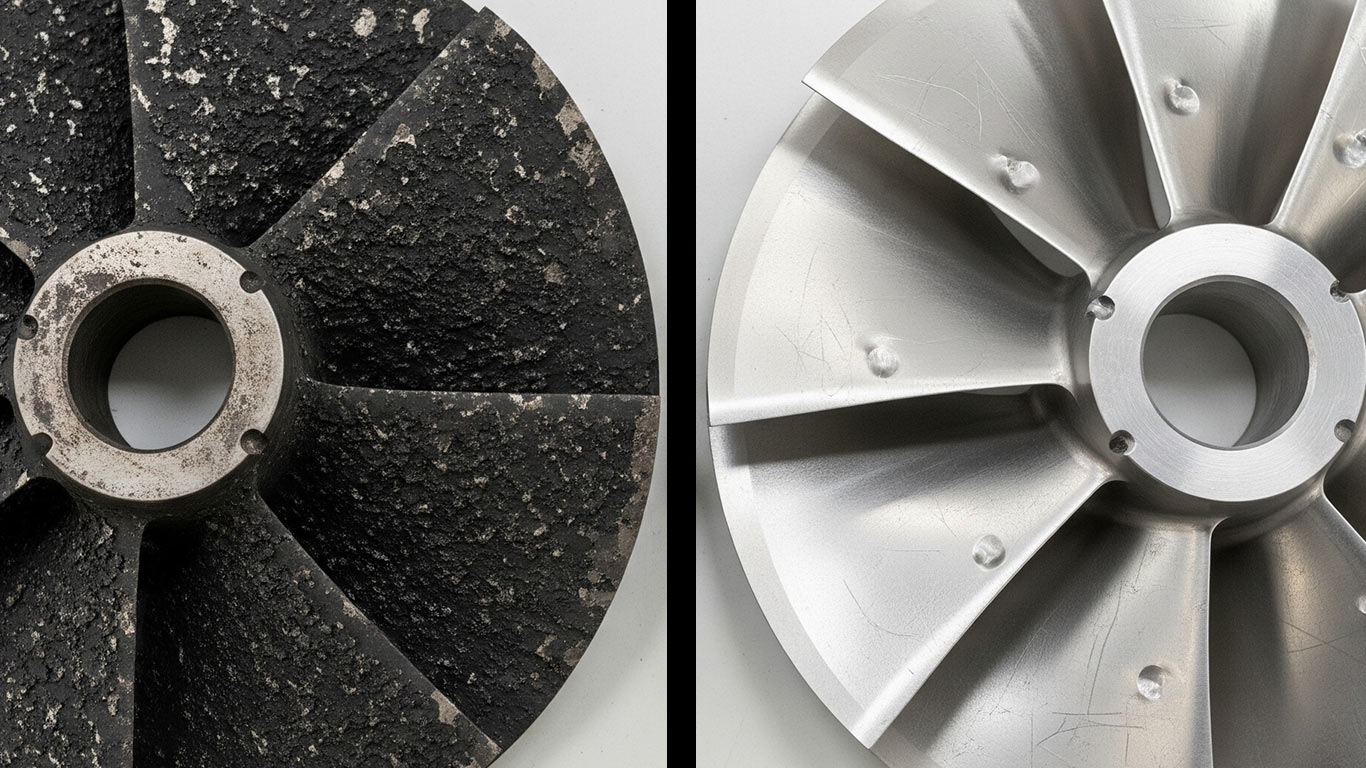
Inconel surface undergoing laser cleaning showing precise contamination removal
Alessandro Moretti
Alessandro MorettiPh.D.Italy
Laser-Based Additive Manufacturing
Published
Dec 16, 2025

Inconel Laser Cleaning

Inconel, this nickel-based superalloy, manifests tenacious resistance to oxidation and corrosion, rendering it suitable for aerospace components. In laser cleaning applications, its thermal stability enables precise contaminant removal, yet high reflectivity challenges efficient energy absorption, it seems.

Inconel surface magnification

Before Treatment

I've seen the contaminated Inconel surface under magnification, and it shows a rough, uneven texture everywhere. Dark, irregular patches of buildup cling tightly to the base material. Scattered debris makes the whole area look dull and obstructed.

After Treatment

After laser treatment, that same surface transforms into a smooth, even finish without a trace of residue. The metal gleams with a consistent shine across every spot. Now it reveals the clean, pristine structure underneath clearly.

Regulatory Standards & Compliance

Inconel Laser Cleaning Laser Cleaning FAQs

Q: What are the optimal laser parameters (wavelength, power, pulse duration) for effectively removing oxides and heat tint from Inconel without causing micro-cracking or altering the base material?
A: When dealing with Inconel, it's essential to select a 1064 nm wavelength paired with nanosecond pulses of about 10 ns, enabling oxide ablation without substrate melting. Keep fluence around 2.5 J/cm² and scanning speed at 500 mm/s. Notably, this approach removes heat tint effectively while averting micro-cracking through reduced thermal load on the delicate base material.
Q: Can laser cleaning be used to prepare Inconel welds (e.g., for NDT or rework) without leaving behind a layer that could cause liquation cracking or other weld defects?
A: Prevents liquation cracking. Properly configured laser cleaning at 2.5 J/cm² fluence and 100W power effectively strips oxides from Inconel without generating a problematic heat-affected zone. Notably, this prevents micro-fissures leading to liquation cracking during subsequent welding, ensuring surface integrity for critical aerospace components. The essential key is using nanosecond pulses for precise contaminant ablation.
Q: How do you safely remove radioactive or toxic contaminants from Inconel components used in nuclear applications with a laser, and what are the fume extraction requirements?
A: Requires HEPA/ULPA filtration. For nuclear Inconel components, we employ a distinct 1064 nm laser at ~2.5 J/cm² to ablate contaminants. This essential process requires full containment plus a HEPA/ULPA filtration system, trapping all aerosolized radioactive particles to prevent environmental release.
Q: What is the effectiveness of laser cleaning for removing stubborn, tenacious scales like aluminum oxide (Al2O3) or silica (SiO2) from Inconel heat exchanger tubes?
A: Preserves softer underlying alloy. Laser cleaning proves notably effective in stripping away tenacious Al₂O₃/SiO₂ scales from Inconel through parameter tuning, including the essential 2.5 J/cm² fluence threshold. It selectively vaporizes the rigid ceramic buildup while safeguarding the softer base alloy, delivering a precise, chemical-free solution for heat exchanger upkeep.
Q: Does laser cleaning induce any measurable change in the corrosion resistance or high-temperature performance of Inconel, particularly for components in aerospace and chemical processing?
A: Preserves chromium oxide layer. Properly calibrated laser cleaning at 2.5 J/cm² fluence preserves Inconel's chromium oxide layer. For aerospace components, post-process validation like ASTM A967 passivation testing is essential to confirm corrosion resistance and high-temperature integrity remain uncompromised.
Q: What are the best practices for laser cleaning intricate Inconel parts, such as turbine blades with internal cooling channels, to ensure complete contaminant removal without causing collateral damage?
A: Prevents thermal accumulation in channels. For intricate Inconel components, it's essential to deploy a 1064nm laser with a scanner head for tackling complex geometries. Hold fluence above 2.5 J/cm² alongside a brisk 500 mm/s scan speed, ensuring effective oxide ablation without thermal buildup in sensitive spots like cooling channels.
Q: How does the presence of a 'dirty' cast layer on Inconel investment castings affect the laser cleaning process, and what parameters are needed to uniformly clean it?
A: The notable tenacity of oxide and mold residue on as-cast Inconel demands a precise fluence exceeding 2.5 J/cm² to achieve uniform ablation. We apply a 100W, 1064nm laser at 500 mm/s with 50% overlap—an essential approach for removing this contaminated layer without harming the underlying alloy.
Q: Is there a risk of generating hexavalent chromium (Cr6+) during the laser cleaning of Inconel, and how can this be mitigated?
A: Nanosecond pulses avoid Cr6+ formation. Indeed, Cr6+ formation presents a notable risk given Inconel's high chromium content. We address this through nanosecond pulses of 10 ns and a fluence of 2.5 J/cm², sidestepping the extreme temperatures needed for its creation. Moreover, effective fume extraction adds an essential safeguard for regulatory adherence.
Q: What real-time monitoring or process control methods (e.g., LIBS, acoustic) are most effective for laser cleaning Inconel to ensure complete removal without over-processing?
A: Laser-Induced Breakdown Spectroscopy delivers distinct closed-loop control by identifying the elemental shift from contaminants to the Inconel substrate. At 1064 nm and 2.5 J/cm², LIBS verifies full oxide removal, avoiding over-processing of this sensitive alloy. In turn, the essential integrity of the base material stays intact.
Q: After laser cleaning, what post-process inspection methods are recommended to verify surface cleanliness and the absence of damage on critical Inconel components?
A: Penetrant testing detects micro-cracks. For Inconel, I recommend visual inspection for gross cleanliness, followed by penetrant testing to detect any micro-cracks potentially induced by excessive fluence above 2.5 J/cm². Finally, surface profilometry is essential to verify that the specified roughness is maintained, ensuring no detrimental alteration to the component's surface integrity.

Inconel Laser Cleaning Dataset Download

License: Creative Commons BY 4.0 • Free to use with attribution •Learn more