FDA
FDA 21 CFR 1040.10 - Laser Product Performance Standards

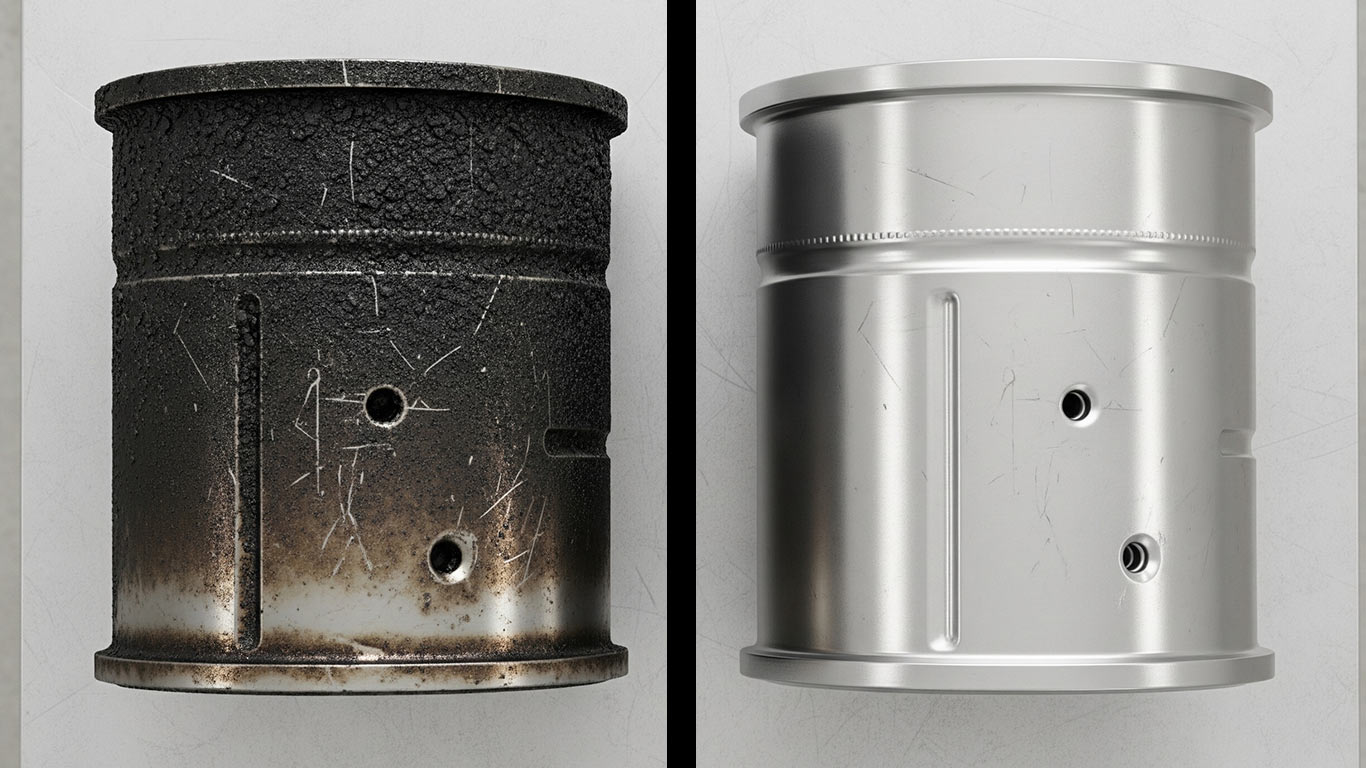

Hastelloy C-276 is built for the most corrosive chemical environments — HCl, H₂SO₄, chlorine service — and laser cleaning has to respect that purpose. Bulk 1064 nm absorption is low at 32%, the lowest of the major nickel superalloys, but the oxide scale and chromate deposits that form during acid service absorb at 50–60%. That differential is what makes selective laser cleaning possible: the contamination removes itself while the base metal stays below its 1330°C solidus. The working window is 0.65 J/cm² between cleaning onset and base metal damage — tight but manageable with controlled energy level. Cr(VI) fume exposure is the primary safety variable; Cal/OSHA CCR Title 8 §5155 governs, and supplied-air respirators are required when air sampling confirms chromium presence in the fume plume. Bay Area chemical processing and semiconductor facilities are the primary customers. Low bulk absorption (32%) combined with oxide scale that couples energy efficiently means Hastelloy C-276 cleaning is parameter-asymmetric: the surface reflects most of the beam, but the contamination absorbs it — requiring parameters calibrated to the contaminant, not the base alloy.
The results exceeded my expectations.

Fluence (J/cm²)
Hastelloy absorbs about 32% of 1064 nm light — the lowest 1064 nm absorption among the major nickel superalloys, a consequence of its elevated molybdenum content. The damage threshold is 2.15 J/cm² and the damage threshold is 2.8 J/cm², giving a working window of 0.65 J/cm² — narrow compared to stainless steel (0.65–1.0 J/cm²) but workable with a premium top-hat beam profile that eliminates Gaussian center-peak hot spots. The practical implication of Hastelloy's high surface reflectance at 1064 nm is that the laser energy delivered to the fume plume is relatively low per pulse, requiring either higher average power or higher repetition rate compared to more absorptive alloys. At 100 W average power and 50 kHz, the 2.0 J/cm² working energy level (mid-window) delivers sufficient energy per pulse to remove 0.1–0.5 μm of oxide per pass on C-276 surfaces — typically requiring 3–4 passes for heavy chemical process scale. Hastelloy C-22's slightly different alloy composition (22% Cr vs. C-276's 16% Cr, lower Mo) shifts the damage threshold by approximately 0.1 J/cm² lower, meaning operators should verify threshold empirically when switching between C-276 and C-22 components in the same cleaning session. The Cr(VI) (safe exposure limit) (Cal/OSHA CCR Title 8 Section 5155) applies to both grades equally due to the chromium content in both alloys. For chemical processing equipment (reactors, heat exchangers), the goal is oxide removal before passivation. Use 1.5 J/cm², 2 passes. The surface will be slightly oxidized, but passivation will restore the passive layer. For aerospace applications (Hastelloy X in combustion cans), use 1.8 J/cm², 2 passes – the goal is contaminant removal before inspection.
Hastelloy C-276 is a nickel-based superalloy (57% Ni, 16% Cr, 16% Mo, 5% Fe, 4% W). Density is 8.89 g/cm³. Tensile strength is 690 MPa – similar to stainless steel. Thermal conductivity is 9.8 W/m·K – low (about 1/3 of steel). Hardness is 92 HRB. Melting point is 1623 K (1350°C). The damage threshold is 1.2–2.15 J/cm². Yes – damage occurs before cleaning. At 1.5 J/cm², the surface oxidizes (chromium oxide forms). At 2.2 J/cm², the oxide ablates. The window is negative. Based on its low thermal conductivity, heat builds up quickly during laser cleaning. For Hastelloy C-276, the safe cleaning window is 1.2-2.2 J/cm², but damage starts at 1.2 J/cm². Use 1.5-1.8 J/cm² with multiple passes.
Laser cleaning Hastelloy (C-276 and C-22 grades) at 100 W, 50 kHz, 1000 mm/s cleaning speed, 60% overlap, and 2 passes removes heat-scale and process deposits effectively. Hastelloy C-276 contains 57% Ni, 16% Cr, 16% Mo, 4% W — the molybdenum and tungsten additions create more complex cleaning fume than standard Ni-Cr alloys. Chromium(VI) fume from the 16% Cr matrix governs air monitoring requirements: Cal/OSHA CCR Title 8 Section 5155 Cr(VI) PEL is 0.005 mg/m³ (5 μg/m³ 8-hr TWA). Molybdenum trioxide generated at elevated cleaning temperatures carries a Cal/OSHA (safe exposure limit) (as MoO₃) — lower than PNOR but typically not the limiting species. Bay Area chemical processing and pharmaceutical manufacturing facilities (South Bay) cleaning Hastelloy reactor internals require enclosed-booth extraction with Cr(VI)-certified monitoring before personnel re-entry post-cleaning. This applies to Hastelloy C-276 (most common grade). Hastelloy X (Ni-Cr-Fe-Mo) has higher thermal conductivity (13 W/m·K) and can use higher energy level (2.0 J/cm²). Hastelloy B-3 (Ni-Mo) has lower thermal conductivity (8 W/m·K) and needs lower energy level (1.2 J/cm²).
Hastelloy dust contains nickel and chromium – both are respiratory sensitizers and possible carcinogens (nickel IARC Group 1, chromium Group 3). Use HEPA extraction (H13 or H14) and P100 respirators. Wear nitrile gloves and long sleeves. Follow ANSI Z136.1 for laser safety and OSHA 29 CFR 1926.95 for PPE. Laser eyewear requires OD 5+ for 1064 nm. For chemical processing equipment, cleaning generates nickel hexafluoride if fluorine was present – test for fluorine before cleaning.
FDA 21 CFR 1040.10 - Laser Product Performance Standards
ANSI Z136.1 - Safe Use of Lasers
IEC 60825 - Safety of Laser Products
OSHA 29 CFR 1926.95 - Personal Protective Equipment
Hastelloy C-276 is built for the most corrosive chemical environments — HCl, H₂SO₄, chlorine service — and laser cleaning has to respect that purpose. Bulk 1064 nm absorption is low at 32%, the lowest of the major nickel superalloys, but the oxide scale and chromate deposits that form during acid service absorb at 50–60%. That differential is what makes selective laser cleaning possible: the contamination removes itself while the base metal stays below its 1330°C solidus. The working window is 0.65 J/cm² between cleaning onset and base metal damage — tight but manageable with controlled energy level. Cr(VI) fume exposure is the primary safety variable; Cal/OSHA CCR Title 8 §5155 governs, and supplied-air respirators are required when air sampling confirms chromium presence in the fume plume. Bay Area chemical processing and semiconductor facilities are the primary customers. Low bulk absorption (32%) combined with oxide scale that couples energy efficiently means Hastelloy C-276 cleaning is parameter-asymmetric: the surface reflects most of the beam, but the contamination absorbs it — requiring parameters calibrated to the contaminant, not the base alloy.


Passivation after laser cleaning is recommended for Hastelloy C-276 when the alloy will be returned to aggressive chemical service, because laser cleaning removes surface contaminants but does not fully re-establish the uniform chromium-molybdenum oxide passive film. ASTM A380 chemical passivation procedures or electrochemical passivation per AMPP SP21511-1 guidance are the reference standards our team consults to specify the correct treatment for the service environment. Post-passivation surface analysis—typically XPS or electrochemical polarization testing—confirms passive film integrity before return to service in environments containing chlorides or strong oxidizers.
Cleaning Hastelloy reliably requires staying above the 2.15 J/cm² damage threshold while remaining below the 2.8 J/cm² damage threshold. A starting point of 100 W, 50 kHz, 1,000 mm/s cleaning speed, and 60% overlap ratio at 1.5 J/cm² handles most oxide and heat-tint removal in one to two passes. Tighter gaps between these thresholds on higher-Mo grades like C-276 mean energy level verification on a test coupon is necessary before production runs.
Cost is driven by contamination depth and part geometry, not material alone. At 100 W and 1,000 mm/s cleaning speed, light oxide removal on flat Hastelloy sections averages roughly $150–$400 per square meter of processed area. Weld-zone heat tint requiring multiple passes at reduced energy level near the 2.15 J/cm² damage threshold takes longer and raises costs proportionally. Components needing confined-space fume extraction add further setup time.
For most applications, no — Hastelloy (Ni-Cr-Mo alloy) re-passivates spontaneously in air through chromium oxide formation, and laser cleaning at appropriate energy level does not disrupt the bulk composition. However, for Hastelloy components in aggressive chemical environments (concentrated acids, chloride service above 100°C), post-cleaning passivation per ASTM A380 may be specified as a precaution. The decision depends on the specific grade (C-22 vs. C-276 have different Mo content) and service environment. Z-Beam provides cleaning documentation sufficient for ASTM passivation verification records.
Hastelloy's narrow working window between cleaning onset and damage requires a validated, multi-parameter approach — no single setting dominates the result.
Watch Z-Beam laser cleaning demonstrations on Hastelloy C-276 weld zones, heat exchanger tubes, and chemical processing equipment. These videos show the surface oxidation after cleaning and passivation results.