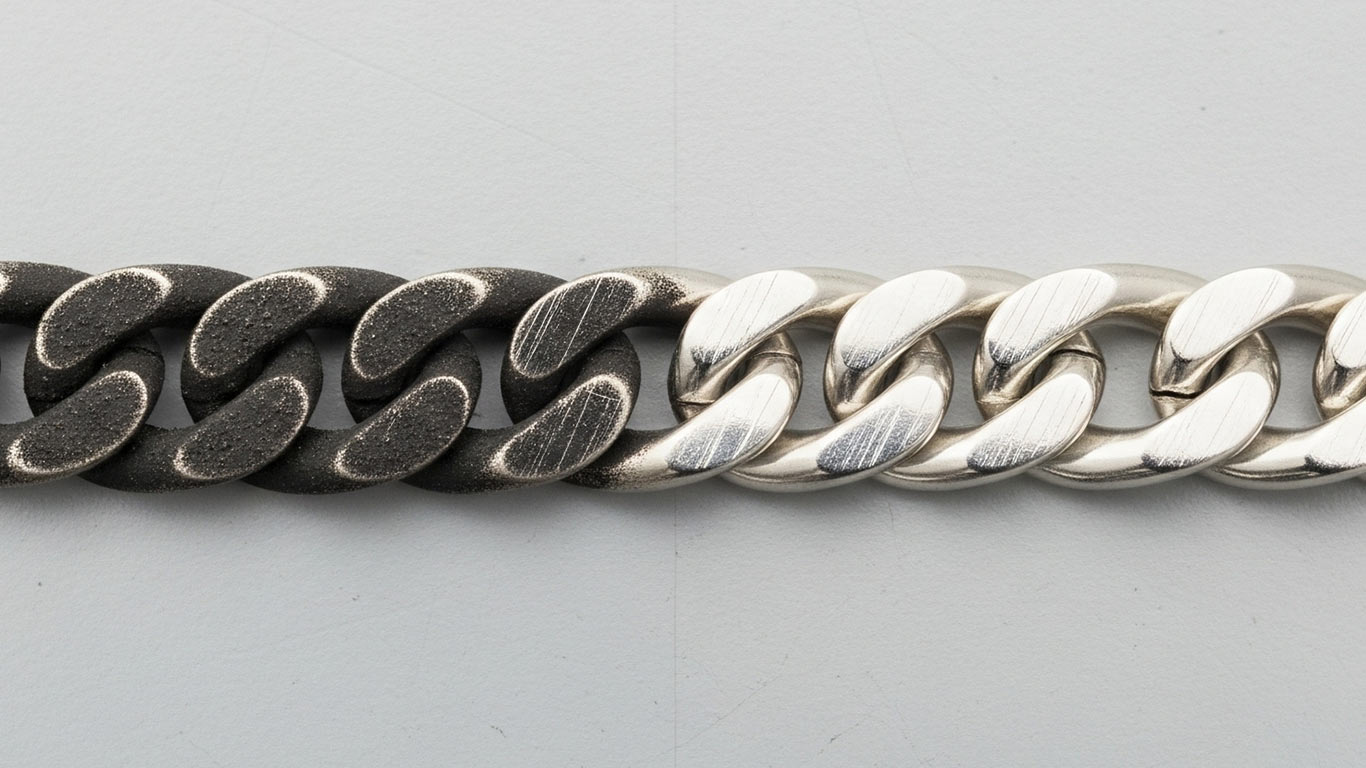
Palladium surface undergoing laser cleaning showing precise contamination removal
Yi-Chun Lin
Yi-Chun LinPh.D.Taiwan
Laser Materials Processing
Published
Dec 16, 2025

Palladium Laser Cleaning

When laser cleaning palladium, begin with lower power settings to address its high reflectivity, which reflects most of the laser energy back. This helps remove surface contaminants effectively while safeguarding the metal's integrity for uses in jewelry or electronics, without causing thermal distortion.

Palladium surface magnification

Before Treatment

I've seen the contaminated surface of palladium up close at high magnification, and it looks rough with scattered dark spots clinging everywhere. Layers of grime build up unevenly, making the whole thing dull and patchy under the lens. Those contaminants stick tight, hiding the metal's true shine beneath a messy coat.

After Treatment

After the laser treatment, the surface turns smooth and even, revealing a bright, uniform gleam. No more spots or buildup mar the view; everything clears out neatly. The cleaned palladium now

Regulatory Standards & Compliance

Palladium Laser Cleaning Laser Cleaning FAQs

Q: What laser parameters are optimal for cleaning palladium without causing surface damage or altering its catalytic properties?
A: Preserves catalytic integrity. I suggest a 1064 nm wavelength for palladium laser cleaning, particularly with 12 ns pulses at 2.5 J/cm² fluence. Set the repetition rate to 50 kHz and scan speed at 500 mm/s. This setup thus removes oxides effectively, while safeguarding the substrate's catalytic integrity against thermal damage and microstructural alterations.
Q: How does palladium's high reflectivity affect laser cleaning efficiency, and what wavelengths work best?
A: Shorter wavelengths enhance absorption. Palladium's high reflectivity, notably at 1064 nm, poses challenges to laser cleaning efficiency. We address this through 90 W average power and 2.5 J/cm² fluence, ablating contaminants while safeguarding the substrate. Specifically for such reflective surfaces, shorter wavelengths like 532 nm green lasers yield better absorption.
Q: What are the specific safety concerns when laser cleaning palladium, particularly regarding fume extraction and airborne particles?
A: Particularly, palladium's ablation threshold of 2.5 J/cm² produces toxic nanoparticles that demand HEPA/ULPA filtration. Thus, OSHA caps airborne exposure at 0.015 mg/m³, requiring powered air-purifying respirators for 1064 nm laser processing to trap these respirable metallic compounds.
Q: Can laser cleaning remove oxidation from palladium without damaging the precious metal substrate?
A: Prevents substrate melting. Yes, laser cleaning effectively removes palladium oxide at 2.5 J/cm² fluence and 1064 nm wavelength. Notably, this selectively ablates the oxide layer, while the 12 ns pulse width thus prevents substrate melting, preserving the precious metal's integrity far superior to chemical methods.
Q: What is the risk of hydrogen embrittlement in palladium during laser cleaning, and how can it be mitigated?
A: Maintain fluence below 2.5 J/cm². Palladium, particularly with its exceptional hydrogen absorption, poses an embrittlement risk during laser cleaning. Keep fluence below 2.5 J/cm² at a 500 mm/s scan speed to prevent thermal-driven hydrogen dissolution. Thus, subsurface hydride formation is avoided while contaminants are effectively removed.
Q: How effective is laser cleaning for preparing palladium surfaces for subsequent plating or bonding applications?
A: Optimizes surface energy micro-roughness. Using a fluence of 2.5 J/cm² and 1064 nm wavelength, laser cleaning particularly activates palladium surfaces by removing organic contaminants. Thus, this approach optimizes surface energy and micro-roughness, yielding an ideal condition for enhanced plating adhesion and bonding strength in industrial applications.
Q: What are the economic considerations when choosing laser cleaning versus traditional methods for palladium components?
A: Eliminates high-cost material loss. Laser cleaning delivers superior economic value, particularly for palladium components, by eliminating material loss—essential given the metal's high cost. Our optimized 2.5 J/cm² fluence and 500 mm/s scan speed thus enable rapid, non-contact cleaning, markedly improving throughput and ROI for jewelry and catalytic converters.
Q: How does laser cleaning affect the surface roughness and microstructure of palladium, particularly for thin films or coatings?
A: Specific laser parameters, such as 2.5 J/cm² fluence and 12 ns pulses, selectively remove oxides while preserving the palladium substrate. Notably, this preserves surface roughness and prevents grain growth in thin films, thus ensuring functional integrity for sensitive electronic applications.
Q: What contaminants commonly found on palladium surfaces respond best to laser cleaning versus those requiring alternative methods?
A: Excels at organics, thin oxides. Laser cleaning is particularly effective for removing organic residues and thin oxide layers on palladium surfaces at 2.5 J/cm² fluence. Yet, embedded metallic particles or thick oxides typically demand alternative approaches, thus risking substrate damage during removal, even under optimized 500 mm/s scan speeds and 1064 nm wavelength settings.
Q: Are there specific laser cleaning challenges for palladium alloys compared to pure palladium?
A: Prevents selective silver removal. For palladium alloys, particularly Pd-Ag, precise fluence control near 2.5 J/cm² is essential to avoid selective silver removal caused by varying ablation thresholds. This thus preserves the alloy's composition. Employing 50% overlap at 500 mm/s scan speed specifically addresses differential vaporization rates among elements, ensuring surface integrity.

Palladium Laser Cleaning Dataset Download

License: Creative Commons BY 4.0 • Free to use with attribution •Learn more