

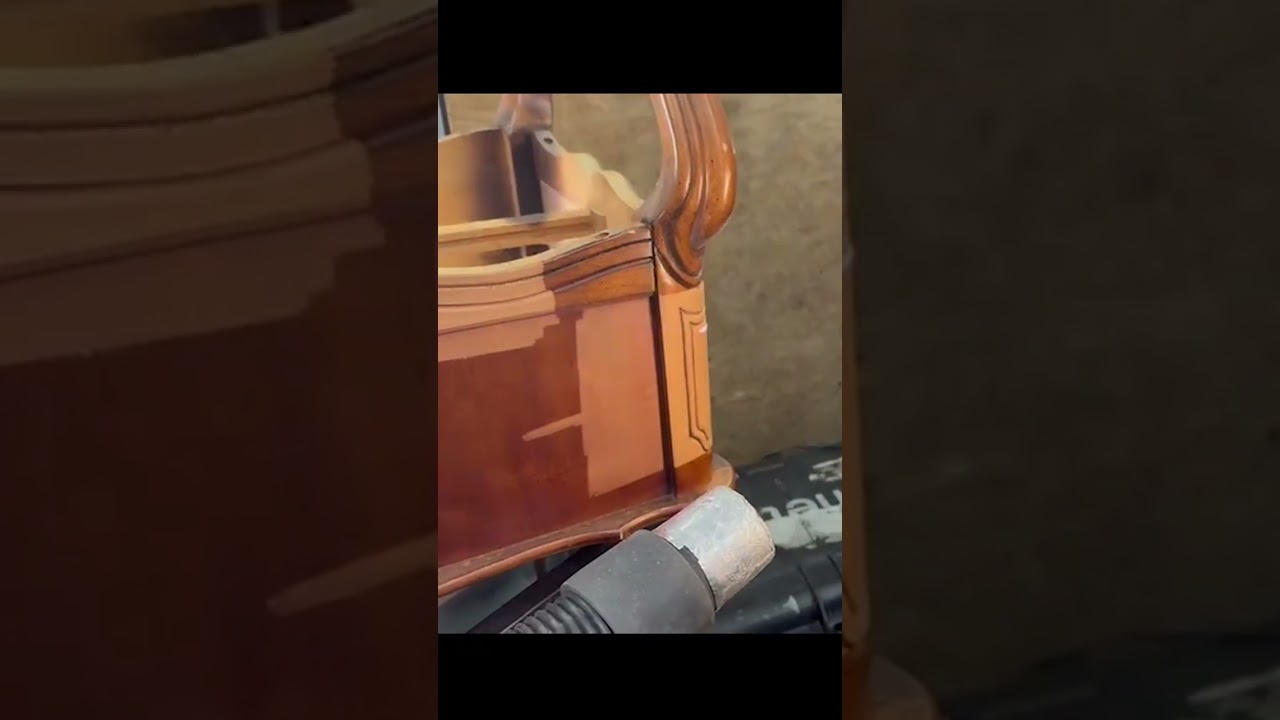

Mahogany Laser Cleaning
Old varnish removes cleanly from this hardwood species without bleaching the finish the way thinner settings do on cherry's furniture-grade boards. Mahogany's tight, resin-rich gra...


Laser cleaning removes decades of wax, smoke film, and failed varnish from fine furniture without sanding through veneer or a crisp inlay line. It clears grime from dense hardwoods such as walnut and mahogany while leaving the wood's own patina intact, which is why the same control shows up in heritage restoration work. It won't rebuild a loose joint or stand in for a hand rubbed oil finish, and settings tuned for a dense hardwood can scorch a softer species, so precision surface control matters more than raw power.
Short xWQv61oR1MA shows pulsed laser clearing old varnish and paint from fine furniture wood in 25 seconds without grit.
Old varnish removes cleanly from this hardwood species without bleaching the finish the way thinner settings do on cherry's furniture-grade boards. Mahogany's tight, resin-rich gra...

Laser cleaning removes finish and grime from birch furniture without abrasive media or added moisture. Its pale, tight grain scorches more easily than [ash](/materials/ash-laser-cl...

Finish, glue, and work soil come off maple without sanding the bright face dull. Scorch shows immediately on this pale wood. Curly or birdseye figure takes heat unevenly. A thin fi...

Laser cleaning removes aged wax, shellac, and varnish from walnut furniture without sanding into the dark figured grain that makes the wood valuable. A pulsed beam lifts each finis...

Laser cleaning removes soot and old varnish from ash furniture and flooring without raising the open grain that abrasive sanding tears open. Ash's ring-porous structure alternates...

Cherry's closed hardwood grain governs how much surface dust a cleaning pass removes from furniture and millwork stock before it scorches, unlike oak's open ring-porous structure....
Laser cleaning decomposes mineral oil, synthetic lubricant, and machine grease off steel, aluminum, and stainless steel through fast thermal breakdown of the hydrocarbon film, the same damage-threshold logic that broader laser-cleaning threshold research has documented across very different host materials (Journal of Cultural Heritage, 2000). It is not a substitute for a wet alkaline line degreasing a full rack of parts at once, and it will not clear a bonded hard coating or a thick paint stack sitting on top of the oil.
Requires matching the paint system and substrate pairing before setting energy, because a thin single topcoat on [steel](/materials/steel-laser-cleaning) clears at a fraction of the fluence a multilayer primer stack on [aluminum](/materials/aluminum-laser-cleaning) needs, and the substrate sets its own ceiling once the coating is gone. Paint sits as an applied, cross-linked polymer film bonded by mechanical keying and resin adhesion, not a corrosion product, so pigment load and binder chemistry decide more of the setting than the substrate alone. A surface-integrity study on laser-cleaned aluminum alloy carrying a paint layer documents that a visually bare finish does not by itself confirm the metal underneath escaped the pass undamaged (Applied Optics, 2024).
Loose soot and bonded char leave brick, concrete, and painted exterior trim under a dry pulsed near-infrared pass that replaces water, chemical sponges, and grit. Burned drywall paper and timber that already lost structural backing stay outside this page, and any wood still needs a scrap coupon before production settings.
A pulsed fiber laser strips PVD and CVD hard coatings, CrN, TiN, TiAlN, CrTiAlN, and DLC, from tool steel and cemented carbide without a hot alkaline bath or media blast, and the same beam clears Type III hardcoat anodize from aluminum. Removal fluence is coating and substrate specific, not a single fleet number, and a separate study clearing titanium oxide needed its own coupon-proven band near 5 to 7 J/cm², with residue remaining below it and cracking above it, the same chemistry-and-substrate sensitivity a hard-coating strip job has to respect before running a full tool through the cell.

Precision surface work requires contact-free cleaning because gauge faces, optical flats, and polished tooling scratch under abrasive pads or chemical baths. Pulsed fiber sources r...

Landmark facade work requires a hidden test patch before pulsed laser cleaning touches any visible elevation. The pass removes soot, pollution crust, and graffiti from [brick](/mat...

A Bay Area body shop stripping failed epoxy or polyurethane before recoat runs into a VOC cap near 50 grams per liter on solvent surface prep and spray-line cleanup, and older meth...


