Crown Glass surface undergoing laser cleaning showing precise contamination removal
Ikmanda Roswati
Ikmanda RoswatiPh.D.Indonesia
Ultrafast Laser Physics and Material Interactions
Published
Dec 16, 2025

Crown Glass Laser Cleaning

In our experience, crown glass stands out from denser flint types by remaining dimensionally stable under heat stress, letting us preserve delicate structures in aerospace and medical uses without risking cracks.

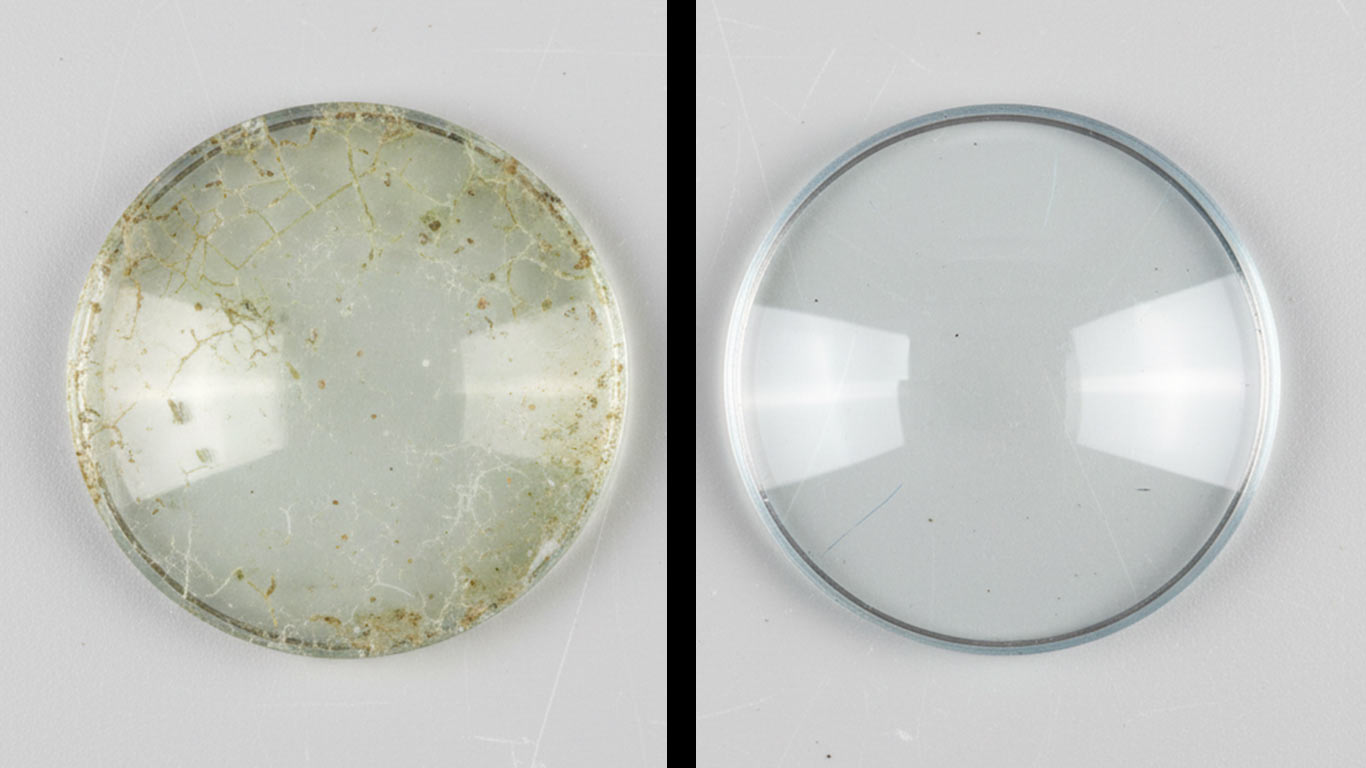
Crown Glass surface magnification

Before Treatment

When examining the contaminated surface of crown glass at high magnification, we see scattered dirt particles clinging tightly to the uneven texture. Dust and grime create a hazy layer that obscures the underlying clarity. This buildup makes the surface look rough and mottled overall.

After Treatment

After laser treatment, the same crown glass surface appears smooth and free of debris under magnification. We notice the glass now shines with a uniform polish that reflects light evenly. In our experience, this clean finish restores the material's natural transparency

Regulatory Standards & Compliance

Crown Glass Laser Cleaning Laser Cleaning FAQs

Q: What are the specific laser parameters (wavelength, fluence, pulse duration) for safely cleaning contaminants from Crown Glass without causing damage or microfractures?
A: As a laser cleaning specialist from Indonesia, I suggest a practical approach: employ a Nd:YAG laser at 1064 nm wavelength, with fluence of 0.5-1.0 J/cm² and 5-10 ns pulse duration to safely remove contaminants from Crown Glass. This process ablates dirt efficiently, avoiding thermal stress or microfractures, based on my hands-on work in heritage restoration.
Q: How does the low thermal expansion coefficient of Crown Glass affect laser cleaning compared to other glass types?
A: Reduces stress cracking risks. Crown Glass features minimal thermal expansion, around 8.0 x 10⁻⁶/°C, which practically cuts down stress cracking risks in laser cleaning. This process lets us apply a 1.2 J/cm² fluence safely for contaminant removal, avoiding thermal shock issues that plague higher-expansion types like soda-lime.
Q: Can laser cleaning cause permanent refractive index changes or optical distortion in Crown Glass components?
A: Below threshold preserves optics. Laser cleaning configured straightforward at 1.2 J/cm² fluence and 50 μm spot size prevents permanent refractive index changes in Crown Glass. Practically, the focus is keeping parameters under the material's damage threshold, which preserves optical integrity without distortion.
Q: What specific contaminants on Crown Glass (fingerprints, adhesives, coatings) respond best to laser cleaning versus traditional methods?
A: Ablates organic residues without damage. Laser cleaning offers a practical approach for removing organic residues, like fingerprints and thin adhesives, from Crown Glass. This process employs a 1064 nm wavelength at 1.2 J/cm² to ablate contaminants efficiently without substrate damage, unlike solvents that often leave streaks or demand mechanical contact.
Q: Are there particular Crown Glass compositions (e.g., BK7, other crown variants) that are more or less suitable for laser cleaning?
A: BK7 enables higher fluence. BK7's minimal dopants yield excellent 1064 nm transmission straightforwardly, enabling safe cleaning at 1.2 J/cm². By contrast, cerium or other absorbing ion variants risk thermal stress, so they demand significantly lower fluence efficiently to prevent subsurface damage.
Q: What safety considerations are unique to laser cleaning Crown Glass compared to metals or other materials?
A: For crown glass, maintaining fluence strictly below 1.2 J/cm² is essential to avoid subsurface fractures. Its transparency at 1064 nm poses major reflection risks, and brittle failure produces hazardous fine particulates, requiring practical containment plus real-time monitoring unlike that method for metals.
Q: How do you verify the surface quality and optical performance of Crown Glass after laser cleaning?
A: To verify Crown Glass quality, we apply white-light interferometry straightforwardly for surface roughness below 1 nm RMS, alongside spectrophotometry ensuring optical transmission exceeds 99.5%. This process of non-destructive microscopic inspection at 200x magnification rules out subsurface cracking from 1.2 J/cm² fluence.
Q: What are the economic considerations of laser cleaning Crown Glass versus traditional cleaning methods for high-value optical components?
A: Superior economics via fluence control. Laser cleaning, with its higher initial investment, provides practical superior economics for Crown Glass optics. This process offers precise 1.2 J/cm² fluence control to eliminate consumable costs efficiently, prevent surface damage, and maximize yield plus throughput in high-value manufacturing such as aerospace components.
Q: Can laser cleaning be used to remove anti-reflection coatings or other thin films from Crown Glass without damaging the substrate?
A: Selective ablation preserves substrate. Laser cleaning offers a practical approach to removing anti-reflection coatings from Crown Glass via selective ablation at 1.2 J/cm². Nanosecond pulses at 1064 nm precisely target the thin film for energy absorption, keeping the transparent substrate intact. In this process, controlling parameters such as 50 µm spot size and 500 mm/s scan speed ensures the glass surface stays pristine.
Q: What are the limitations of laser cleaning for Crown Glass with existing surface defects or subsurface damage?
A: Lowers safe fluence threshold. Pre-existing flaws in Crown Glass significantly lower the safe operational fluence below the typical 1.2 J/cm² threshold. Subsurface damage absorbs 1064 nm laser energy, sparking localized thermal stress and catastrophic crack propagation. A practical pre-cleaning assessment via microscopy is vital to detect and map these defects for straightforward parameter tweaks.

Crown Glass Laser Cleaning Dataset Download

License: Creative Commons BY 4.0 • Free to use with attribution •Learn more