Silver surface undergoing laser cleaning showing precise contamination removal
Alessandro Moretti
Alessandro MorettiPh.D.Italy
Laser-Based Additive Manufacturing
Published
Dec 16, 2025

Silver Laser Cleaning

When laser cleaning silver, start by dialing back the power to suit its mirror-like reflectivity, which bounces away most energy, while its top-notch thermal conductivity spreads any absorbed heat evenly across the surface to avoid localized melting and preserve the underlying structure—but always monitor closely to prevent unintended discoloration from prolonged exposure.

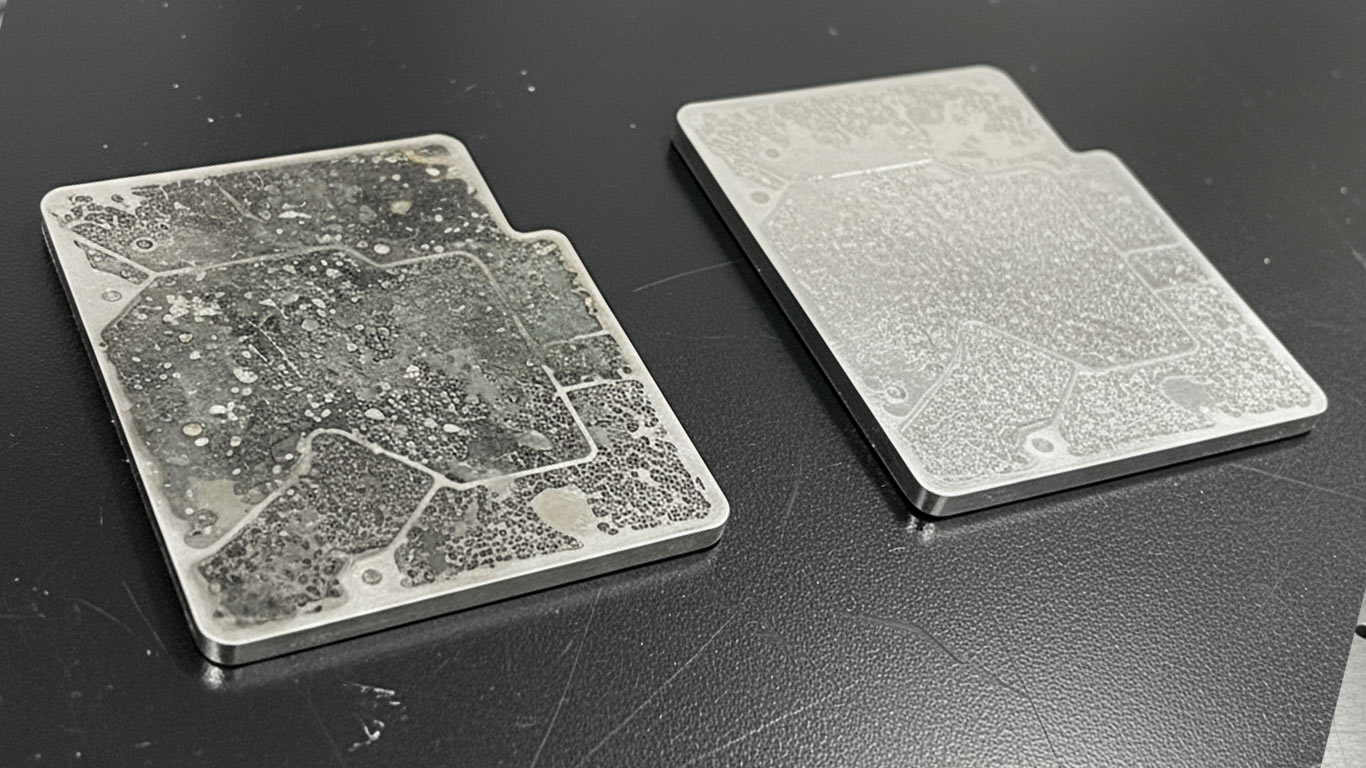
Silver surface magnification

Before Treatment

At 1000x magnification, the silver surface looks rough and covered in dark spots. Layers of grime cling tightly to every bump and crevice. This buildup hides the metal's true shine completely.

After Treatment

After laser treatment at the same view, you see a smooth and even surface emerge. The metal gleams with fresh clarity across its full area. Now it reflects light sharply without any trace of dirt.

Regulatory Standards & Compliance

Silver Laser Cleaning Laser Cleaning FAQs

Q: What safety precautions are essential when using a 1064 nm laser to clean highly reflective silver surfaces in cultural heritage artifacts, given its 97% reflectivity?
A: Mitigate specular reflection risks. When cleaning highly reflective silver artifacts—boasting 97% reflectivity at 1064 nm—it's essential to counter specular reflection hazards using OD 5+ eyewear certified for 1064 nm, guarding against invisible near-IR beam-induced retinal burns. Opt for full-body laser-protective suits to shield skin from 0.45 J/cm² damage threshold exposures. Confine operations within interlocked Class 1 barriers, and position beam dumps alongside angled matte shields for secure containment.
Q: How can the low absorptivity of 4% in silver be overcome to ensure effective tarnish removal during laser cleaning without excessive energy input?
A: Apply carbon-based absorptive coatings. To tackle silver's notable 4% absorptivity at 1064 nm during tarnish removal, deploy thin carbon-based coatings that amplify laser absorption, permitting fluences of 0.2-0.4 J/cm²—exceeding the 0.18 J/cm² ablation threshold while remaining under the 0.45 J/cm² damage threshold. It's essential to adjust pulse lengths to 10-50 ns, thereby restricting thermal diffusion (165.63 mm²/s) and preventing melting at 1234.93 K. Pre-roughen surfaces to 0.
Q: What pulse energy settings are recommended for laser cleaning silver electronics components to stay below the 0.45 J/cm² damage threshold while achieving ablation at 0.18 J/cm²?
A: Fluence 0.18-0.40 J/cm² ablation. When cleaning silver electronics at 1064 nm, it's essential to target fluence of 0.18-0.40 J/cm² for threshold ablation, staying below the 0.45 J/cm² damage limit. Nanosecond pulses (10-50 ns) offer notable efficiency, while picosecond ones (10-100 ps) distinctly reduce heat-affected zones in delicate parts. Scan speeds of 200-500 mm/s with 50-100 μm spots ensure uniform results.
Q: In cultural heritage applications, how does silver's high thermal conductivity of 429 W/(m·K) impact laser cleaning parameters for antique silverware?
A: Requires low fluence high speed. Silver's notable thermal conductivity of 429 W/(m·K) and diffusivity of 165.63 mm²/s quickly disperse heat, widening the heat-affected zone in 1064 nm laser cleaning of antique silverware. Reduce HAZ and warping through higher scan speeds of 200 mm/s, fluence limited under 0.18 J/cm² ablation threshold, plus essential nitrogen cooling to avert discoloration.
Q: For medical device manufacturing, what are the best practices for laser cleaning silver alloys to remove contaminants while maintaining biocompatibility and corrosion resistance rated at 9.0?
A: Employ a 1064 nm laser at 0.2-0.4 J/cm² fluence, remaining below the 0.45 J/cm² damage threshold and notable 1234.93 K melting point, to enable residue-free ablation of contaminants on silver alloys. It's essential to manage sterility with 235 J/(kg·K) heat control; confirm biocompatibility through XPS analysis, upholding 9.0 corrosion
Q: How does silver's melting point of 1234.93 K influence the choice of laser power and repetition rate when cleaning thin silver films in electronics?
A: The notable melting point of silver at 1234.93 K demands careful laser parameters to maintain peak temperatures underneath it, achieved through thermal modeling with specific heat (235 J/kg·K) and diffusivity (165.63 mm²/s). When handling thin films, opt for power under 10 W alongside a repetition rate exceeding 10 kHz, thus reducing heat buildup and preventing delamination; adjust fluence to 0.1-0.15 J/cm², staying below 0.18 J/cm
Q: What equipment features, such as beam delivery systems, are critical for precise laser cleaning of intricate silver jewelry designs without damaging low-hardness (25 HV) surfaces?
A: For precise laser cleaning of intricate silver jewelry with its notable 25 HV hardness, galvanometer scanners deliver agile beams at 1064 nm, curbing thermal diffusion (429 W/m·K conductivity). Essential spot size control caps fluence at 0.18–0.45 J/cm² to prevent melting at 1234.93 K. Imaging integration supports targeted ablation free of surface damage.
Q: Given silver's low porosity of 0.0001%, how can laser cleaning parameters be adjusted to effectively remove embedded oxides from silver contacts in high-reliability electronics?
A: Multi-pass low fluence strategy. For silver contacts exhibiting 0.0001% porosity, employing the 1064 nm wavelength proves essential to capitalize on its 4% absorptivity against 97% reflectivity. Implement a multi-pass approach: 0.2-0.4 J/cm² fluence (surpassing the 0.18 J/cm² ablation threshold yet under 0.45 J/cm² damage limit), with 10-
Q: What ventilation and filtration systems are required to handle silver vapors produced during laser ablation cleaning, considering its boiling point of 2435 K?
A: HEPA filters capture silver aerosols. When cleaning silver via laser ablation, which produces vapors near its 2435 K boiling point, it's essential to deploy local exhaust ventilation with capture velocities exceeding 0.5 m/s. HEPA filters, offering 99.97% efficacy at 0.3 μm, effectively trap condensed silver aerosols, augmented by activated carbon adsorption. Notably, real-time aerosol spectrometer monitoring keeps exposure below the OSHA PEL of 0.01 mg/m³, averting argyria and respiratory hazards.
Q: In medical device applications, how does laser cleaning of silver improve electrical conductivity (63,000,000 S/m) compared to traditional methods, and what validation is needed?
A: Restores conductivity without residue. Laser cleaning of silver in medical devices notably restores electrical conductivity to 63,000,000 S/m, ablating contaminants at a 0.18 J/cm² threshold via 1064 nm wavelength. This approach sidesteps residues from chemical methods that elevate resistivity. Essential for superior contacts, it preserves 0.12 μm surface roughness, in contrast to abrasive techniques inducing pitting. Validation demands ASTM F1538 conductivity metrics, profilometry, and ISO 10993 compliance testing.

Silver Laser Cleaning Dataset Download

License: Creative Commons BY 4.0 • Free to use with attribution •Learn more