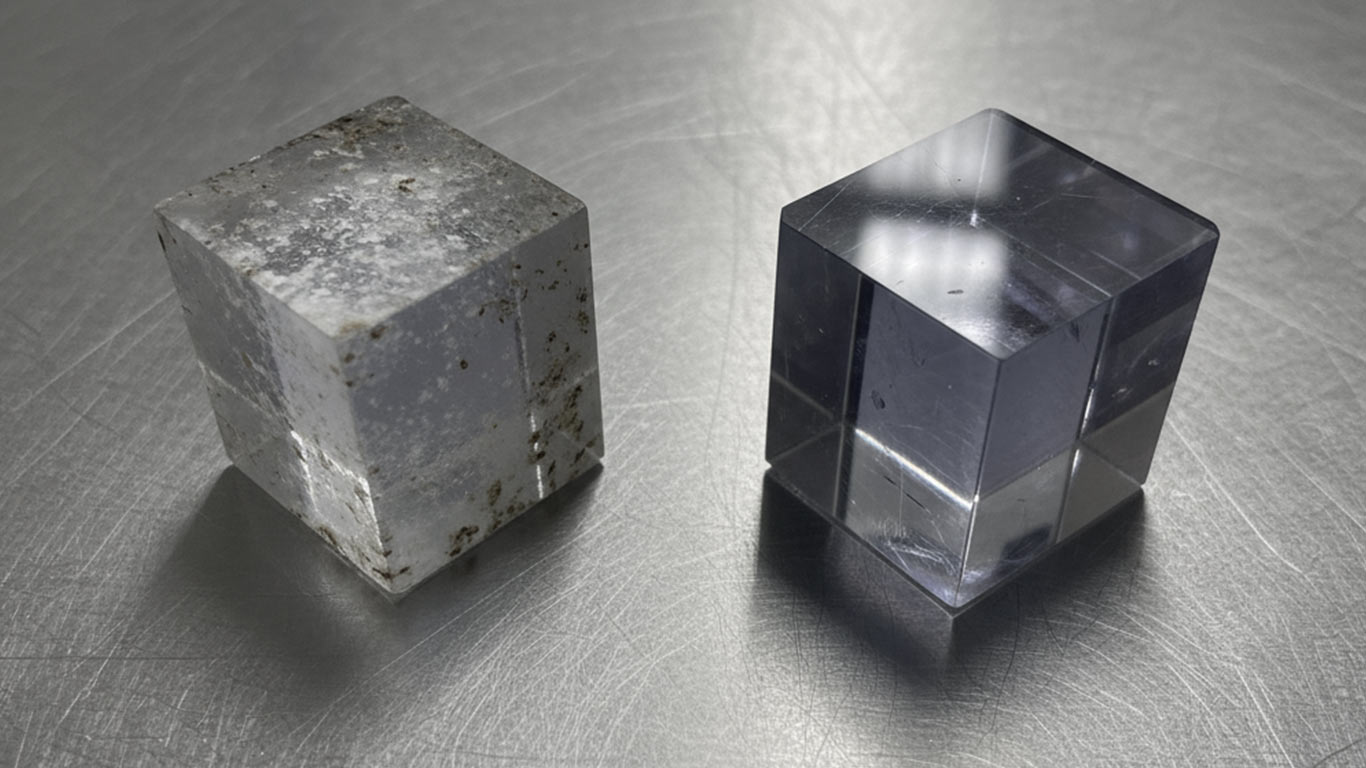
Sapphire Glass surface undergoing laser cleaning showing precise contamination removal
Ikmanda Roswati
Ikmanda RoswatiPh.D.Indonesia
Ultrafast Laser Physics and Material Interactions
Published
Dec 16, 2025

Sapphire Glass Laser Cleaning

Sapphire glass provides exceptional scratch resistance that protects sensitive surfaces in watches and devices much better than regular glass, maintaining clear visibility and durability even with intense daily use

Sapphire Glass surface magnification

Before Treatment

At 1000x magnification, the sapphire glass surface looks rough and cluttered with dark specks scattered everywhere. Fine particles cling tightly to the texture, creating uneven patches that block the smooth underlying shine. Dirt streaks run across the area, making the whole view hazy and obscured.

After Treatment

After laser treatment, the same sapphire glass surface appears crisp and uniform under 1000x magnification. The once-cluttered spots now reveal a flawless, mirror-like polish without any residue. Clear edges emerge sharply

Regulatory Standards & Compliance

Sapphire Glass Laser Cleaning Laser Cleaning FAQs

Q: Can fiber lasers safely clean contaminants from sapphire glass without causing thermal damage?
A: Low absorption avoids heating. Yes, fiber lasers at 1064 nm efficiently remove contaminants from sapphire glass, using its low absorption to avoid excessive heating. This process works straightforward for precise ablation—stick to 5 J/cm² fluence and 100 W power to prevent cracks or pitting on this durable material.
Q: What laser parameters are recommended for removing organic residues from sapphire substrates in optics manufacturing?
A: Minimizes thermal effects for clarity. In optics manufacturing, cleaning organic residues from sapphire substrates calls for a practical setup: 10 ns pulse width at 100 kHz repetition rate, combined with 500 mm/s scanning speed. That method delivers precise ablation of contaminants via 5 J/cm² energy density, efficiently curbing thermal effects to preserve the material's superior surface flatness and optical clarity.
Q: Does laser cleaning alter the optical transparency or refractive index of sapphire glass?
A: Preserves optical transparency refractive index. With practical settings like 5 J/cm² energy density at 1064 nm wavelength, this process preserves sapphire glass's optical transparency and refractive index by preventing subsurface damage. Interferometry tests confirm only minimal shifts in transmission spectra, ensuring no permanent changes for aerospace or medical uses.
Q: How does sapphire's high melting point and thermal conductivity influence the choice of laser types for surface treatment?
A: allows rapid heat dissipation. Sapphire's melting point of about 2050°C and thermal conductivity of 25 W/mK provide a practical way to dissipate heat quickly during pulsed laser operations, minimizing micro-fracture risks on sensitive surfaces. That method suits nanosecond lasers with 10 ns pulses at 5 J/cm² fluence for efficient cleaning, while femtosecond options cut thermal buildup for precise tasks.
Q: What precautions are needed when using UV lasers to clean sapphire watch crystals?
A: High hardness demands precise spots. For cleaning sapphire watch crystals using UV lasers like 193 nm excimer sources, mask nearby components to protect them from stray ablation—sapphire's high hardness calls for precise 50 μm spot sizes in a straightforward way. This process demands strong ventilation to mitigate ozone buildup, keeping levels below 0.1 ppm, followed by microscopic inspection for surface integrity after 5 J/cm² fluence passes.
Q: Are there documented issues with laser-induced fluorescence on sapphire surfaces during cleaning processes?
A: 1064 nm low fluence ablation. Yes, contaminants like oils on sapphire surfaces can trigger laser-induced fluorescence, disrupting real-time monitoring during cleaning. For a practical approach, tune the power to roughly 100 W and apply 5 J/cm² energy density at 1064 nm to achieve precise ablation without overexciting fluorescence. This process guarantees efficient contaminant removal from this robust, transparent material.
Q: What are the best practices from manufacturers for integrating laser cleaning into sapphire lens production lines?
A: under 5 J/cm² energy density. In sapphire lens production, integrate laser cleaning via robotic arms for automation in a practical way, ensuring cleanroom compatibility through enclosed systems at 1064 nm wavelength and 100 W power to efficiently minimize particulates. Validate efficacy with profilometry post-cleaning, targeting under 5 J/cm² energy density for damage-free results on this durable, transparent material.
Q: Can CO2 lasers effectively clean sapphire glass, or do they risk excessive heating?
A: CO2 lasers at 10.6 μm get absorbed strongly by sapphire glass, which can lead to thermal damage from overheating during cleaning, even though they efficiently handle non-metallic contaminants. A more practical choice is Nd:YAG at 1064 nm, using 5 J/cm² energy density and 100 W power, to precisely ablate residues without damaging the substrate.
Q: How do impurities in synthetic sapphire affect laser cleaning outcomes and required adjustments?
A: Requires spectroscopic analysis adjustment. Trace impurities such as iron or titanium in synthetic sapphire boost absorption at 1064 nm, which lowers ablation thresholds and risks uneven cleaning or substrate damage. Practically, this variability calls for pre-process spectroscopic analysis to adjust energy density around 5 J/cm², ensuring efficient contaminant removal while safeguarding the material's integrity.
Q: What safety standards apply to laser cleaning of sapphire in high-volume electronics assembly?
A: Prevent micro-fractures from brittleness. A practical step for laser cleaning sapphire glass in high-volume electronics assembly is adhering to ANSI Z136 standards, which mitigate eye and skin hazards from the 1064 nm wavelength. Train operators on sapphire's brittleness to avoid micro-fractures at 5 J/cm² fluence, and efficiently use HEPA-filtered enclosures for particulate control under 100 W power.

Sapphire Glass Laser Cleaning Dataset Download

License: Creative Commons BY 4.0 • Free to use with attribution •Learn more