


Brick Laser Cleaning
Brick's porosity is what makes it both easy and tricky to clean by laser. At 15–25%, pores are large enough for soot, biological growth, and mineral deposits to migrate well below...


Laser cleaning removes soot, creosote, and smoke staining from brick fireplace surfaces without abrasive media or chemical strippers. It does not repoint mortar joints or repair spalled brick faces, and it will not lighten fire-darkened mortar back to original color in a single pass. Historic hearths often pair this step with historic masonry restoration planning before any thermal work begins.
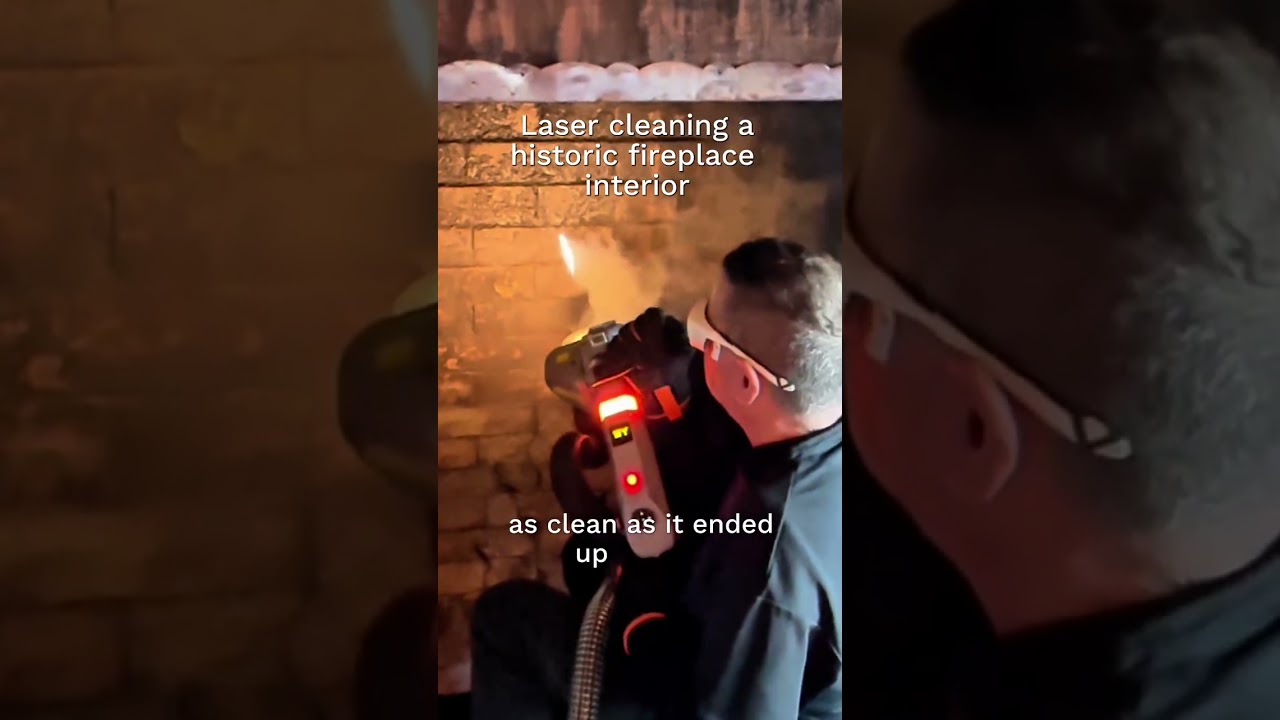
Short AhhoirJT1LA shows a Netalux laser clearing about 3/8 inch of pitch tar, creosote, and soot from an 80-year-old brick fireplace at roughly 415 mm standoff with repeated passes.
The crew classifies the soot as dry powder or wet oily residue, then walks a labeled brick coupon at sub-1 J/cm² fluence where the carbon layer vaporizes while the masonry stays cool. Structural wood gets the same pass only after species tests, because the margin between lifting surface char and scorching fiber is narrower than on brick. HEPA capture keeps laser-generated soot particulate under California's five-milligram respirable dust limit, and wet synthetic fires still trigger the tighter PAH exposure line for tar-like volatiles.
The crew inspects the rake face under magnification, then runs the pulsed 1064 nm beam across the cold-welded aluminum buildup until the pressure-welded chip spalls off the [carbide](/materials/tungsten-carbide-laser-cleaning) insert without eroding the cutting edge. Homogeneous [tool-steel](/materials/tool-steel-laser-cleaning) galling on the same die steel gets rejected because there is no absorption window to separate deposit from substrate. HEPA extraction keeps respirable aluminum dust under California's five-milligram respirable limit, and the tool goes back into the cut before built-up edge re-forms on the next pass.
Bridge crews reach for HEPA before solvent when lead or chromate primers hide under aged topcoats, because BAAQMD cold-cleaner rules cap stripper VOC well below what commercial products carry. A pulsed 1064 nm pass removes organic films without a liquid hazmat stream, yet [oak](/materials/oak-laser-cleaning) and [concrete](/materials/concrete-laser-cleaning) test coupons on the same job do not inherit plate-[steel](/materials/steel-laser-cleaning) damage margins. Grit-profile recoats that demand ISO 8503 anchor tooth stay out of scope even when the visible coat is gone.
Black crust on heritage stone will not come off safely until the crew knows whether they are facing gypsum sulphation, a biofilm, or salt efflorescence beneath the dark layer. Fluence that clears gypsum crust on [marble](/materials/marble-laser-cleaning) can overheat porous [sandstone](/materials/sandstone-laser-cleaning) where the sandstone coupon crust margin at 1064 nm is only about 0.4 J/cm².

When black crust, soot, or biological growth penetrates Bay Area Victorian [brick](/materials/brick-laser-cleaning), Chinatown masonry, or Mission-era stone, conventional abrasives...

Exterior cleaning of San Francisco City Landmarks and Mills Act properties must satisfy the Secretary of the Interior's Standards. The "gentlest means possible" mandate under 36 CF...
