


On-Site Demo
Free/ 60 mins
- CoversCoverage SF Bay Area
- Test your material
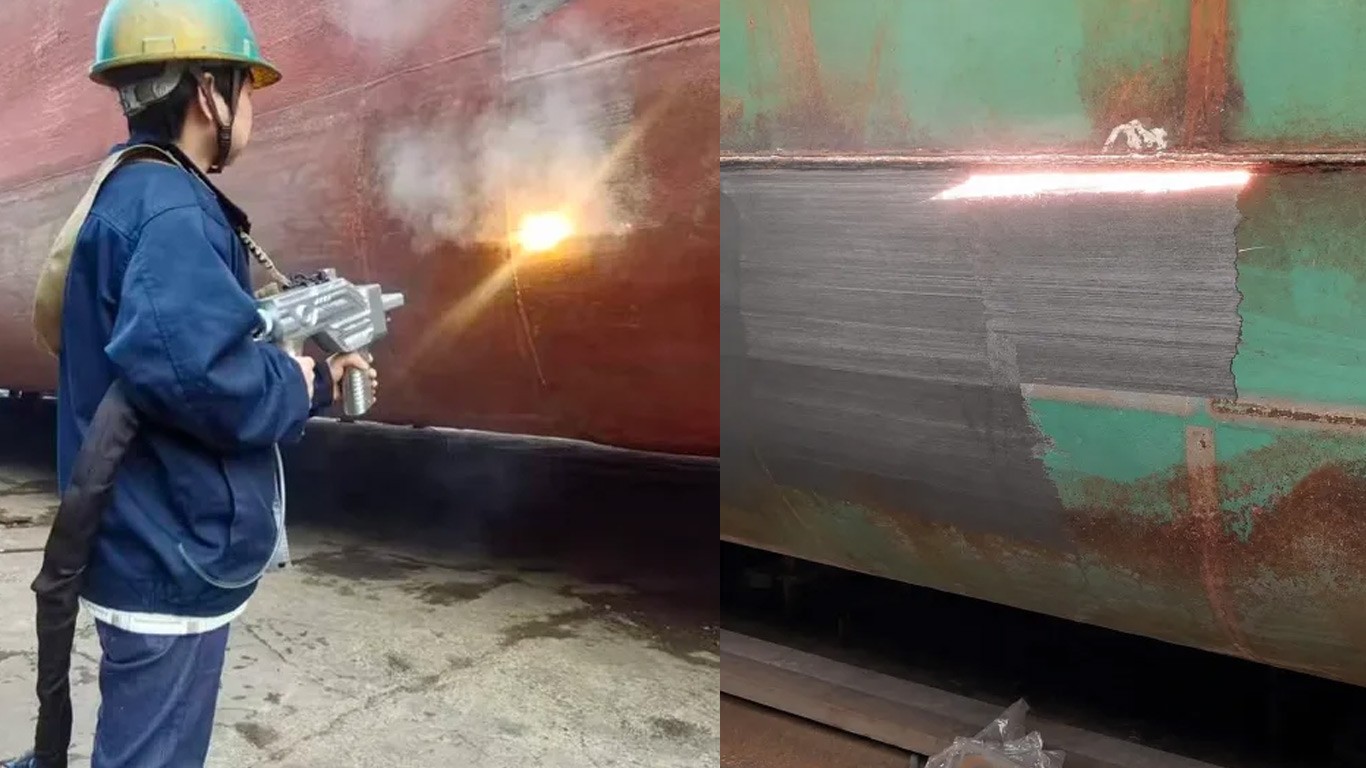
Laser cleaning gives shipyards a way to ready steel and aluminum for paint without the grit that a blast tent has to catch. Bay Ship still prepares vessels inside and out with sandblasting and hand tools, all of it fully contained. That blast route feeds certified painting work, and no public record shows the yard using laser yet.
On a modeled 100,000 sq ft hull, blasting left 59,860 lb of waste against 7,300 lb for laser, so disposal is where marine stripping costs split. That Lasertronics model from ASNE 2011 is vendor math, not field data, but it priced blast disposal at $35,168, or $0.35 per sq ft, against $4,289 for laser on 20 mil paint. OSHA names the same driver for shipyards: large quantities of spent abrasive mixed with paint chips, which become costly to clean up and dispose of when the paint is hazardous. Bay Area grit shows why. Spent blast grit from the Hunters Point Annex held 1,832 mg/kg total copper and leached 144 mg/L soluble copper on the WET test, well above the 25 mg/L STLC, so it was classed as California-only hazardous waste. Labor sets the rest of the bill. KKMI Sausalito lists bottom prep and detailing at $145 per hour plus a 4.75% SHE fee, with extra prep billed as time and materials. One contractor blog, outside the Bay Area, quotes dry sandblasting at $2.00-$4.50 per sq ft, wet abrasive at $1.30-$3.50, and dry ice at $3.50-$5.00. The laser side has its own weight. A Navy maintenance view puts initial laser investment at $300,000-$500,000 and notes that handheld tools always cost less head to head.
| Method | Cost per 100 sq ft | Hourly Rate | Consumables/hr | Setup Cost | Cleaning rate |
|---|---|---|---|---|---|
| Sandblasting / Abrasive Blast | 425 USD | 145 USD/hr | 55 USD/hr | 200 USD | 150 sq ft/hr |
| Soda Blasting | 329 USD | 155 USD/hr | 90 USD/hr | 175 USD | 200 sq ft/hr |
| Dry Ice Blasting | 750 USD | 350 USD/hr | 150 USD/hr | 550 USD | 200 sq ft/hr |
| Dustless Blasting | 641 USD | 375 USD/hr | 80 USD/hr | 250 USD | 130 sq ft/hr |
| Laser Cleaning | 500 USD | 400 USD/hr | 0 USD/hr | 0 USD | 80 sq ft/hr |
On a thick hull coating, heat input below about 3 J/mm² leaves cleaning efficiency under 50%. The test stack was about 1000 µm of antifouling over anticorrosive paint on KE36 ship steel, stripped with a nanosecond pulsed lab source. Those figures are research values, not Dagger settings. Full removal took about 4-5 J/mm². Once the coating is gone, extra overlap stops paying off and only adds heat and time.
Hearing protection is needed within 5 ft of a marine cleaning laser, against 95 ft for a needle gun. Other common questions cover which jobs suit a laser on a vessel, how it compares with blasting on badly rusted steel, and which Bay Area rule covers marine surface preparation.[1][2]
Hearing protection was needed only within 5 ft of the laser in a Puget Sound Naval Shipyard test. For the needle gun, that distance was 95 ft, so nearby trades could keep working.
BAAQMD Rule 8-43 covers surface preparation and coating of marine vessels, along with their components and structures. Its scope also reaches oil platforms and navigational aids.
Mostly rust and corrosion on steel and aluminium decks, frames, and fittings. Trend Diesel also lists spot coating removal, weld seams before and after welding, and prep for inspection or NDT. Paint on brackets, mounts, and handrails is on the list too, and engine-room cleaning where the beam can reach.
In one study, a 3 kW[18] continuous-wave laser on severely corroded steel reached Sa 2.5 or Sa 3, the same grades as garnet blasting. It also removed salt well and left no spent abrasive behind.
Salt removal on corroded steel members was good in the same study. That matters before recoating, since salt left on the surface works against the new paint.
A laser trial works best beside sandblasting that is already 100%[1] contained. Bay Ship & Yacht keeps steel and aluminum prep inside that kind of blasting, so the laser should fit the existing setup instead of replacing it in one move.