


On-Site Demo
Free/ 60 mins
- CoversCoverage SF Bay Area
- Test your material
Removable tools and parts suit dry laser decon with the debris captured, but free-release still waits on the plant's radiation protection survey. In Reinecke's lab work, laser passes removed 90-100% of surrogate Co-60, Cs-137, Sr-85, and Am-241 from stainless, mild, galvanized, and painted steel. Those were surrogate tests, not a claim for primary-circuit chemical decon.
On 304L stainless, laser decon has a selective window near 5 J/cm2[1] where the contaminated oxide comes off before the metal melts and locks contamination in, while grinding removes base metal along with the layer. That matters for tools and parts meant to go back into service, since every pass of a grinder thins the part. Staying in the window keeps the base metal and avoids pushing contamination deeper.
Release limits often cited from IE Circular 81-07 are 5000 dpm per 100 cm2 total and 1000 dpm per 100 cm2 removable, and a tool meets them only when the radiation protection survey says so. The laser lowers the reading. Your plant procedure sets the limits that apply and who signs the release.
Capture filters are drummed as radwaste because Cs-137 can volatilize near 700-705 C and travel into the off-gas. Plan cooled capture and radiation protection waste handling before the first pass.
The peer-reviewed tables come from dried Co-60 and Cs-137 test coupons, so they say little about alpha removal. Alpha figures so far come from vendors and trade press. Verify alpha results on your own items before planning a release around them.
At about 10 J/cm2 and above, the melted surface can pull contamination down into the metal, where later passes cannot reach it. Stay below that level and survey between passes rather than raising power to chase a lower reading.
Turning the laser up past about 10 J/cm2 to chase a better decontamination factor can backfire, because melt-pool currents at that level pull contamination into the bulk metal where no surface pass can reach it. The other common miss is planning porous concrete items from metal results, when KAERI measured concrete factors of only about 1.8 and 1.7 at 9.4 J/cm2.
| Condition |
|---|
| Fluence pushed to about 10 J/cm2 or higher on metal tools to get more contamination off in one pass. |
| Decontamination factors from metal coupons used to schedule porous concrete pieces. |
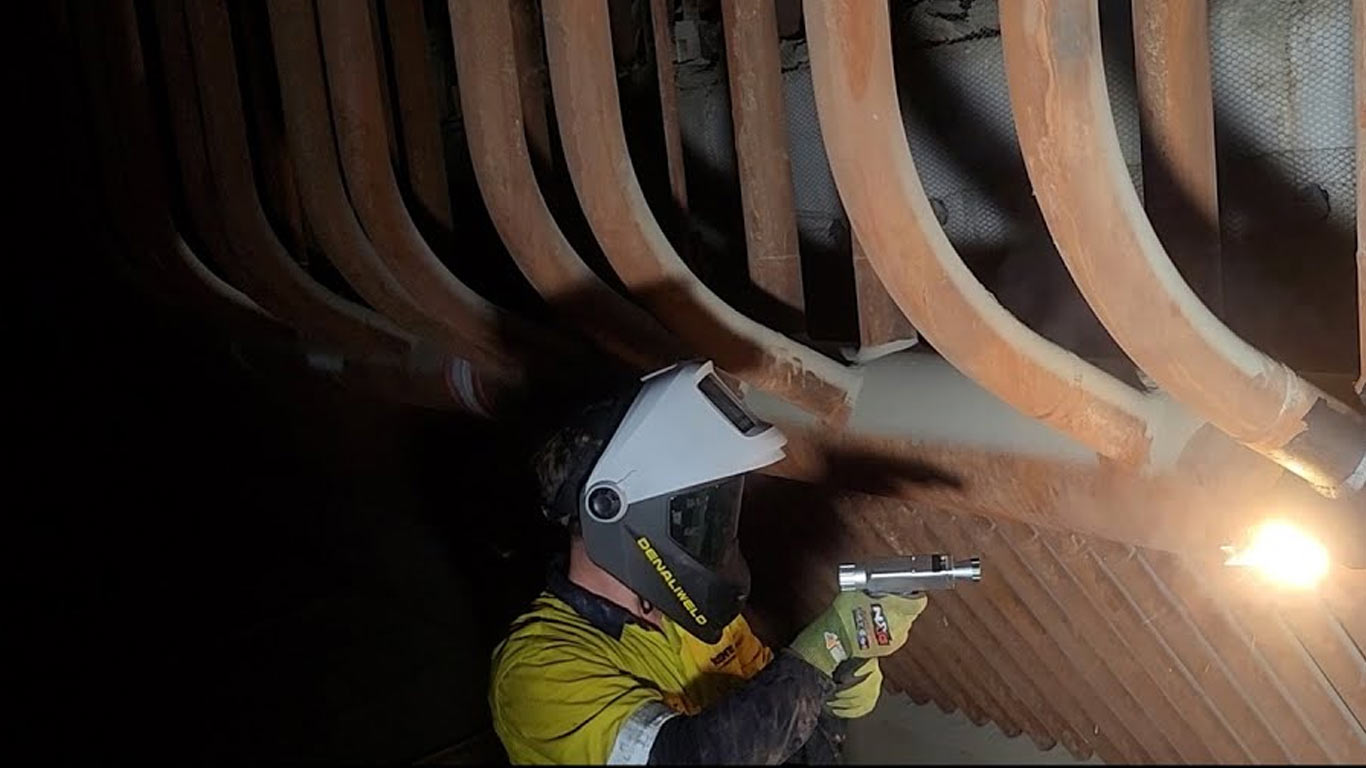
Laser decon of nuclear tools and removable parts goes best with the laser source and chiller left outside the radiologically controlled area and only a bagged optic and fiber umbilical carried inside, where a continuous air monitor and HEPA capture handle the plume. Open-air ablation turns surface contamination into an airborne hazard, so the capture has to be running before the first pulse. Plan on a second pass as well. In KAERI's work the second pass raised metal decontamination factors roughly 10-30x over the first, and those figures come from dried test coupons rather than service-worn parts.
A schedule that books a single laser sweep per tool runs short, because KAERI needed a second pass to raise metal decontamination factors 10-30x. Budget the second pass into every item's time before comparing laser speed with blasting or wiping. Those factors came from dried test coupons, so expect worn parts to need their own trial.
Grit blasting a contaminated part turns about 100 lb of sand into waste for every pound of coating removed, and in DOE-era figures waste storage ran about 33% of decommissioning cost at $300/ft3. That volume is where the money goes. Laser decon still leaves filters to drum, but it does not add spent blast media to the waste stream.
| Method | Cost per 100 sq ft | Hourly Rate | Consumables/hr | Setup Cost | Cleaning rate |
|---|---|---|---|---|---|
| Sandblasting / Abrasive Blast | 425 USD | 145 USD/hr[1] | 55 USD/hr[2] | 200 USD[3],[4] | 150 sq ft/hr[2] |
| Soda Blasting | 329 USD | 155 USD/hr | 90 USD/hr | 175 USD | 200 sq ft/hr |
| Dry Ice Blasting | 750 USD | 350 USD/hr[1],[5] | 150 USD/hr[5],[6],[7] | 550 USD | 200 sq ft/hr |
| Dustless Blasting | 641 USD | 375 USD/hr | 80 USD/hr | 250 USD[3] | 130 sq ft/hr |
| Laser Cleaning | 500 USD | 400 USD/hr[8],[9] | 0 USD/hr | 0 USD | 80 sq ft/hr[9] |