


On-Site Demo
Free/ 60 mins
- CoversCoverage SF Bay Area
- Test your material
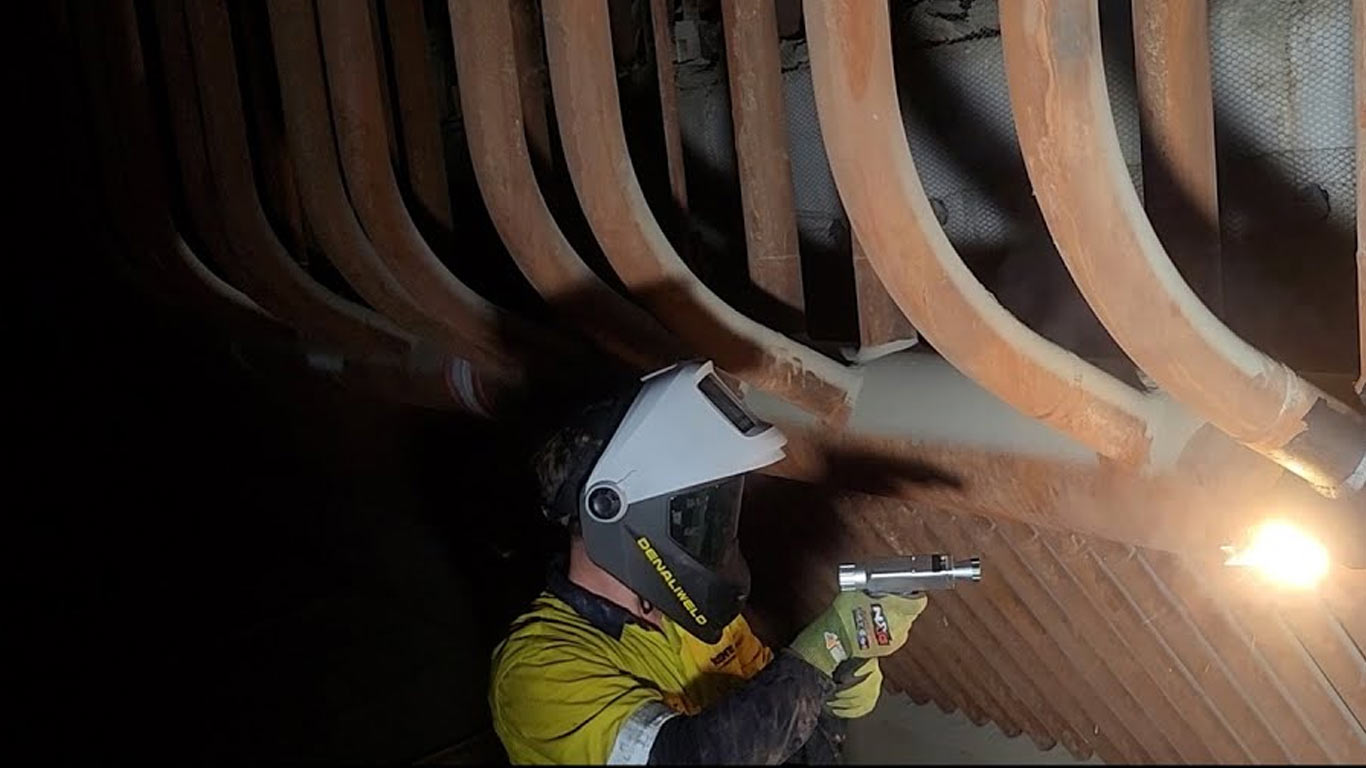
Renting laser decontamination for a nuclear facility is a different purchase from buying an OEM system, because the rental arrives as a split kit that keeps the laser source outside the radiologically controlled area while only a bagged optic and fiber umbilical work inside. That split keeps the costly equipment clean and limits what has to be surveyed out after the job. Service reaches sites across the US, covering removable parts and coatings with HEPA capture and filters sent to radwaste. Primary-circuit chemistry stays outside the scope, since the published results come from removable parts and coating work rather than in-place circuit campaigns.
Laser decontamination reaches nuclear sites across the US through radiation protection contractors, but it has firm limits that buyers often miss. A laser run does not decide free release, the capture filters count as radioactive waste, and the peer-reviewed results come from removable parts and coatings rather than primary-circuit chemistry.
No. A laser pass lowers the contamination reading, but release is decided by a radiation protection survey under the plant's own procedure. Older NRC guidance on contaminated material is often quoted for release limits, yet the plant procedure is what governs, so the laser result is an input to that survey and never the decision.
The filters go in a drum as radioactive waste. Cs-137 can volatilize near 700-705 C and travel into the off-gas, so the filters hold more than ordinary dust and their handling is planned before the first pass.
Not on current evidence. Reinecke and colleagues measured 90-100%[4] decontamination ratios on stainless, mild, galvanized, and painted steel, but those were removable-part and coating surrogates. None of the peer-reviewed tables describe an in-place oxide campaign on primary-circuit piping, so chemical decontamination keeps that role.
Yes. Equipment reaches sites across the US through radiation protection contractors who already hold site access. It is set up as a split kit, with the laser source and chiller outside the radiologically controlled area and a bagged optic working inside.
ANSI Z136.1 Class 4 controls apply on nuclear sites, and they run alongside the plant's radiation protection access rules rather than replacing them. The laser safety procedure stays under radiation protection and the laser safety officer together, so neither program is dropped when the work moves into a controlled area.
Pushing fluence to about 10 J/cm2 or higher in pursuit of a better decontamination factor can backfire, because melt-pool currents start pulling contamination down into the bulk metal where no later pass can reach it. The second mistake is borrowing metal results for concrete. On porous concrete, KAERI measured decontamination factors near 1.8 and 1.7 at 9.4 J/cm2 after two passes, far below what metal tables suggest.
| Condition |
|---|
| Fluence raised to about 10 J/cm2 or more to chase a higher decontamination factor |
| Metal decontamination tables used to plan work on porous concrete |
Laser ablation in open air turns fixed surface contamination into an airborne radiation hazard, so a rented laser job at a nuclear facility depends on capture and monitoring being in place before the beam is ever used. The usual answer is a split kit. The laser source and chiller sit outside the radiologically controlled area, and only a bagged optic and fiber umbilical go inside, working under a continuous air monitor and HEPA capture. A test coupon and a radiation survey between passes then show whether the method is earning its place on the work package.
DOE-era records put grit blasting at about 100 lb of sand for every pound of coating removed, and with waste storage near 33% of decommissioning cost at $300/ft3, that sand is often the most expensive part of the job. Every pound of media that touches a contaminated surface has to be packaged and stored as radioactive waste. A rented laser kit still sends its HEPA filters to radwaste, but it adds no spent media to the volume being stored.
| Method | Cost per 100 sq ft | Hourly Rate | Consumables/hr | Setup Cost | Cleaning rate |
|---|---|---|---|---|---|
| Sandblasting / Abrasive Blast | 425 USD | 145 USD/hr | 55 USD/hr | 200 USD | 150 sq ft/hr |
| Soda Blasting | 329 USD | 155 USD/hr | 90 USD/hr | 175 USD | 200 sq ft/hr |
| Dry Ice Blasting | 750 USD | 350 USD/hr | 150 USD/hr | 550 USD | 200 sq ft/hr |
| Dustless Blasting | 641 USD | 375 USD/hr | 80 USD/hr | 250 USD | 130 sq ft/hr |
| Laser Cleaning | 500 USD | 400 USD/hr | 0 USD/hr | 0 USD | 80 sq ft/hr |