


Cast Iron Laser Cleaning
Laser cleaning strips rust and foundry scale from gray and ductile cast iron without disturbing the graphite matrix that gives the metal its strength. Cast iron holds the narrowest...


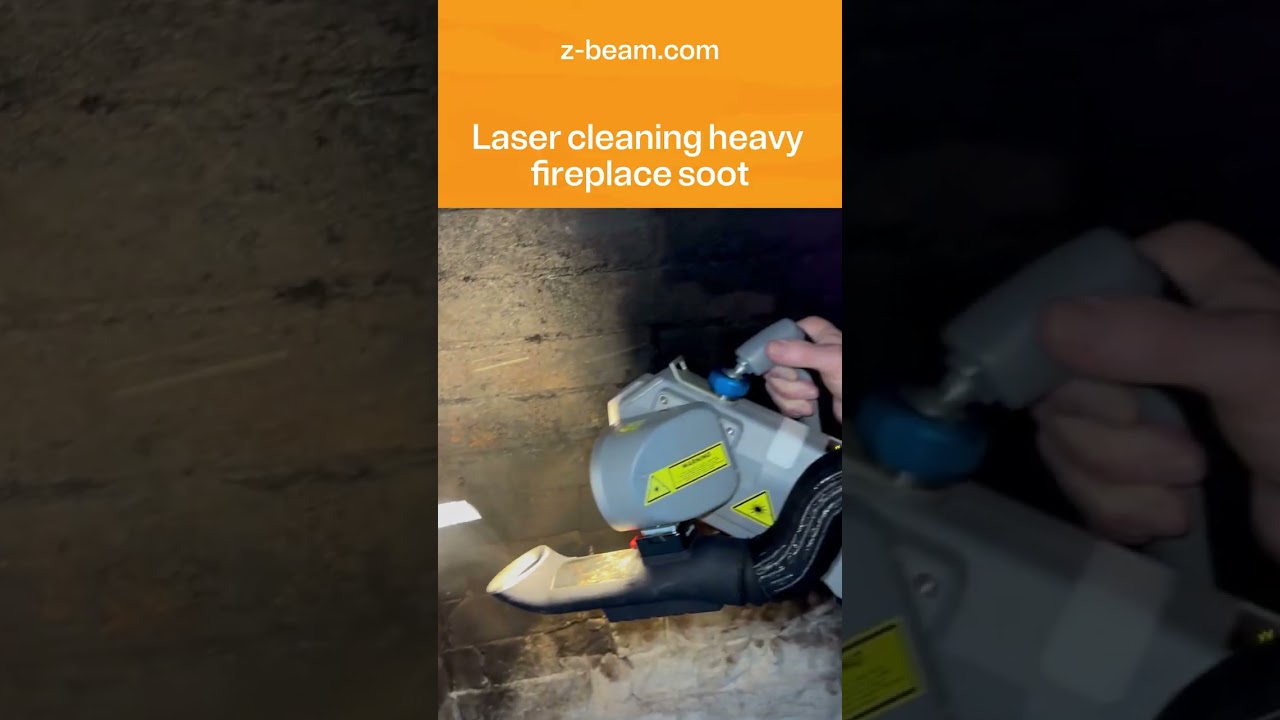
Heavy fireplace soot keeps a thick carbon and creosote layer across brick, mortar, and metal surrounds, and it resists ordinary scrubbing once heat has baked it into the surface. Laser cleaning strips that carbon film and removes smoke staining down to the original stone or masonry color without water, chemical strippers, or abrasive blasting that can gouge soft mortar joints. The beam works well on flat firebox brick and on metal surrounds, much like soot removal on cast iron cookware or stove parts elsewhere in a home. It reaches into shallow mortar texture but will not fully clear deep creosote that has penetrated porous brick or cracked masonry, and it will not repair spalled stone, reset loose mortar, or reverse heat damage to a firebox liner. On older hearths tied to heritage architectural work or historic masonry surrounds, cleaning still needs a mason's judgment for anything beyond surface carbon and stain.
Short gVGrNv-UajU shows pulsed laser clearing heavy fireplace soot from metal in 44 seconds without grit.
Laser cleaning strips rust and foundry scale from gray and ductile cast iron without disturbing the graphite matrix that gives the metal its strength. Cast iron holds the narrowest...

Laser cleaning strips rust and mill scale from iron without touching the metal underneath. The process is self-limiting because iron oxide absorbs 60–70% of 1064 nm light while bar...

Oak's open ring-porous structure (porosity 0.55) sets it apart from closed-grain hardwoods like [Maple](/materials/maple-laser-cleaning): soot, biological growth, and finish residu...
Hydrated rust blocks primer adhesion until someone names the ISO grade on the plate. A pulsed 1064 nm pass strips the red film on [steel](/materials/steel-laser-cleaning) once mill scale is already gone. Coupon repetition-rate and fluence numbers stay on labeled plates, not on every shell or roller in the bay.
Bridge crews reach for HEPA before solvent when lead or chromate primers hide under aged topcoats, because BAAQMD cold-cleaner rules cap stripper VOC well below what commercial products carry. A pulsed 1064 nm pass removes organic films without a liquid hazmat stream, yet [oak](/materials/oak-laser-cleaning) and [concrete](/materials/concrete-laser-cleaning) test coupons on the same job do not inherit plate-[steel](/materials/steel-laser-cleaning) damage margins. Grit-profile recoats that demand ISO 8503 anchor tooth stay out of scope even when the visible coat is gone.
Crews on hot-rolled plate with intact mill scale run four or five pulsed 1064 nm passes under HEPA because the magnetite laminate clears slower than field rust and Cal/OSHA caps iron oxide fume at 5 mg/m³. Thermoelastic spallation at the oxide-steel interface drives removal on [carbon steel](/materials/steel-laser-cleaning), not the same recipe as [field rust](/contaminants/iron-oxide-rust-laser-cleaning).
Greasy steel and aluminum weld coupons need extraction bracketed before the pulsed pass. Cutting-fluid residue pyrolyzes at the lowest degrease energy band of any contaminant family on those joint faces, coupon work, not a production shell throughput claim.

Exterior cleaning of San Francisco City Landmarks and Mills Act properties must satisfy the Secretary of the Interior's Standards. The "gentlest means possible" mandate under 36 CF...

ISO 8501-1 Grade A mill scale is mechanical prep. Grades C–D field rust is the pulsed-laser job.
