

FDA
FDA 21 CFR 1040.10 - Laser Product Performance Standards

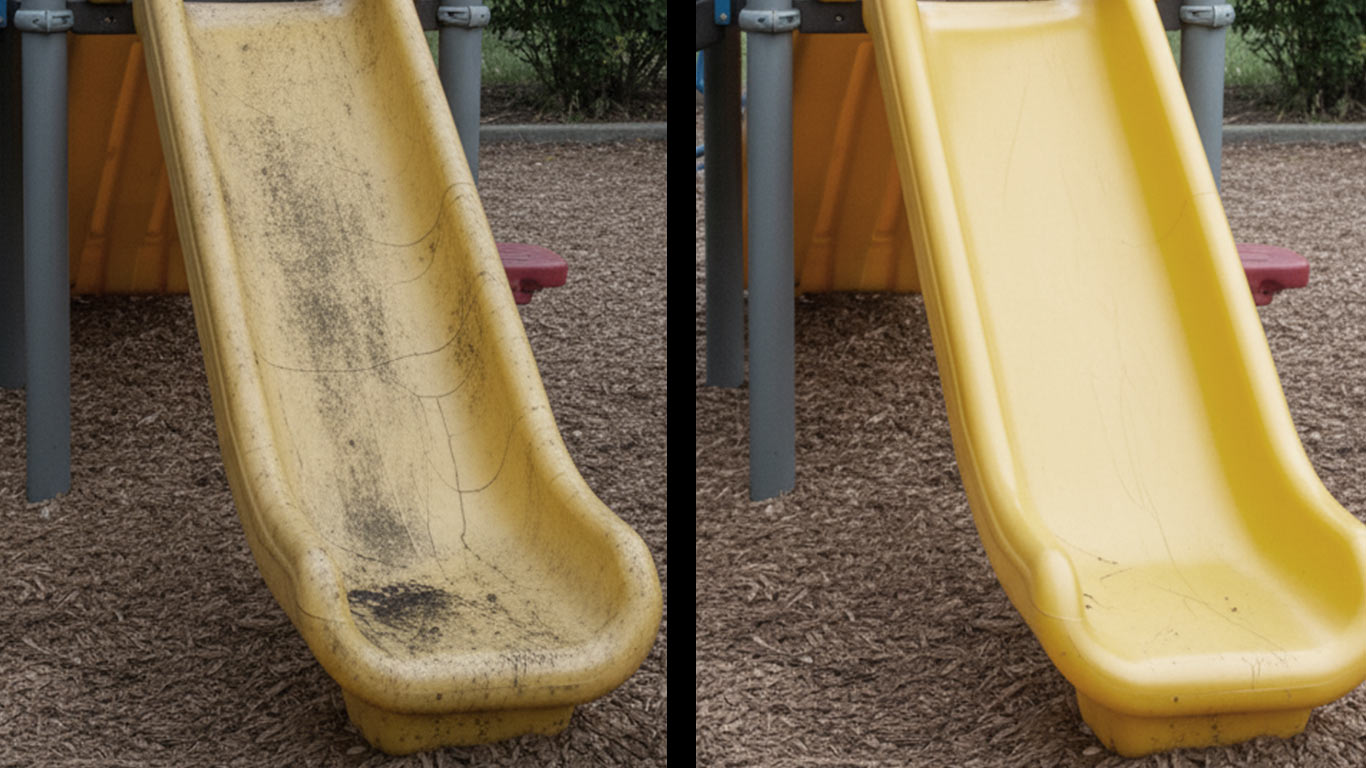

PVC is the one polymer where chemistry, not optics, defines the cleaning window. Laser energy above 0.65 J/cm² triggers depolymerization reactions that generate hydrogen chloride gas and, at higher doses, dioxins and furans — both regulatory hazards that require source-capture extraction rated for acid gases, not just standard HEPA. PVC absorbs 92% of UV laser energy, so 355 nm at 0.2–0.5 J/cm² is the preferred approach, working at 1,000 mm/s with 50% overlap and continuous fume monitoring. The 0.8 J/cm² damage threshold at 1064 nm gives less headroom than UV, and backscatter from the denser material amplifies risk. Bay Area industrial facilities — particularly chemical processing plants in Richmond and Contra Costa County — use PVC piping and tank liners that accumulate surface films requiring periodic decontamination without solvent contact. HCl and dioxin generation above 0.65 J/cm² is not a theoretical risk — it's the governing constraint that makes source-capture extraction rated for acidic gases mandatory on every PVC cleaning job, regardless of part geometry or scale.
…Z-Beam took the time to demo the machine for us, answer all our questions, and made sure we were comfortable.

Fluence (J/cm²)
Exceeding 0.65 J/cm² on PVC initiates HCl gas generation from dehydrochlorination of the polymer backbone — a reaction that begins below the visible burn threshold, producing detectable HCl before any surface discoloration is observed. The NIOSH REL for hydrogen chloride is 0.5 ppm ceiling; OSHA PEL is 5 ppm ceiling. Even brief exposures at 1–2 ppm cause mucous membrane irritation. Bay Area industrial laser cleaning of PVC conduit, pipe insulation, cable jacketing, or vinyl flooring in commercial renovation requires continuous HCl gas monitoring with an electrochemical sensor — not just particulate monitoring. Plasticized PVC (soft PVC used in cable jackets and flooring) decomposes at lower energy level than rigid PVC and generates phthalate vapors (DEHP, DINP) in addition to HCl; phthalates are California Prop 65 reproductive toxins requiring workplace exposure notification when airborne concentrations exceed established action levels. Heat spreads very slowly. The damage threshold is 0.65 J/cm². Effective cleaning must stay below 0.5 J/cm² for rigid PVC, and below 0.3 J/cm² for plasticized (flexible) PVC. Above 0.65 J/cm², HCl gas release begins. Never exceed 0.7 J/cm².
Why is PVC hazardous for laser cleaning? Above 0.65 J/cm², it releases hydrogen chloride (HCl) gas and dioxins. Density is 1.4 g/cm³ and tensile strength is 50 MPa. Thermal conductivity is low at 0.19 W/m·K. Heat does not spread. The damage threshold is 0.65 J/cm². Plasticized PVC (flexible) degrades at even lower energy level. UV wavelengths are preferred over IR for better absorption and lower thermal load.
Use UV wavelength (355 nm) with energy level at 0.2-0.5 J/cm² for rigid PVC, below 0.3 J/cm² for flexible PVC. Pulse length at 20 ns. Scan at 1000 mm/s with 50% overlap. PVC generates HCl gas above 0.65 J/cm². Never exceed 0.7 J/cm². Two passes maximum. Use active fume extraction with HEPA and activated carbon filtration rated for acid gases. IR 1064 nm is less effective. UV is strongly preferred.
Laser cleaning PVC generates hydrogen chloride (HCl) gas and potentially dioxins and furans. HCl is corrosive and a respiratory hazard. Dioxins are persistent environmental pollutants and carcinogens. Use ventilation with HEPA and activated carbon filtration rated for acid gases. Monitor air quality for HCl. Never exceed 0.65 J/cm². UV wavelengths are mandatory. IR is not recommended. Follow OSHA 29 CFR 1910.119 for hazardous chemical processes. Consult local environmental regulations for dioxin emissions if processing large volumes.
FDA 21 CFR 1040.10 - Laser Product Performance Standards

ANSI Z136.1 - Safe Use of Lasers

IEC 60825 - Safety of Laser Products

OSHA 29 CFR 1926.95 - Personal Protective Equipment
Chemical processing facilities in Richmond and Contra Costa County rely on PVC piping and storage vessels where solvent cleaning is incompatible with product purity requirements — laser cleaning removes surface films without chemical contact or residue. Semiconductor fabs use PVC fluid-handling lines where particulate cleanliness is critical; laser methods achieve cleanliness levels that wipe-down cannot. Construction contractors cleaning PVC window profiles and storefront framing before adhesive bonding get stronger joints without primer solvents. Bay Area water treatment plants with PVC distribution components use laser surface prep ahead of inspection or lining repairs.


Laser cleaning PVC above 0.65 J/cm² releases hydrogen chloride gas and dioxins. HCl is corrosive and a respiratory hazard. Dioxins are carcinogens. Use UV wavelengths only. Never exceed 0.65 J/cm². Use acid gas filtration.
Use multi-stage filtration: pre-filter, HEPA, and activated carbon specifically rated for HCl and acid gases. Standard carbon filters are insufficient. Monitor air quality for HCl. Replace carbon filters regularly. pH test exhaust.
Plasticized (flexible) PVC degrades at lower energy level than rigid PVC. Use energy level below 0.3 J/cm² for flexible PVC. Rigid PVC (uPVC) can tolerate up to 0.5 J/cm². Never exceed 0.65 J/cm² for either type.
Cost depends on PVC type (rigid vs flexible) and fume extraction requirements. uPVC window frame cleaning: $3-10 per square foot. Flexible PVC cleaning requires slower speeds, increasing cost by 30-50%. Add acid gas filtration consumables.
PVC thermal decomposition releases HCl gas (Cal/OSHA PEL: 5 ppm ceiling) — fume controls are non-negotiable, and the settings must minimize thermal decomposition depth.