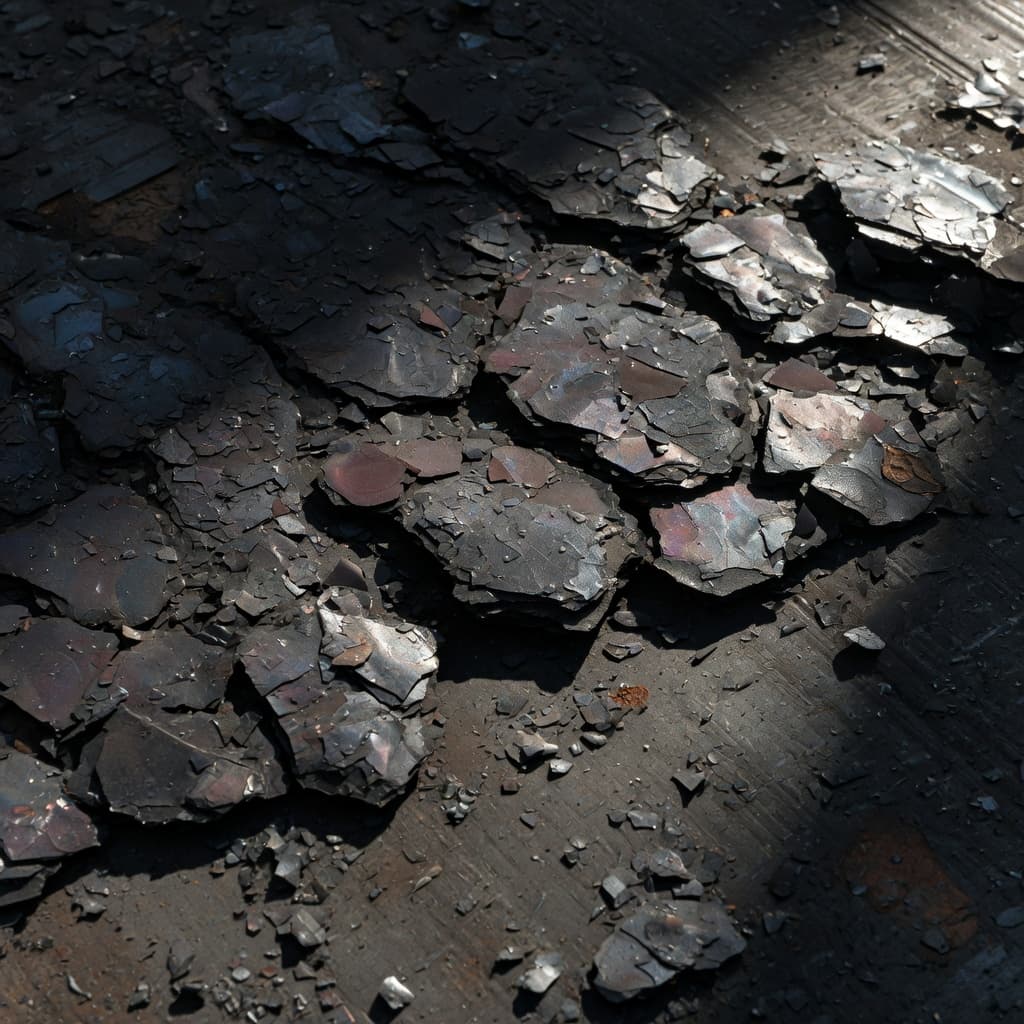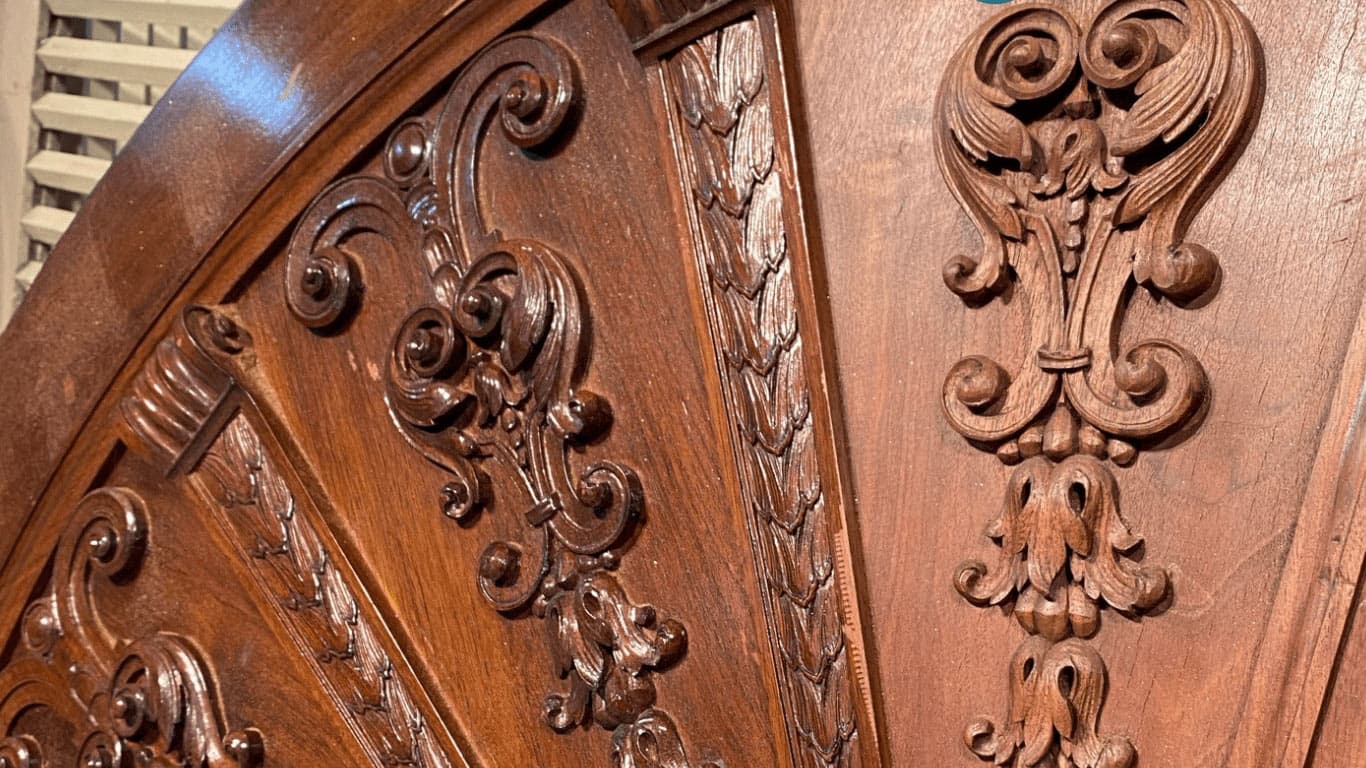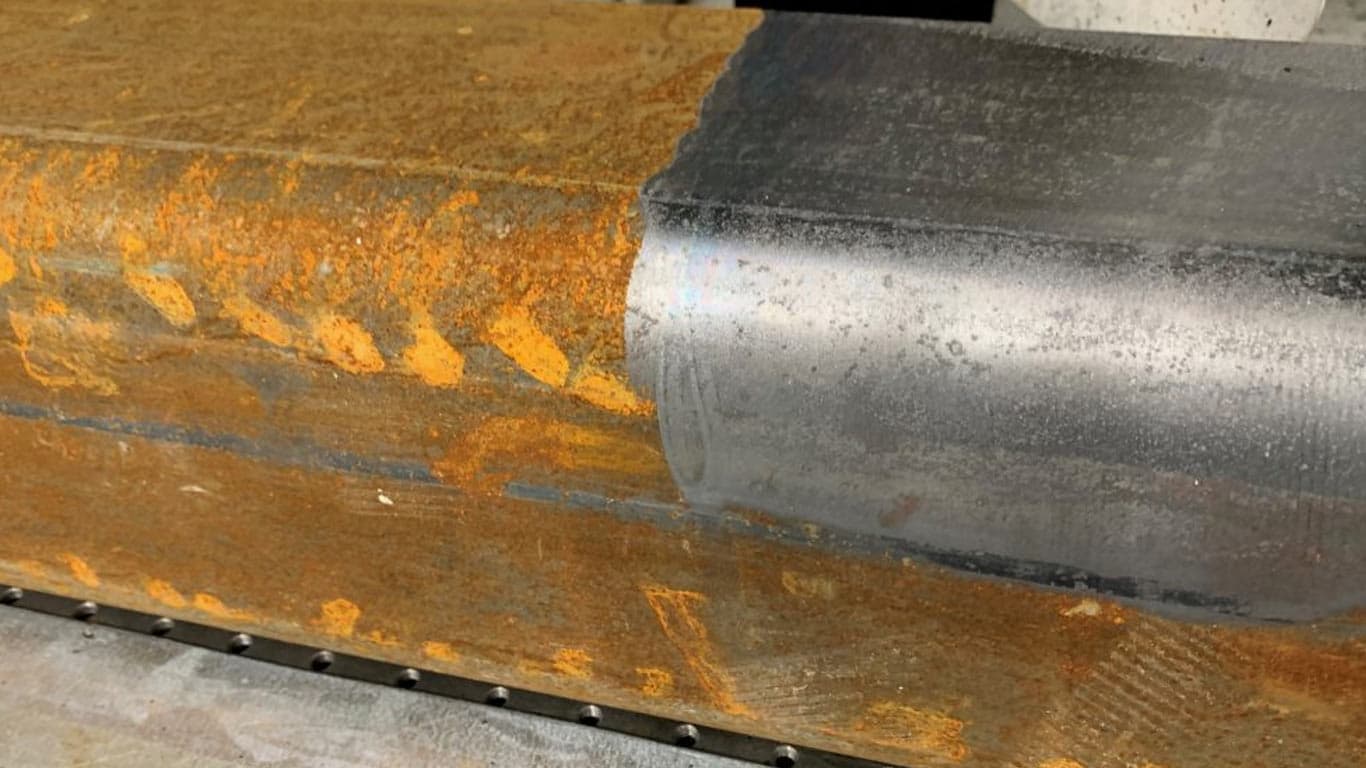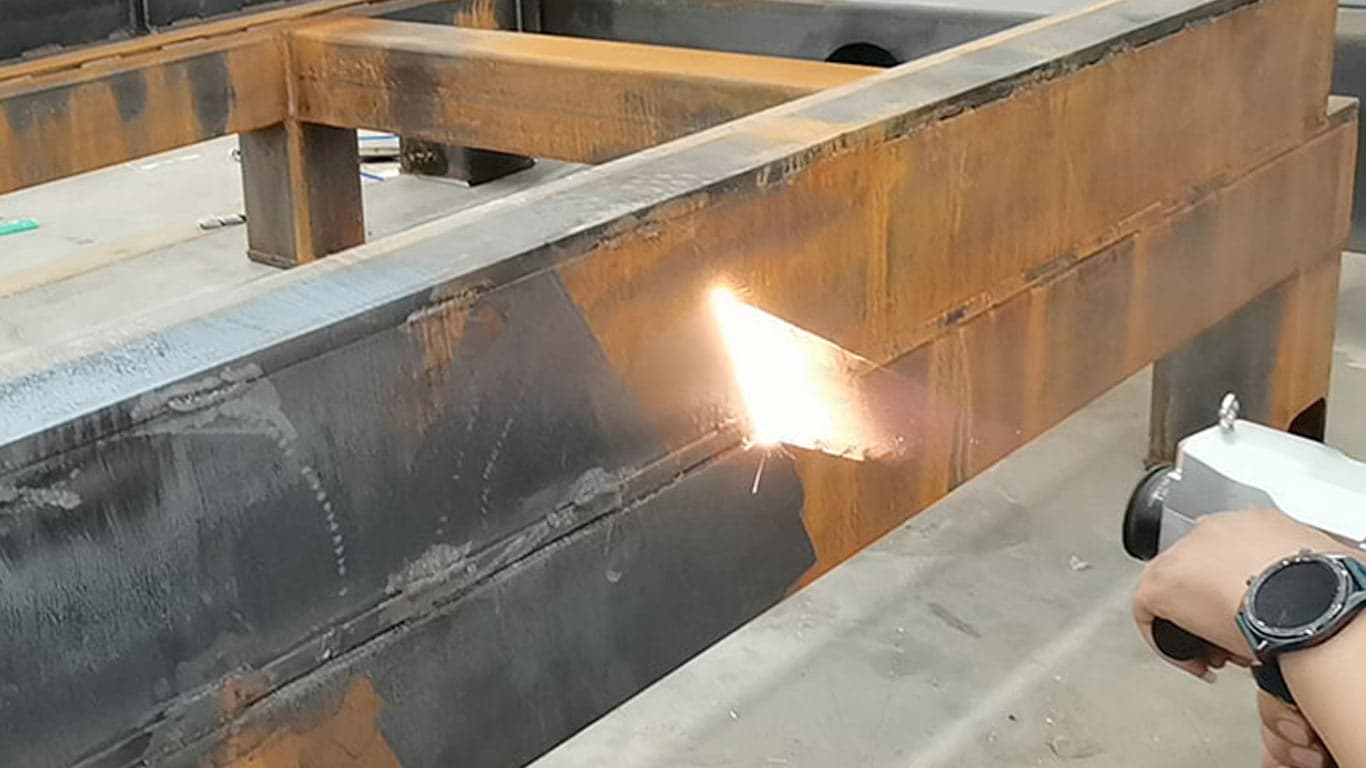

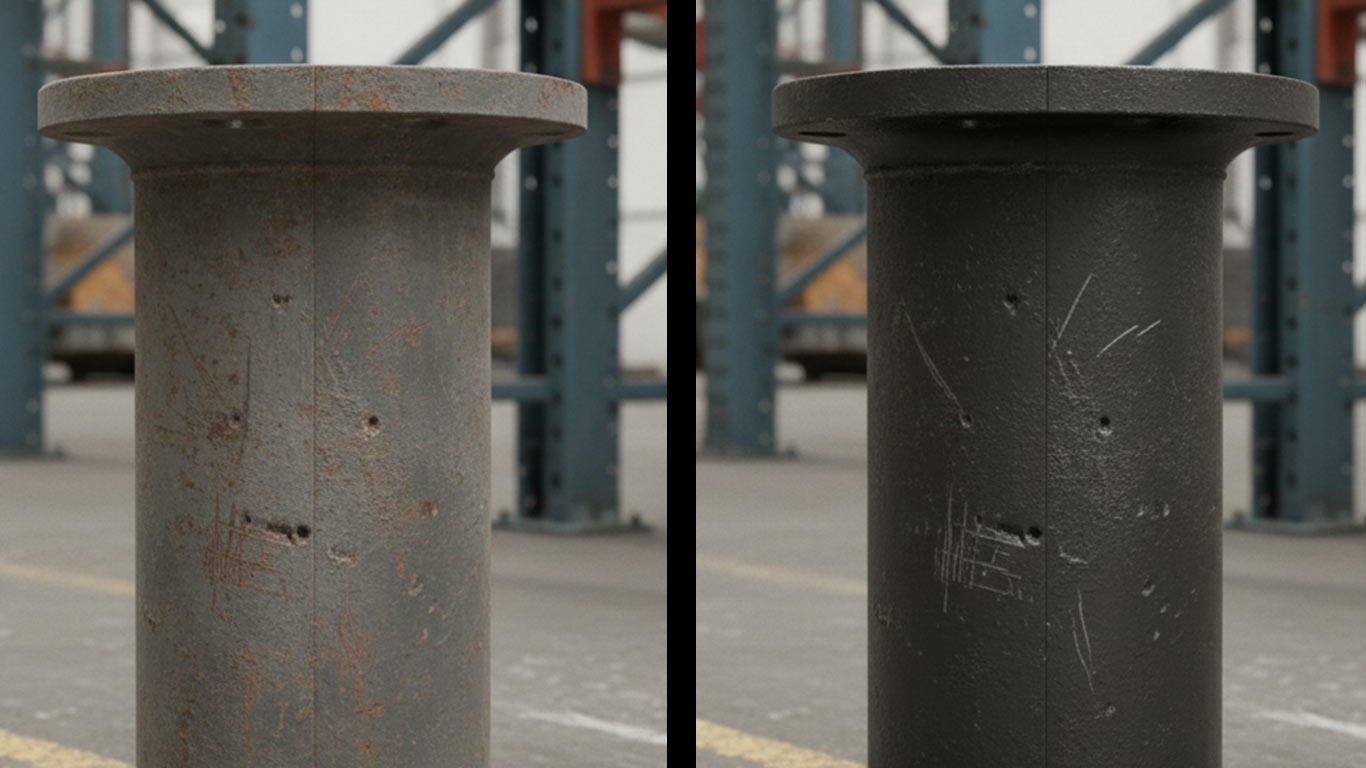

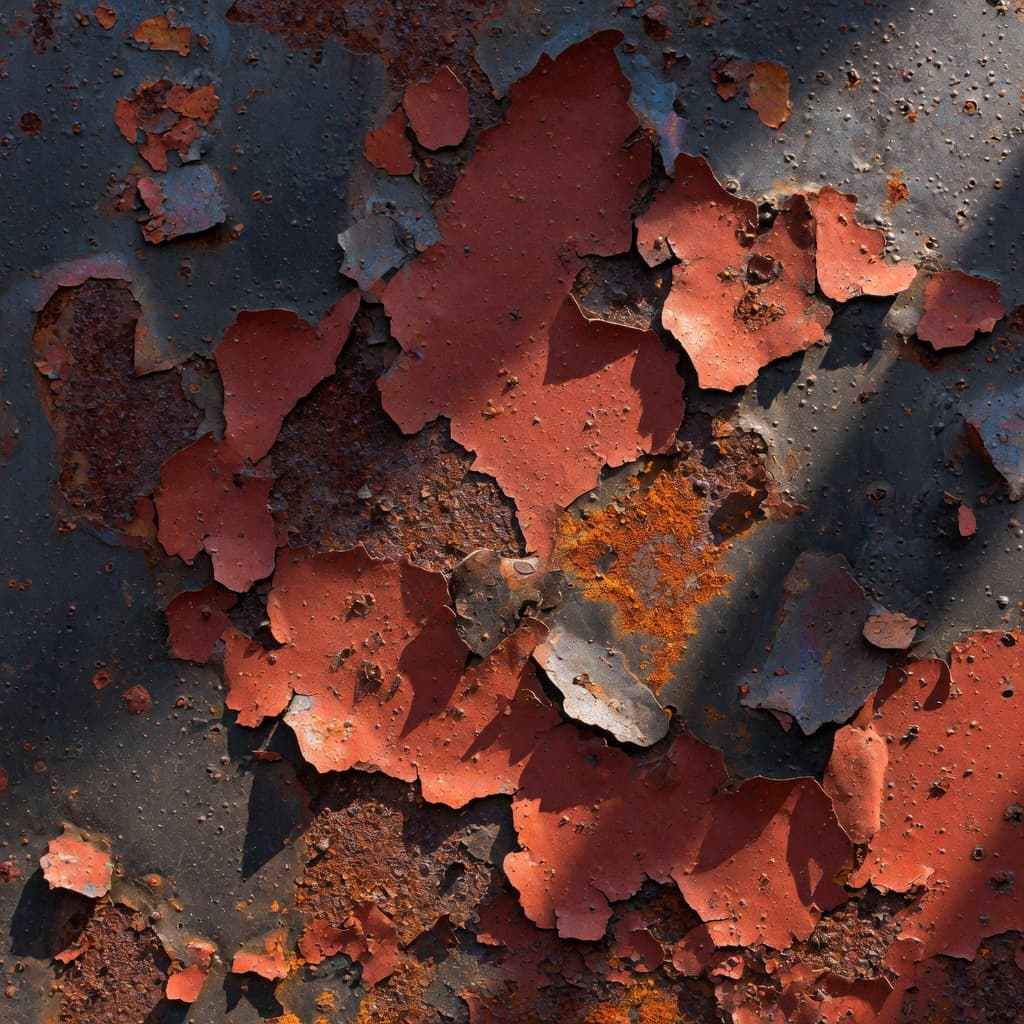
Cast Iron surface undergoing laser cleaning showing precise contamination removal
Ikmanda Roswati
Ikmanda RoswatiPh.D.Indonesia
Ultrafast photonics and laser-matter interaction
Published
Jan 6, 2026

Cast Iron Laser Cleaning

Laser cleaning strips rust and foundry scale from gray and ductile cast iron without disturbing the graphite matrix that gives the metal its strength. Cast iron holds the narrowest safe window of the common ferrous alloys — gray iron's graphite flakes expand at 27 µm/m·K, 2.25 times the iron matrix, so heating past a 0.4 J/cm² threshold triggers graphite pullout. Held at an operating 1.5 J/cm², a pulsed fiber laser clears corrosion for Bay Area foundries and shops with none of the blast-media porosity abrasive methods leave — measured surface roughness drops from 55.45 µm on a rusted casting to 1.29 µm after cleaning.

How to Laser Clean Cast Iron

1Assess graphite type and oxide depth
  • Gray iron (lamellar graphite) and ductile iron (nodular graphite) respond differently under rapid thermal cycling — lamellar graphite acts as stress concentrators that propagate micro-cracks if energy level exceeds the safe ceiling, while nodular graphite tolerates marginally more energy.
  • Confirm contamination before parameter selection: surface rust responds differently from oil-impregnated graphite matrix — oil saturation requires lower energy level and higher pass count to prevent thermal decomposition products from driving deeper into the porous structure.
2Test on a small area first
  • Lamellar graphite in gray cast iron pulls out above ~2.2 J/cm², leaving permanent surface voids; Z-Beam operates at 1.5 J/cm², maintaining the 0.7 J/cm² headroom that defines the narrowest safe cleaning window of any ferrous metal.
  • Pulse length, cleaning speed, beam overlap, and pass count all interact on cast iron — advancing incrementally across all settings is required, not just increasing power level; a single parameter overshoot can cause graphite pullout across the entire test area.
3Book a Z-Beam cast iron assessment
  • Z-Beam provides on-site coupon validation on representative cast iron sections before any production commitment; Bay Area foundry equipment, pump housings, and historic architectural ironwork are served on-site via Netalux Kamino 300.
  • Each cast iron scope produces a compliance log with Cal/OSHA fume pathway confirmation, documenting iron oxide fume controls and ventilation verification for enclosed or limited-air-exchange foundry and industrial environments.

Regulatory Standards

Cal/OSHA Title 8 §5155 sets the iron oxide fume Permissible exposure limit (PEL) at 5 mg/m³ (time-weighted average) — half the federal OSHA threshold — making Bay Area cast iron laser cleaning subject to stricter exposure controls than most other US states. Graphite dust carries a Cal/OSHA nuisance-dust classification; however, graphite is electrically conductive and can damage electronics, so HEPA extraction with conductive filters is required in enclosed spaces.

FAQ

  • Why does gray cast iron have a narrower laser cleaning window than carbon steel?

    Gray cast iron contains lamellar graphite flakes that act as localized energy absorbers — graphite's absorption coefficient at 1064 nm is significantly higher than the iron matrix, creating thermal hot spots at flake boundaries that can initiate micro-cracks under excessive energy level. Carbon steel has a more uniform microstructure without these localized absorption concentrators. The practical effect is that gray cast iron requires conservative energy level in the 1.5–2.8 J/cm² range (operating point 2.8 J/cm²) with close monitoring for surface change, versus carbon steel which tolerates a wider window. Ductile iron (nodular graphite) is more tolerant than gray iron and allows marginally higher energy level per pass.

  • Does laser cleaning change the surface hardness of cast iron?

    At operating energy level of 1.5–2.8 J/cm² with 100 ns pulses, nanosecond laser cleaning removes surface oxide and contamination without inducing the thermal cycle depth that causes martensite transformation in cast iron. The concern is localized heating at graphite flake boundaries — if energy level exceeds the operating ceiling, those zones can develop altered microstructure. Fogbekene et al. (2018) documented Ra surface roughness improvement from 55.45 µm (rusted surface) to 1.29 µm after laser cleaning, with no reported hardness change at conservative settings. A hardness test on a representative coupon before production cleaning is best practice.

  • Can laser cleaning preserve the seasoning layer on cast iron cookware?

    ASTM A48 gray iron grades (20B, 30B, 40B) differ in graphite flake size and distribution, and a 1064 nm fiber laser set to 0.4–0.6 J/cm² ablates seasoning and oxide without disturbing the graphite matrix. Operating at 1.5–2.0 J/cm² removes rust and oxide but also strips seasoning. For cookware restoration, the correct approach is — laser cleaning removes the rust completely, then the piece is re-seasoned from scratch. Attempting to preserve existing seasoning by reducing energy level below the rust removal threshold leaves incomplete cleaning and uneven surface texture.

  • What fume extraction is required for cast iron laser cleaning in California?

    Cal/OSHA Title 8 §5155 sets the iron oxide fume PEL at 5 mg/m³ TWA — half the federal OSHA ceiling of 10 mg/m³ (OSHA 1910.1000 Table Z-1). HEPA extraction at the cleaning head is required; graphite dust generated from cast iron is electrically conductive and requires conductive-rated filters to prevent filter damage and static discharge risk. In enclosed spaces, Ventilation with P100 respiratory protection is mandatory. Bay Area Air Quality Management District (BAAQMD) Rule 11 applies to facilities above permitted emission thresholds in Alameda, Contra Costa, and San Francisco counties — confirm applicable permit thresholds with your EHS team before starting any enclosed-space cast iron cleaning operation.

Fluence (J/cm²)Stainless Steel1.2 J/cm²12.0 J/cm²Cast Iron1.5 J/cm²15.0 J/cm²Iron1.5 J/cm²15.0 J/cm²Steel1.5 J/cm²15.0 J/cm²0 J/cm²5 J/cm²10 J/cm²15 J/cm²20 J/cm²
  • This material (highlighted)
  • Other materials in this group

Machine Settings

Cast iron is the most technically constrained ferrous material for laser cleaning. Gray iron's graphite flakes expand along their c-axis at 27 µm/m·K — 2.25 times the iron matrix — generating grain boundary shear stress that causes graphite pullout above 0.4 J/cm² — a margin so narrow it rewards a tunable-pulse MOPA source like the JNCT 100W, whose independently adjustable 10–350 ns pulse strips cast-iron rust where a fixed-pulse cleaner would scorch the surface. Pulsed 1064 nm fiber laser at 1.5 J/cm² removes rust and foundry scale from gray iron, ductile iron, and cast iron pipe without disturbing the graphite network.

WavelengthCast Iron · ferrousCast Iron1.1k nmIron1.1k nmStainless Ste…1.1k nmSteel1.1k nm0.005001.0k1.5kThis materialOther materials in subcategory
Spot SizeCast Iron · ferrousCast Iron200 μmSteel250 μmIron200 μmStainless Ste…200 μm0.00100200300This materialOther materials in subcategory
FluenceCast Iron · ferrousCast IronSteel2.50 J/cm²Stainless Ste…1.50 J/cm²Iron0.001.002.003.00This materialOther materials in subcategory
Pulse WidthCast Iron · ferrousCast Iron50.0 nsStainless Ste…50.0 nsIron30.0 nsSteel20.0 ns0.0020.040.060.0This materialOther materials in subcategory
FrequencyCast Iron · ferrousCast Iron100 kHzSteel80.0 kHzStainless Ste…50.0 kHzIron30.0 kHz0.0050.0100150This materialOther materials in subcategory
Scan SpeedCast Iron · ferrousCast Iron2.0k mm/sIron2.0k mm/sStainless Ste…2.0k mm/sSteel2.0k mm/s0.005001.0k1.5k2.0k2.5kThis materialOther materials in subcategory
Overlap RatioCast Iron · ferrousCast Iron60.0 %Iron70.0 %Steel60.0 %Stainless Ste…50.0 %0.0020.040.060.080.0This materialOther materials in subcategory
Pass CountCast Iron · ferrousCast Iron2.00 passesStainless Ste…3.00 passesIron2.00 passesSteel2.00 passes0.001.002.003.004.00This materialOther materials in subcategory
Laser PowerCast Iron · ferrousCast Iron100 WIron100 WStainless Ste…100 WSteel100 W0.0050.0100150This materialOther materials in subcategory
Power (Alt.)Cast Iron · ferrousCast Iron200 WIron200 WStainless Ste…200 WSteel200 W0.0050.0100150200250This materialOther materials in subcategory

Laser-Material Interaction

Gray iron has the narrowest safe cleaning window of the common iron alloys — 0.4 J/cm² — making these parameters the validated operating zone, not a starting point for adjustment: 100 W, 100 kHz, 2000 mm/s cleaning speed, 60% beam overlap, 2 passes (ASTM A48, internal testing 2026-03-27). An energy level increase that is inconsequential on wide-margin structural steel or the more forgiving aluminum window will trigger graphite pullout on gray iron.

Ablation ThresholdCast Iron · ferrousCast Iron1.50 J/cm²Iron1.50 J/cm²Steel1.50 J/cm²Stainless Ste…1.20 J/cm²0.000.501.001.502.00This materialOther materials in subcategory
Damage ThresholdCast Iron · ferrousCast Iron15.0 J/cm²Iron15.0 J/cm²Steel15.0 J/cm²Stainless Ste…12.0 J/cm²0.005.0010.015.020.0This materialOther materials in subcategory
Laser AbsorptionCast Iron · ferrousCast IronSteel0.45 ratio (0–1)Iron0.35 ratio (0–1)Stainless Ste…0.35 ratio (0–1)0.000.100.200.300.400.50This materialOther materials in subcategory
Laser ReflectivityCast Iron · ferrousCast IronStainless Ste…0.65 ratio (0–1)Iron0.62 ratio (0–1)Steel0.58 ratio (0–1)0.000.200.400.600.80This materialOther materials in subcategory
AbsorptivityCast Iron · ferrousCast IronSteel0.42 ratio (0–1)Iron0.35 ratio (0–1)Stainless Ste…0.35 ratio (0–1)0.000.100.200.300.400.50This materialOther materials in subcategory
ReflectivityCast Iron · ferrousCast IronIron0.65 ratio (0–1)Stainless Ste…0.62 ratio (0–1)Steel0.55 ratio (0–1)0.000.200.400.600.80This materialOther materials in subcategory
Absorption CoefficientCast Iron · ferrousCast IronSteel52000.0k m⁻¹Stainless Ste…47200.0k m⁻¹Iron630.0k m⁻¹0.0020000.0k40000.0k60000.0kThis materialOther materials in subcategory
Thermal ConductivityCast Iron · ferrousCast IronIron80.2 W/m·KSteel50.0 W/m·KStainless Ste…16.2 W/m·K0.0020.040.060.080.0100This materialOther materials in subcategory
Thermal DiffusivityCast Iron · ferrousCast IronIron0.00 m²/sSteel0.00 m²/sStainless Ste…0.00 m²/s0.000.010.010.01This materialOther materials in subcategory
Specific HeatCast Iron · ferrousCast IronStainless Ste…500 J/kg·KSteel490 J/kg·KIron449 J/kg·K0.00200400600This materialOther materials in subcategory
Thermal ExpansionCast Iron · ferrousCast IronStainless Ste…17.3 K^{-1}Steel12.0 K^{-1}Iron0.00 K^{-1}0.005.0010.015.020.0This materialOther materials in subcategory
Thermal DestructionCast Iron · ferrousCast IronIron1.8k KStainless Ste…1.7k KSteel1.7k K0.005001.0k1.5k2.0kThis materialOther materials in subcategory
Destruction PointCast Iron · ferrousCast IronIron1.8k KStainless Ste…1.4k KSteel1.4k K0.005001.0k1.5k2.0kThis materialOther materials in subcategory
Thermal Shock ResistanceCast Iron · ferrousCast IronStainless Ste…132 MPa√mIron1.20 MPa√mSteel0.0050.0100150This materialOther materials in subcategory
Vapor PressureCast Iron · ferrousCast IronStainless Ste…0.01 PaSteel0.01 PaIron0.00 Pa0.000.010.010.01This materialOther materials in subcategory
Laser-Material Interaction Sources(2 references)
  1. post-CW CO2 laser cleaning; baseline corroded surface was 55.41 µm Ra (Fogbekene et al. 2018)

    Fogbekene et al. Fogbekene et al., Laser Cleaning of Grey Cast Iron Automotive Brake Disc, 2018
  2. graphite c-axis thermal expansion coefficient; a-axis is -1.5 µm/m·K (contracts); iron-ferrite matrix ~11.8 µm/m·K (Kindle-tech 2025)

    Kindle-tech 2025. Kindle-tech 2025, What Is The Thermal Expansion Coefficient Of Graphite?

Material Characteristics

Graphite flakes in gray iron expand along their c-axis at 27 µm/m·K — 2.25 times the iron-ferrite matrix rate of ~11.8 µm/m·K — generating interfacial shear stress at grain boundaries when laser heating exceeds the 0.4 J/cm² threshold. Because that shear stress concentrates at the flake boundaries, the graphite network — not the iron matrix — sets the cleaning ceiling, a constraint with no equivalent in steel laser cleaning.

DensityCast Iron · ferrousCast Iron7.15 g/cm³Stainless Ste…8.0k g/cm³Iron7.9k g/cm³Steel7.8k g/cm³0.002.0k4.0k6.0k8.0k10.0kThis materialOther materials in subcategory
HardnessCast Iron · ferrousCast Iron224 HVIron80.0 HVSteel15.0 HVStainless Ste…2.15 HV0.0050.0100150200250This materialOther materials in subcategory
Tensile StrengthCast Iron · ferrousCast IronStainless Ste…505 MPaSteel480 MPaIron350 MPa0.00200400600This materialOther materials in subcategory
Young's ModulusCast Iron · ferrousCast IronIron211 GPaSteel200 GPaStainless Ste…193 GPa0.0050.0100150200250This materialOther materials in subcategory
Fracture ToughnessCast Iron · ferrousCast Iron13.0 MPa m^{1/2}Stainless Ste…100 MPa m^{1/2}Iron65.0 MPa m^{1/2}Steel0.0050.0100150This materialOther materials in subcategory
Flexural StrengthCast Iron · ferrousCast IronStainless Ste…530 MPaIron275 MPaSteel0.00200400600This materialOther materials in subcategory
Compressive StrengthCast Iron · ferrousCast IronStainless Ste…505 MPaIron350 MPaSteel0.00200400600This materialOther materials in subcategory
Oxidation ResistanceCast Iron · ferrousCast IronSteel150 index (0–1)Stainless Ste…10.0 index (0–1)Iron0.00 index (0–1)0.0050.0100150200This materialOther materials in subcategory
Corrosion ResistanceCast Iron · ferrousCast IronSteel2.50 index (0–1)Stainless Ste…0.80 index (0–1)Iron-0.44 index (0–1)0.001.002.003.00This materialOther materials in subcategory
Laser Damage ThresholdCast Iron · ferrousCast Iron15.0 J/cm²Iron15.0 J/cm²Steel15.0 J/cm²Stainless Ste…12.0 J/cm²0.005.0010.015.020.0This materialOther materials in subcategory
PorosityCast Iron · ferrousCast Iron0.10 fraction (0–1)Iron0.00 fraction (0–1)Stainless Ste…0.00 fraction (0–1)Steel0.000.050.100.15This materialOther materials in subcategory
Electrical ResistivityCast Iron · ferrousCast IronStainless Ste…0.00 Ω·mIron0.00 Ω·mSteel0.00 Ω·m0.000.010.010.01This materialOther materials in subcategory
Electrical ConductivityCast Iron · ferrousCast IronIron10300.0k S/mSteel6990.0k S/mStainless Ste…1390.0k S/m0.005000.0k10000.0k15000.0kThis materialOther materials in subcategory
Melting PointCast Iron · ferrousCast IronIron1.8k KStainless Ste…1.4k KSteel1.4k K0.005001.0k1.5k2.0kThis materialOther materials in subcategory
Boiling PointCast Iron · ferrousCast IronIron3.1k KSteel2.9k KStainless Ste…2.8k K0.001.0k2.0k3.0k4.0kThis materialOther materials in subcategory
Surface RoughnessCast Iron · ferrousCast IronIron1.20 μmSteel1.20 μmStainless Ste…0.80 μm0.000.501.001.50This materialOther materials in subcategory
Material Characteristics Sources(1 reference)
  1. 93 HV corroded surface; 224 HV un-corroded baseline; 235 HV post-CW CO2 laser (Fogbekene et al. 2018)

    Fogbekene et al. Fogbekene et al., Laser Cleaning of Grey Cast Iron Automotive Brake Disc, ResearchGate, 2018
Technical Reference — Cast Ironliterature-sourced
ParameterValue
Equipment operating range1.5–3.5 J/cm² (Moderate contamination)
Operating point (20% below ceiling)2.8 J/cm²
Cal/OSHA TWA5 mg/m³

When Laser Cleaning Does Not Work

ConditionConsequence
Iron oxide fume from heavy rust scale without extractionHard stopFe2O3 fume inhalation risk; Cal/OSHA PEL exceeded in confined spaces without extraction
Surface micro-cracking at graphite flake boundaries from excessive fluence on grey cast ironCrack initiation points at graphite flake boundaries reduce fatigue life under cyclic loading

Compliance · Bay Area + California

ContaminantBAAQMD Permit
Iron OxideNot required

Process Window — Cast Iron

Surface ConditionFloor (J/cm²)Ceiling (J/cm²)Window (J/cm²)Safety %
No literature fluence data in research briefs — using equipment operating ranges. Cast iron graphite microstructure creates localized energy absorption at flake boundaries — conservative operating point preferred for grey iron. Moderate range standard.1.53.5220%
Sources(11 references)
  1. "The roughness of the laser cleaned surface was, 1.29μm while the rusted surface comprised of 55.45μm (Ra (surface roughness))."

    Fogbekene. Fogbekene, T. et al. Laser Cleaning of Grey Cast Iron Automotive Brake Disc: Rust Removal and Improvement in Surface Integrity. ResearchGate (2018).
  2. "Iron oxide fume... 10 [mg/m³ Time-weighted average (TWA) ceiling]"

    U. U.S. Occupational Safety and Health Administration. 29 CFR 1910.1000 TABLE Z-1 — Limits for Air Contaminants.
  3. "Gray iron castings... classified on the basis of the tensile strength of the iron in separately cast test bars." Grades 20B, 30B, 40B differ in graphite flake size and distribution.

    ASTM International. ASTM International. ASTM A48/A48M-22: Standard Specification for Gray Iron Castings. ASTM International, West Conshohocken, PA.
  4. Empirical Study of Laser Cleaning of Rust, Paint, and Mill Scale from Steel Surface (Deschênes & Fraser, Materials Processing Fundamentals 2020). (opens in new tab)
  5. Wavelength dependence of picosecond-pulsed laser ablation of hot-dip galvanized steel, Applied Physics A, 2022. (opens in new tab)
  6. Laser cleaning of 20 steel: rust removal vs substrate damage, Appl. Sci. 2024, 14(5):2058. (opens in new tab)
  7. Parameters and surface performance of laser removal of rust layer on A3 steel. Surface and Coatings Technology, 166(1), pp. 10-16 (2003). )00736-3 (opens in new tab)
  8. Laser effects based optimal laser parameter identifications for paint removal from metal substrate at 1064 nm: a multi-pulse model, Journal of Modern Optics, 2017. Journal of Modern Optics, 64(19), pp. 1947-1959 (2017). (opens in new tab)
  9. MatWeb Material Property Data — Online Materials Information Resource (opens in new tab)
  10. Steen & Mazumder, Laser Material Processing, 4th ed., Springer, 2010. Springer (London) (2010). (opens in new tab)
  11. graphite c-axis thermal expansion coefficient; a-axis is -1.5 µm/m·K (contracts); iron-ferrite matrix ~11.8 µm/m·K (Kindle-tech 2025)

    Kindle-tech 2025. Kindle-tech 2025, What Is The Thermal Expansion Coefficient Of Graphite?
I would highly recommend Z-Beam to anyone facing a difficult restoration project.
Eric WoodView all testimonials