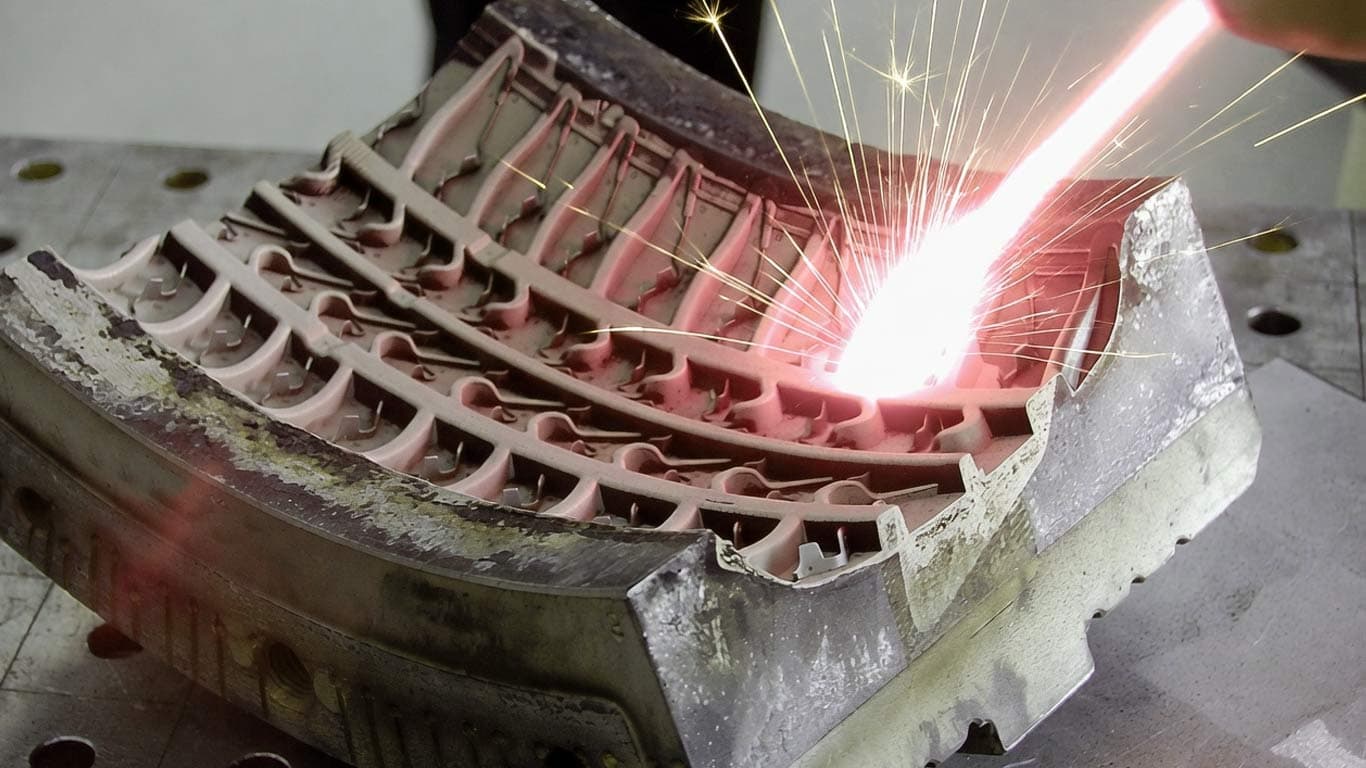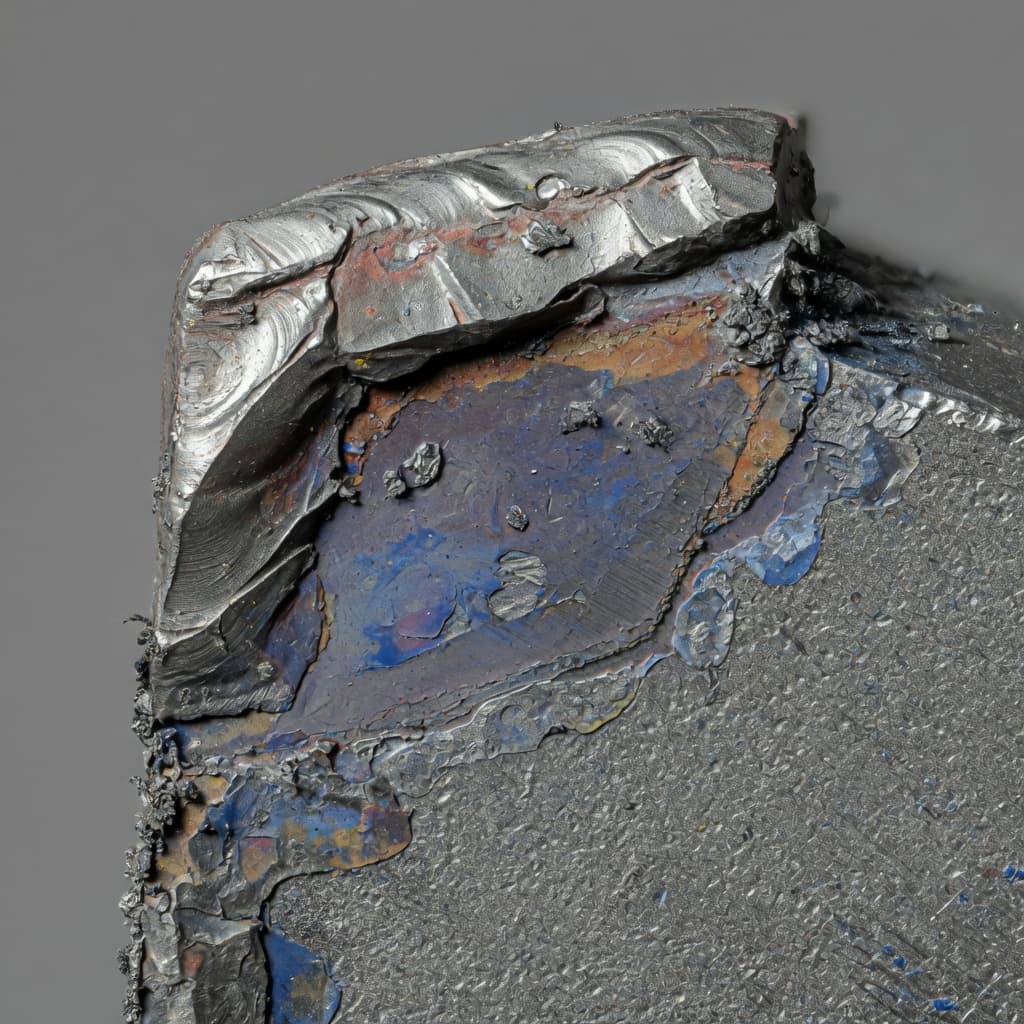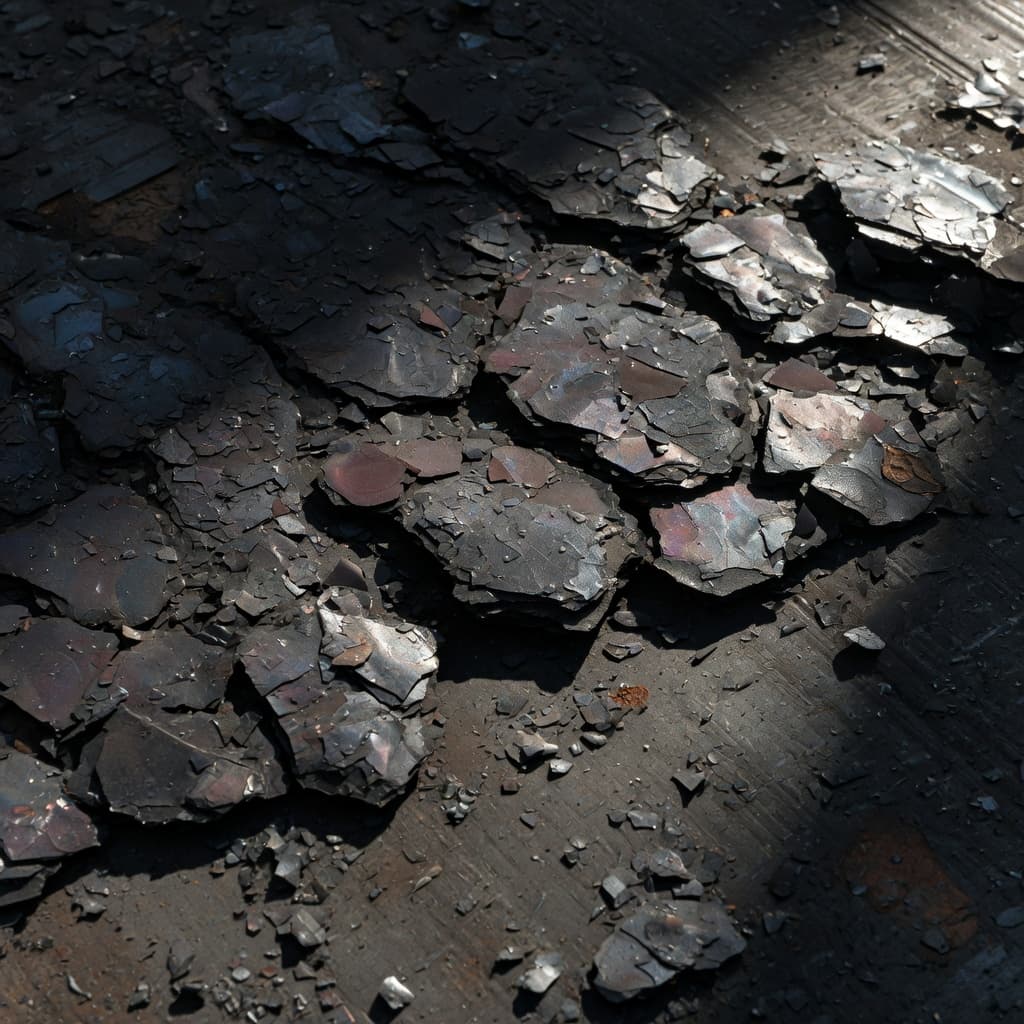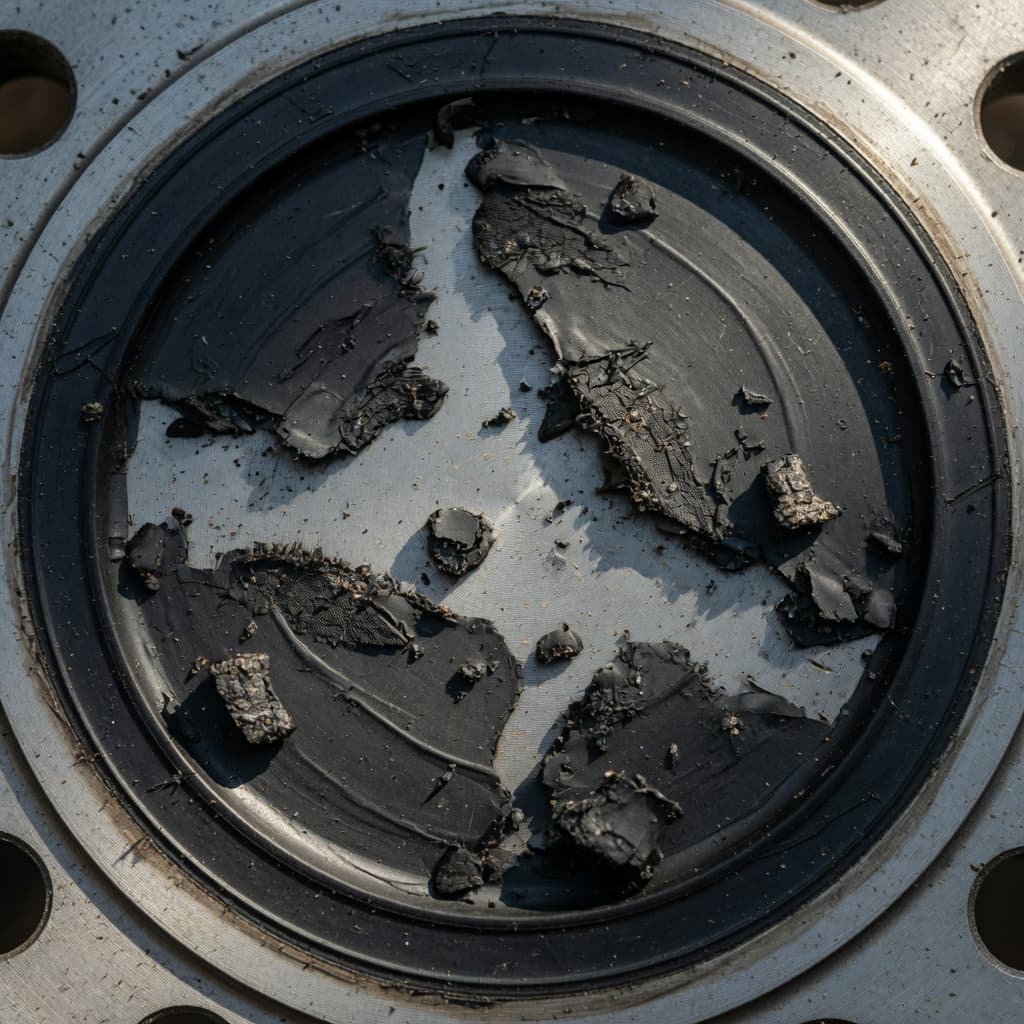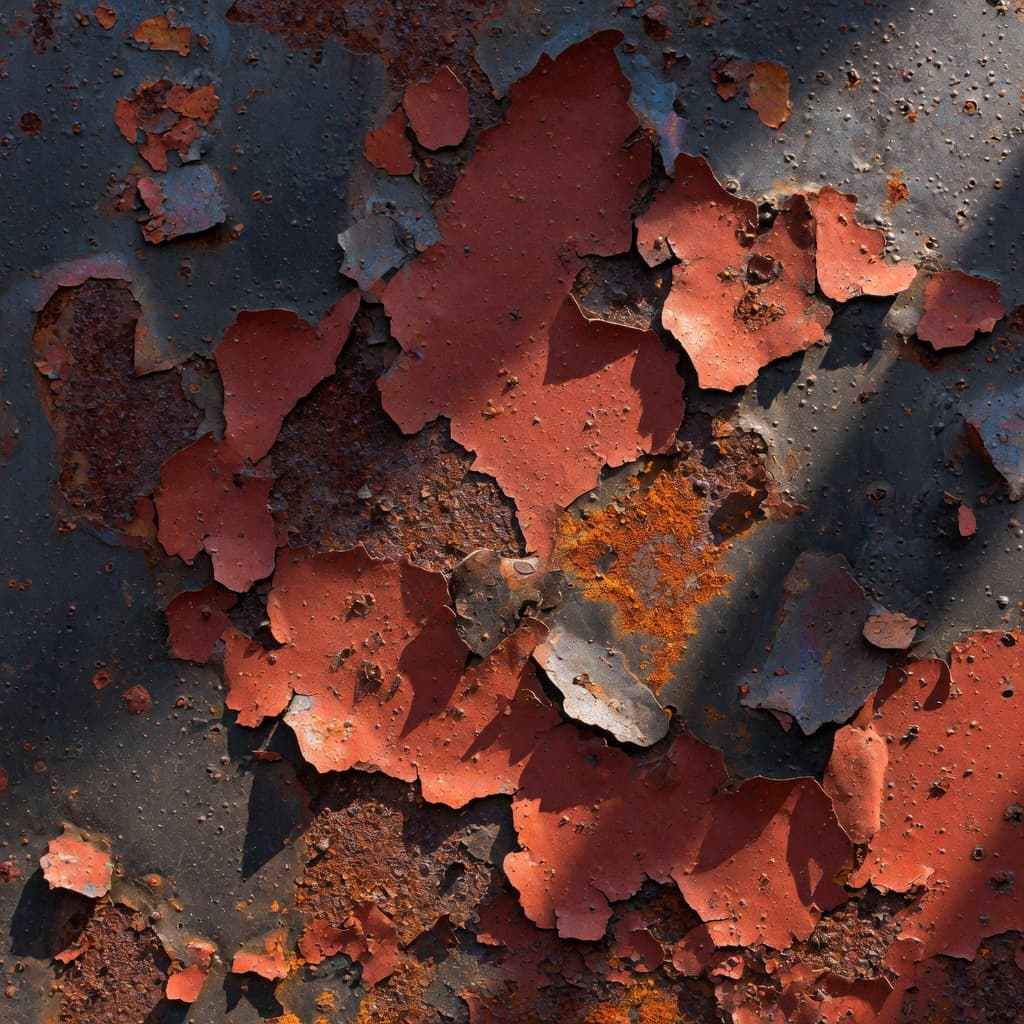

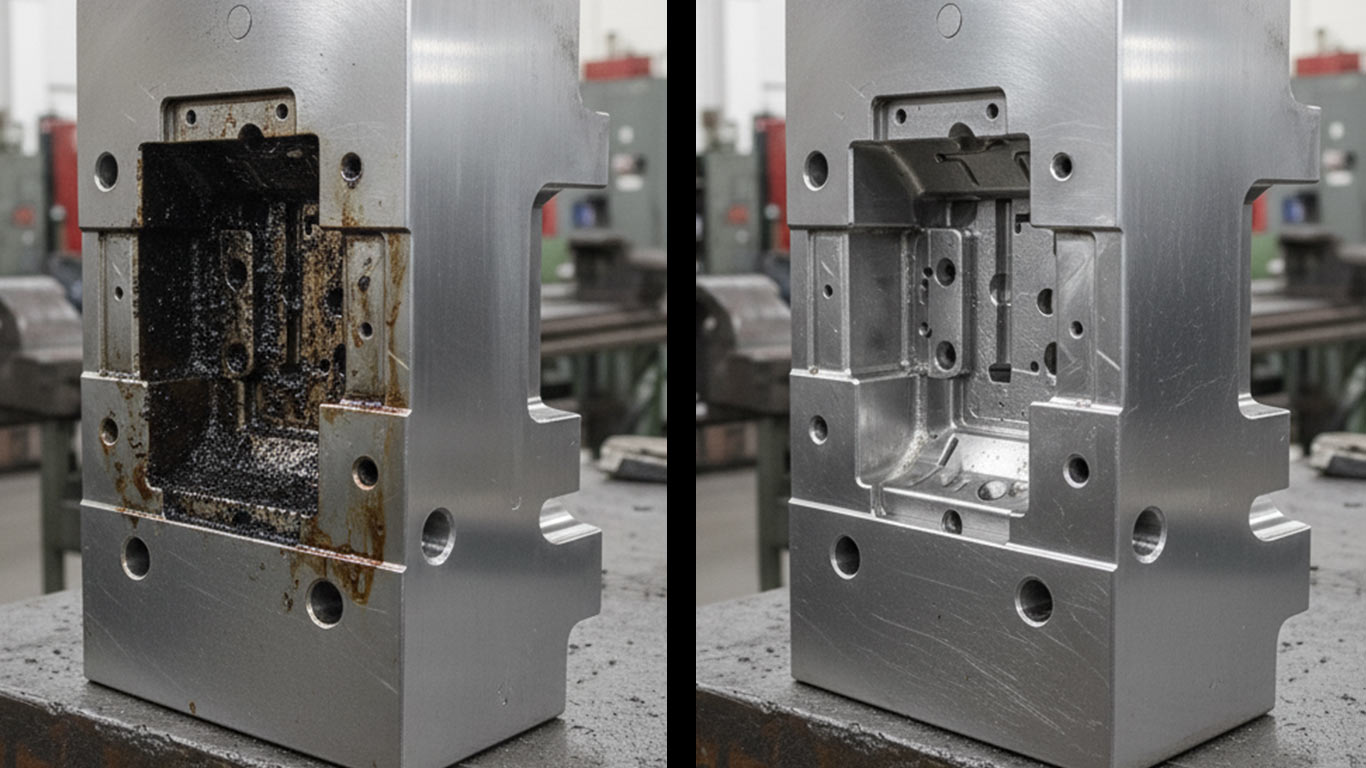

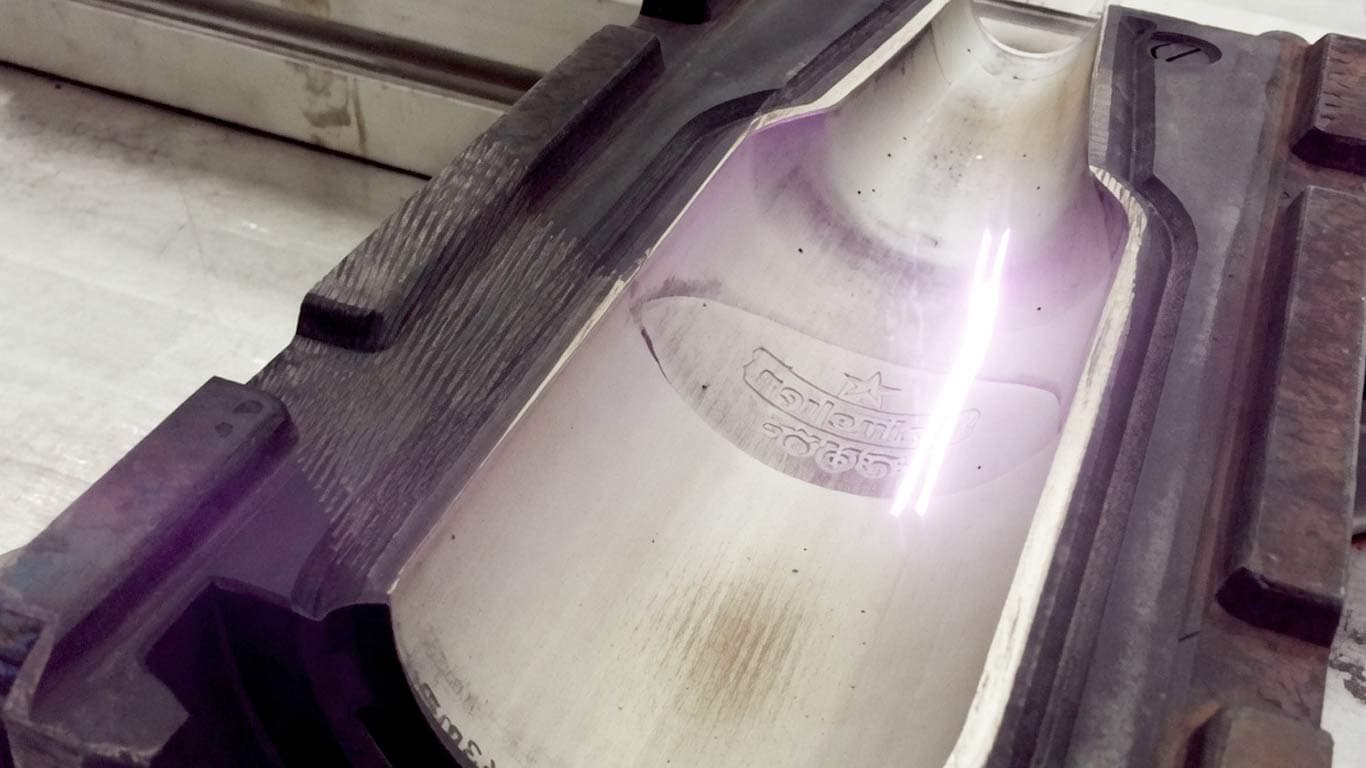
Tool Steel surface undergoing laser cleaning showing precise contamination removal
Alessandro Moretti
Alessandro MorettiPh.D.Italy
Materials process development for ceramics and alloys
Published
Jan 6, 2026

Tool Steel Laser Cleaning

Tool steel is where temper temperature, not damage threshold, governs what's safe. D2 cold-work die steel has a temper limit around 150°C — a single aggressive cleaning pass that pushes surface temperature above that threshold causes martensite softening, and a die that was Rc 60 before cleaning can leave the shop measurably softer. H13 hot-work steel is far more forgiving (530°C+ temper), but D2, M2, and W-series water-hardening grades each have their own thermal budget.

How to Laser Clean Tool Steel by Grade

1Identify steel grade and temper limit
  • Specify grade before setting parameters — D2 cold-work die steel has a ~150°C temper limit requiring the most conservative settings (0.8–1.2 J/cm², 10–15 ns pulse), while H13 hot-work steel tolerates up to 1.8 J/cm² with its 530°C+ limit.
  • Identify contamination — carbonized polymer buildup from injection molding, mold release agent (zinc stearate), or surface oxide — and confirm dimensional tolerance requirements; precision mold cavities often hold ±0.01 mm.
2Run grade-specific test passes
  • Martensite softening is the failure mode — D2 at 60 HRC can lose measurable hardness if the 150°C temper limit is exceeded during cleaning; this occurs without visible surface change and is detected only by portable Rockwell spot-check after cleaning.
  • Use 10–15 ns pulses on D2 to limit heat diffusion depth and keep surface temperature below the 150°C limit; confirm no micro-cracking after each pass with raking light inspection before advancing energy.
3Z-Beam mold and die service
  • Z-Beam provides a tempering temperature compliance record confirming cleaning stayed below the grade-specific temper threshold — each job includes post-cleaning portable Rockwell hardness verification data for D2, H13, and M2 grades.
  • Z-Beam serves Bay Area injection molders, die casters, stamping shops, and precision mold builders for on-site mold cleaning between production runs without disassembly or chemical exposure risk to hardened cavity surfaces.

Regulatory Standards

Laser cleaning tool steel produces fine metallic and alloy particulates (vanadium, chromium, tungsten). Use ventilation with HEPA filtration. Alloy dust may be hazardous; consult MSDS. Tool steel reflects 65-70% of 1064 nm energy. Use full beam enclosure and laser safety eyewear for 1064 nm (OD 5+). Follow ANSI Z136.1. Primary hazard is temper softening without visible indication. Hardness spot-check after cleaning. D2 most sensitive (150°C). H13 and M2 tolerate higher thermal input.

FAQ

  • How do you preserve the temper of D2 tool steel during laser cleaning?

    D2 tool steel has a temper limit of 150°C — if the surface exceeds that during cleaning, the martensite softens and hardness is lost permanently. Conservative multi-pass cleaning at lower energy stays safer than a single aggressive pass. D2 requires slightly more energy input than plain steel because it absorbs less laser energy. A portable hardness check after cleaning confirms temper was not affected — this is standard practice on any hardened tool steel job.

  • Does laser cleaning restore hardness to tool steel surfaces?

    H13 tool steel (AISI H13) runs HRC 44–50 in service; D2 reaches HRC 58–62 — both ASTM A681 grades tolerate laser cleaning at 0.5–1.0 J/cm² because the nanosecond pulse length deposits heat too briefly to alter the hardened microstructure. Laser cleaning does not restore hardness. If temper temperature is exceeded, martensite softens irreversibly. Re-tempering required. Prevention is critical. D2: 150°C limit. H13: 530°C. M2: 540°C. Softening occurs without visible indication. Portable Rockwell tester recommended post-cleaning.

  • Can laser cleaning remove carbide buildup from tool steel cutting inserts?

    ASTM A681 is the standard specification for tool steel alloys, and it lists the composition limits for H13, D2, and other grades that determine how each responds to 1064 nm laser cleaning of oxides and EDM recast layers. D2 is the most temperature-sensitive with a 150°C limit; H13 tolerates higher energy input with its 530°C temper; M2 falls between them. Carbide phases absorb laser energy differently than the steel matrix, so micro-topography changes must be monitored during cleaning. Never exceed the grade-specific temper limit regardless of deposit thickness.

  • What does laser cleaning cost for tool steel dies and inserts?

    Pricing for d2 die cleaning runs $20-100 per die. H13 mold cleaning: $30-150 per mold. M2 cutting tools: $2-10 per tool. Lower light absorption (0.30) means slower cleaning than plain steel. Grade verification adds setup cost. Hardness testing post-cleaning adds 10-20% to cost. D2 requires slowest cleaning (150°C limit).

  • What are the Cal/OSHA exposure limits for Chromium during laser cleaning?

    Chromium generated during laser cleaning is regulated at 5 µg/m³ Time-weighted average (TWA) under Cal/OSHA Title 8 §5155. Z-Beam provides air monitoring data and maintains exposure records for all jobs involving this contaminant in the Bay Area.

Fluence (J/cm²)Aluminum Bronze1.2 J/cm²4.0 J/cm²Tin1.2 J/cm²4.0 J/cm²Zinc1.1 J/cm²4.0 J/cm²Titanium Alloy (Ti-6Al-4V)1.1 J/cm²8.0 J/cm²Tool Steel1.4 J/cm²12.0 J/cm²Stainless Steel 3161.3 J/cm²12.0 J/cm²Stainless Steel 3041.2 J/cm²12.0 J/cm²0 J/cm²5 J/cm²10 J/cm²15 J/cm²
  • This material (highlighted)
  • Other materials in this group

Literature process windows

Ablation windows at 1064 nm that map to Tool Steel in the laser-parameters reference. Screening values from published literature — validate on coupons before production.

Machine Settings

Start with grade identification. D2 (low temper, ~150°C): use 0.8-1.2 J/cm², 10-15 ns pulse length, >600 mm/s cleaning speed. H13 (high temper, 530°C+): use up to 1.8 J/cm². M2: use 1.0-1.5 J/cm². Lower light absorption (0.30) means slightly higher energy level or slower scan than plain steel. 1064 nm wavelength. 50 ns pulse length. Cleaning speed 2000 mm/s. 50% overlap. Multi-pass at moderate energy level is safer than single-pass at elevated energy level. Never exceed grade-specific temper temperature — softening is irreversible and not visible. After cleaning, hardness spot-checks with portable Rockwell tester confirm no martensite degradation.

WavelengthTool Steel · alloyTool Steel1.1k nmAluminum Bron…1.1k nmStainless Ste…1.1k nmStainless Ste…1.1k nmTin1.1k nmTitanium Allo…1.1k nmZinc1.1k nm0.005001.0k1.5kThis materialOther materials in subcategory
Spot SizeTool Steel · alloyTool Steel200 μmAluminum Bron…200 μmTin200 μmTitanium Allo…200 μmZinc200 μmStainless Ste…150 μmStainless Ste…100 μm0.0050.0100150200250This materialOther materials in subcategory
FluenceTool Steel · alloyTool SteelStainless Ste…1.50 J/cm²Stainless Ste…0.50 J/cm²Aluminum Bron…TinTitanium Allo…Zinc0.000.501.001.502.00This materialOther materials in subcategory
Pulse WidthTool Steel · alloyTool Steel50.0 nsAluminum Bron…50.0 nsStainless Ste…50.0 nsZinc50.0 nsStainless Ste…30.0 nsTin20.0 nsTitanium Allo…20.0 ns0.0020.040.060.0This materialOther materials in subcategory
FrequencyTool Steel · alloyTool Steel50.0 kHzAluminum Bron…50.0 kHzStainless Ste…50.0 kHzZinc50.0 kHzStainless Ste…30.0 kHzTin30.0 kHzTitanium Allo…30.0 kHz0.0020.040.060.0This materialOther materials in subcategory
Scan SpeedTool Steel · alloyTool Steel2.0k mm/sStainless Ste…2.0k mm/sTitanium Allo…2.0k mm/sStainless Ste…1.5k mm/sAluminum Bron…TinZinc0.005001.0k1.5k2.0k2.5kThis materialOther materials in subcategory
Overlap RatioTool Steel · alloyTool Steel50.0 %Stainless Ste…60.0 %Stainless Ste…60.0 %Titanium Allo…60.0 %Aluminum Bron…25.0 %Tin10.0 %Zinc10.0 %0.0020.040.060.080.0This materialOther materials in subcategory
Pass CountTool Steel · alloyTool Steel2.00 passesAluminum Bron…2.00 passesStainless Ste…2.00 passesStainless Ste…2.00 passesTin2.00 passesTitanium Allo…2.00 passesZinc2.00 passes0.000.501.001.502.002.50This materialOther materials in subcategory
Laser PowerTool Steel · alloyTool Steel100 WAluminum Bron…100 WStainless Ste…100 WStainless Ste…100 WTitanium Allo…100 WZinc100 WTin45.0 W0.0050.0100150This materialOther materials in subcategory
Power (Alt.)Tool Steel · alloyTool Steel200 WAluminum Bron…200 WStainless Ste…200 WZinc150 WStainless Ste…100 WTin100 WTitanium Allo…100 W0.0050.0100150200250This materialOther materials in subcategory

Laser-Material Interaction

Q-switched pulses of 8–15 ns govern D2 tool steel cleaning because the short pulse length limits heat diffusion and keeps the surface below the 150°C temper limit — longer pulses allow conductive heat to accumulate across passes. Light absorption is 0.30 at 1064 nm — lower than plain steel. Heat spread rate is 5×10⁻⁶ m²/s and thermal conductivity is 25 W/m·K. Carbide phases enable selective removal — vanadium and tungsten carbides respond differently than the iron matrix.

Ablation ThresholdTool Steel · alloyTool Steel1.45 J/cm²Stainless Ste…1.25 J/cm²Aluminum Bron…1.20 J/cm²Stainless Ste…1.20 J/cm²Tin1.20 J/cm²Zinc1.15 J/cm²Titanium Allo…1.05 J/cm²0.000.501.001.502.00This materialOther materials in subcategory
Damage ThresholdTool Steel · alloyTool Steel12.0 J/cm²Stainless Ste…12.0 J/cm²Stainless Ste…12.0 J/cm²Titanium Allo…8.00 J/cm²Aluminum Bron…4.00 J/cm²Tin4.00 J/cm²Zinc4.00 J/cm²0.005.0010.015.0This materialOther materials in subcategory
Laser AbsorptionTool Steel · alloyTool Steel0.35 ratio (0–1)Titanium Allo…0.45 ratio (0–1)Stainless Ste…0.37 ratio (0–1)Stainless Ste…0.34 ratio (0–1)Tin0.20 ratio (0–1)Aluminum Bron…0.12 ratio (0–1)Zinc0.09 ratio (0–1)0.000.100.200.300.400.50This materialOther materials in subcategory
Laser ReflectivityTool Steel · alloyTool Steel0.68 ratio (0–1)Zinc0.72 ratio (0–1)Tin0.71 ratio (0–1)Stainless Ste…0.65 ratio (0–1)Titanium Allo…0.65 ratio (0–1)Aluminum Bron…0.01 ratio (0–1)Stainless Ste…0.01 ratio (0–1)0.000.200.400.600.80This materialOther materials in subcategory
AbsorptivityTool Steel · alloyTool Steel0.30 ratio (0–1)Stainless Ste…0.37 ratio (0–1)Titanium Allo…0.36 ratio (0–1)Stainless Ste…0.35 ratio (0–1)Zinc0.15 ratio (0–1)Tin0.08 ratio (0–1)Aluminum Bron…0.07 ratio (0–1)0.000.100.200.300.40This materialOther materials in subcategory
ReflectivityTool Steel · alloyTool Steel0.70 ratio (0–1)Tin0.92 ratio (0–1)Zinc0.85 ratio (0–1)Aluminum Bron…0.68 ratio (0–1)Stainless Ste…0.62 ratio (0–1)Stainless Ste…0.62 ratio (0–1)Titanium Allo…0.40 ratio (0–1)0.000.200.400.600.801.00This materialOther materials in subcategory
Absorption CoefficientTool Steel · alloyTool Steel50000.0k m^{-1}Tin60000.0k m^{-1}Titanium Allo…50000.0k m^{-1}Aluminum Bron…48000.0k m^{-1}Stainless Ste…47200.0k m^{-1}Stainless Ste…33000.0k m^{-1}Zinc10000.0k m^{-1}0.0020000.0k40000.0k60000.0k80000.0kThis materialOther materials in subcategory
Thermal ConductivityTool Steel · alloyTool Steel25.0 W/m·KZinc116 W/m·KTin66.8 W/m·KAluminum Bron…59.0 W/m·KStainless Ste…16.3 W/m·KStainless Ste…16.2 W/m·KTitanium Allo…6.70 W/m·K0.0050.0100150This materialOther materials in subcategory
Thermal DiffusivityTool Steel · alloyTool Steel0.00 m^2/sTitanium Allo…0.29 m^2/sZinc0.00 m^2/sTin0.00 m^2/sAluminum Bron…0.00 m^2/sStainless Ste…0.00 m^2/sStainless Ste…0.00 m^2/s0.000.100.200.300.40This materialOther materials in subcategory
Specific HeatTool Steel · alloyTool Steel480 J/kg·KTitanium Allo…523 J/kg·KStainless Ste…500 J/kg·KStainless Ste…500 J/kg·KZinc389 J/kg·KAluminum Bron…380 J/kg·KTin227 J/kg·K0.00200400600This materialOther materials in subcategory
Thermal ExpansionTool Steel · alloyTool Steel0.00 10^{-6}/KStainless Ste…17.3 10^{-6}/KZinc0.00 10^{-6}/KTin0.00 10^{-6}/KAluminum Bron…0.00 10^{-6}/KStainless Ste…0.00 10^{-6}/KTitanium Allo…0.00 10^{-6}/K0.005.0010.015.020.0This materialOther materials in subcategory
Thermal DestructionTool Steel · alloyTool Steel1.7k KTitanium Allo…1.9k KStainless Ste…1.7k KStainless Ste…1.7k KAluminum Bron…1.3k KZinc693 KTin505 K0.005001.0k1.5k2.0k2.5kThis materialOther materials in subcategory
Destruction PointTool Steel · alloyTool Steel1.7k °CTitanium Allo…1.7k °CStainless Ste…1.4k °CStainless Ste…1.4k °CAluminum Bron…1.0k °CZinc693 °CTin505 °C0.005001.0k1.5k2.0kThis materialOther materials in subcategory
Thermal Shock ResistanceTool Steel · alloyTool Steel2.50 °CTitanium Allo…637 °CAluminum Bron…210 °CStainless Ste…132 °CStainless Ste…119 °CZinc2.50 °CTin1.20 °C0.00200400600800This materialOther materials in subcategory
Vapor PressureTool Steel · alloyTool Steel1.00 PaStainless Ste…101.3k PaZinc10.0 PaTitanium Allo…3.80 PaStainless Ste…0.01 PaTin0.00 PaAluminum Bron…0.00 Pa0.0050.0k100.0k150.0kThis materialOther materials in subcategory

Material Characteristics

Tool steel's temper temperature — not its damage threshold — is the binding constraint for laser cleaning. Exceeding it softens martensite irreversibly with no visible indication until hardness testing reveals the loss. D2 temper limit is ~150°C, H13 is ~530°C, and M2 is ~540°C, so D2 tooling requires the most conservative thermal budget. Hardness reaches 60 HRC and tensile strength is 1520 MPa. Compressive strength is 1850 MPa. Thermal conductivity is 25 W/m·K and light absorption is 0.30 at 1064 nm — lower than plain carbon steel. Alloy carbides (vanadium, chromium, tungsten) create micro-scale absorption heterogeneity across the surface.

DensityTool Steel · alloyTool Steel7.8k kg/m³Stainless Ste…8.0k kg/m³Stainless Ste…8.0k kg/m³Aluminum Bron…7.8k kg/m³Tin7.3k kg/m³Zinc7.1k kg/m³Titanium Allo…4.4k kg/m³0.002.0k4.0k6.0k8.0k10.0kThis materialOther materials in subcategory
HardnessTool Steel · alloyTool Steel60.0 GPaZinc35.0 GPaTin4.50 GPaTitanium Allo…3.50 GPaAluminum Bron…2.50 GPaStainless Ste…2.17 GPaStainless Ste…2.15 GPa0.0020.040.060.080.0This materialOther materials in subcategory
Tensile StrengthTool Steel · alloyTool Steel1.5k MPaTitanium Allo…900 MPaAluminum Bron…655 MPaStainless Ste…520 MPaStainless Ste…505 MPaZinc110 MPaTin23.0 MPa0.005001.0k1.5k2.0kThis materialOther materials in subcategory
Young's ModulusTool Steel · alloyTool Steel200 GPaStainless Ste…193 GPaStainless Ste…193 GPaAluminum Bron…120 GPaTitanium Allo…114 GPaZinc108 GPaTin50.0 GPa0.0050.0100150200250This materialOther materials in subcategory
Fracture ToughnessTool Steel · alloyTool Steel22.0 MPa m^{1/2}Stainless Ste…120 MPa m^{1/2}Titanium Allo…110 MPa m^{1/2}Stainless Ste…100 MPa m^{1/2}Aluminum Bron…90.0 MPa m^{1/2}Zinc15.0 MPa m^{1/2}Tin2.80 MPa m^{1/2}0.0050.0100150This materialOther materials in subcategory
Flexural StrengthTool Steel · alloyTool Steel1.7k MPaTitanium Allo…950 MPaAluminum Bron…680 MPaStainless Ste…550 MPaStainless Ste…530 MPaZinc110 MPaTin30.5 MPa0.005001.0k1.5k2.0kThis materialOther materials in subcategory
Compressive StrengthTool Steel · alloyTool Steel1.9k MPaTitanium Allo…900 MPaAluminum Bron…655 MPaStainless Ste…520 MPaStainless Ste…505 MPaTin35.0 MPaZinc28.0 MPa0.005001.0k1.5k2.0kThis materialOther materials in subcategory
Oxidation ResistanceTool Steel · alloyTool Steel773 index (0–1)Stainless Ste…10.0 index (0–1)Stainless Ste…8.00 index (0–1)Titanium Allo…7.00 index (0–1)Aluminum Bron…6.00 index (0–1)Zinc1.58 index (0–1)Tin1.30 index (0–1)0.002004006008001.0kThis materialOther materials in subcategory
Corrosion ResistanceTool Steel · alloyTool Steel0.30 index (0–1)Tin0.95 index (0–1)Titanium Allo…0.85 index (0–1)Stainless Ste…0.80 index (0–1)Stainless Ste…0.75 index (0–1)Aluminum Bron…0.65 index (0–1)Zinc0.00 index (0–1)0.000.501.001.502.00This materialOther materials in subcategory
Laser Damage ThresholdTool Steel · alloyTool Steel12.0 J/cm²Stainless Ste…12.0 J/cm²Stainless Ste…12.0 J/cm²Titanium Allo…8.00 J/cm²Aluminum Bron…4.00 J/cm²Tin4.00 J/cm²Zinc4.00 J/cm²0.005.0010.015.0This materialOther materials in subcategory
Electrical ResistivityTool Steel · alloyTool Steel0.00 Ω·mStainless Ste…0.00 Ω·mStainless Ste…0.00 Ω·mAluminum Bron…0.00 Ω·mTin0.00 Ω·mTitanium Allo…0.00 Ω·mZinc0.00 Ω·m0.000.010.010.01This materialOther materials in subcategory
Electrical ConductivityTool Steel · alloyTool Steel2130.0k S/mZinc16950.0k S/mTin8700.0k S/mAluminum Bron…4060.0k S/mStainless Ste…1390.0k S/mStainless Ste…1351.0k S/mTitanium Allo…581.0k S/m0.005000.0k10000.0k15000.0k20000.0kThis materialOther materials in subcategory
Melting PointTool Steel · alloyTool Steel1.4k °CTitanium Allo…1.6k °CStainless Ste…1.4k °CStainless Ste…1.4k °CAluminum Bron…1.0k °CZinc693 °CTin505 °C0.005001.0k1.5k2.0kThis materialOther materials in subcategory
Boiling PointTool Steel · alloyTool Steel3.1k KTitanium Allo…3.6k KStainless Ste…3.0k KTin2.9k KStainless Ste…2.8k KAluminum Bron…2.7k KZinc1.2k K0.001.0k2.0k3.0k4.0kThis materialOther materials in subcategory
Surface RoughnessTool Steel · alloyTool Steel0.40 μmZinc1.60 μmAluminum Bron…1.20 μmStainless Ste…0.80 μmStainless Ste…0.80 μmTin0.80 μmTitanium Allo…0.80 μm0.000.501.001.502.00This materialOther materials in subcategory
Technical Reference — Tool Steelliterature-sourced
ParameterValue
Cleaning fluence range1.43–1.82 J/cm² (±±0.3 J/cm²)
Damage threshold7.5 J/cm²
Operating point (Z-Beam)6.0 J/cm² (20% below ceiling)
Cal/OSHA iron oxide fume PEL10 mg/m³ TWA
Cal/OSHA Cr(VI) PEL5 µg/m³ TWA

When Laser Cleaning Does Not Work

ConditionConsequence
Cr-bearing alloy ablation without Cr(VI) air monitoringHard stopHexavalent chromium fume exposure; Cal/OSHA Cr(VI) action level 2.5 µg/m³ breached — triggers monitoring, medical surveillance
Substrate surface temperature exceeds 550°C (tempering threshold)Hard stopTool steel loses hardness through over-tempering; dimensional and functional failure of tooling

Compliance · Bay Area (BAAQMD) + California (Cal/OSHA Title 8)

ContaminantBAAQMD Permit
Iron Oxide Fume (Fe₂O₃)Not required
Hexavalent Chromium Cr(VI) — D2/H13/P20 Alloy AblationRequired

Process Window — Tool Steel

Netalux Kamino 300, 1064nm fiber, 100ns pulse

Surface ConditionFloor (J/cm²)Ceiling (J/cm²)Window (J/cm²)Safety %
Light oxidation / surface contamination1.437.56.0720%
Moderate oxide buildup / heavy contamination1.827.55.6820%
Sources(8 references)
If you are considering laser ablation for antiques, restoration, industrial cleanup, or precision surface preparation, I highly recommend spending time with the Z-Beam team.
Phillip DeákView all testimonials