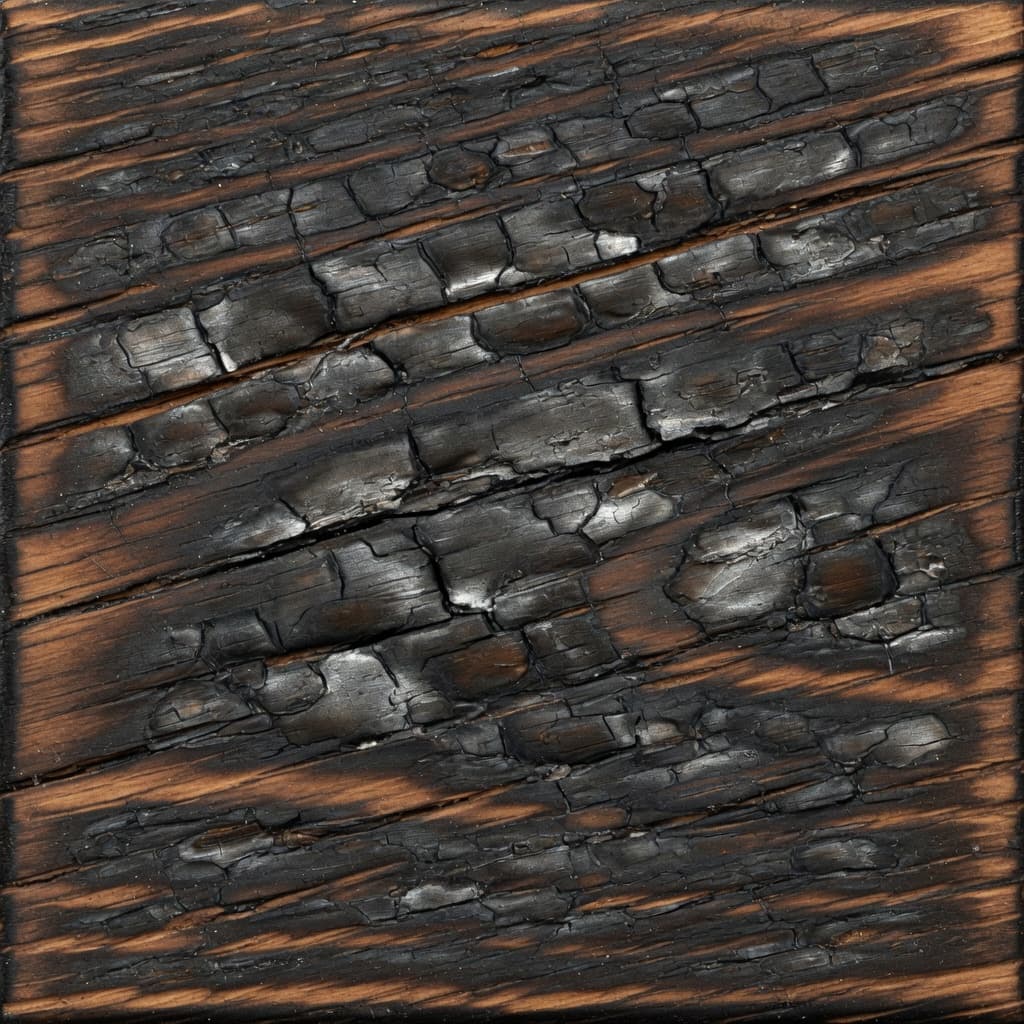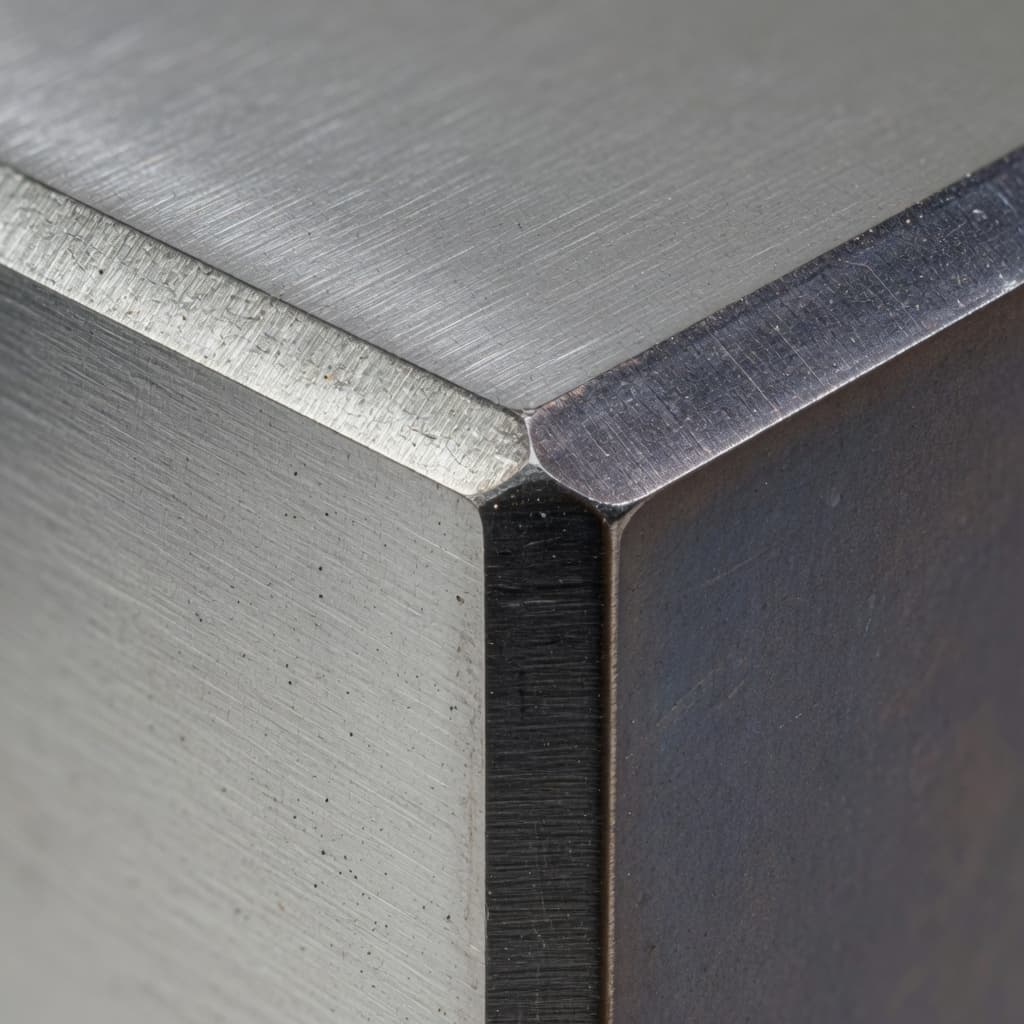

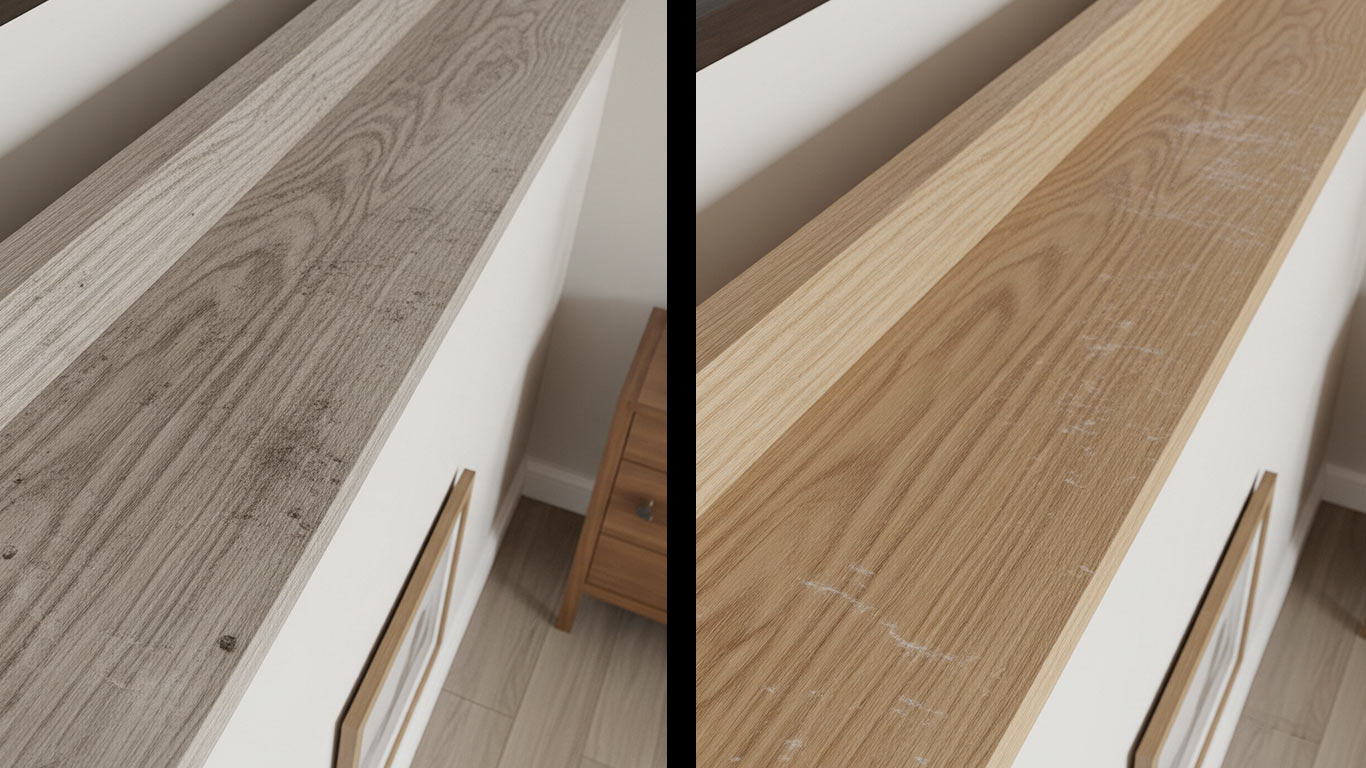

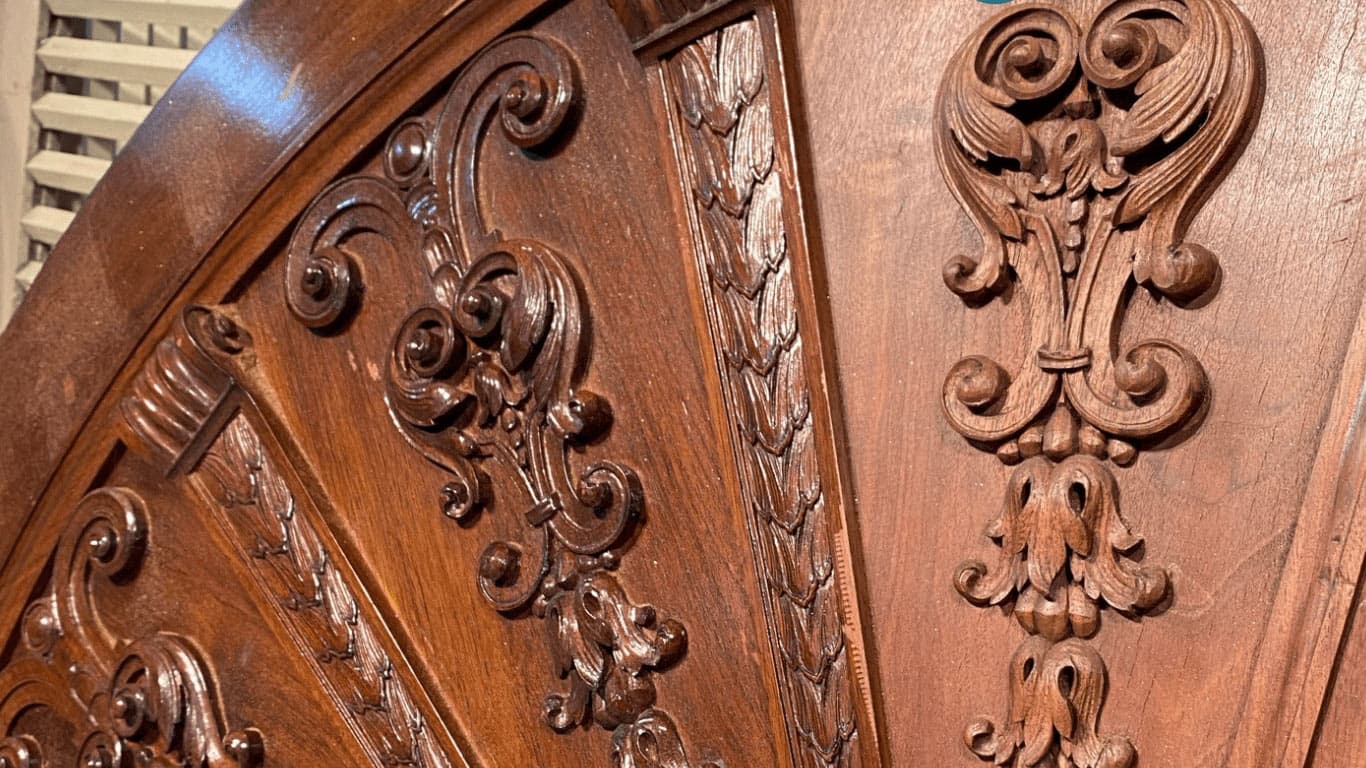
Oak surface undergoing laser cleaning showing precise contamination removal
Alessandro Moretti
Alessandro MorettiPh.D.Italy
Materials process development for ceramics and alloys
Published
Jan 6, 2026

Oak Laser Cleaning

Oak's open ring-porous structure (porosity 0.55) sets it apart from closed-grain hardwoods like Maple: soot, biological growth, and finish residues penetrate millimeters below the surface rather than sitting as a surface film, requiring 2–3 laser passes rather than one to clear embedded contamination. Density is 720 kg/m³ and tensile strength is 99 MPa (per the USDA Wood Handbook). Z-Beam clears that embedded soot and biofilm at an operating 0.5–0.8 J/cm², staying below oak's 1.2 J/cm² charring threshold across the passes the porous grain requires.

How to Clean Oak With a Pulsed Laser

1Confirm oak species and finish type
  • Distinguish white oak (finer medullary rays, denser) from red oak (more open pores, greater earlywood-latewood contrast) — red oak's larger vessel openings create a stronger differential absorption response and a narrower practical operating range within the 0.8–2.0 J/cm² cleaning window.
  • Identify surface finish before setting energy — bare wood, oil or wax finish, and paint or varnish layers have different cleaning thresholds relative to oak's 1.2 J/cm² practical charring limit, and finish type determines whether one pass or multiple passes apply.
2Test on a small area first
  • Differential earlywood scorching is the specific failure mode for ring-porous oak — earlywood's large open vessels absorb more laser energy per unit area than dense latewood, causing earlywood to char above 1.2 J/cm² before latewood contamination is fully removed, producing a striped damage pattern.
  • Grain-parallel passes at 500 mm/s with 50% overlap distribute energy more evenly across earlywood and latewood than cross-grain scanning — uneven cleaning lines on oak's surface are the visible indicator that earlywood-latewood contrast is driving parameter failure.
3Z-Beam on-site service for oak
  • Z-Beam serves Bay Area historic building contractors, furniture restoration specialists, and architectural timber programs needing grime, paint, and biological growth removed without water damage or abrasive marking.
  • Each oak job delivers a post-clean surface assessment and species-specific parameter log — recording oak species, grain direction, energy level per pass, and finish type — suitable for conservation records.

Regulatory Standards

Laser cleaning oak produces combustion byproducts including carbon monoxide and volatile organic compounds. Old finishes or paints may contain lead or other hazardous compounds. Use ventilation with HEPA and activated carbon filtration. Follow ANSI Z136.1 for laser safety and OSHA 29 CFR 1926.1101 if lead-containing paint is suspected. Test unknown coatings before production cleaning.

FAQ

  • How do I remove black charring from oak after laser cleaning?

    Black charring on oak means the energy level exceeded the 1.2 J/cm² practical damage threshold — permanent carbonization at the surface that cannot be reversed by additional laser passes. The corrective path is mechanical removal of the char layer first (light sanding), then restarting at 0.5–0.8 J/cm², 20 ns pulse, at 500 mm/s cleaning speed with 50% overlap. Oak's ring-porous structure means earlywood and latewood respond differently — always validate on a sample piece before running production. Surface darkening during cleaning is the warning sign; reduce energy immediately if it appears (Kolar et al., Applied Physics A, 2000).

  • What are the recommended laser parameters for cleaning soot from oak beams?

    Oak beams clean best at 1.0–1.8 J/cm² — most furniture and millwork jobs take one careful pass at this range to lift old finish, char, or weathering without scorching or cutting into the tight grain. Most furniture and millwork jobs take one careful pass — the wood comes out looking like fresh, raw material without any abrasive contact. Delicate carved details and thin veneers survive intact.

  • What is the maximum laser removal depth on oak before structural damage occurs?

    Oak's laser damage threshold of 2.0 J/cm² means finish, char, and weathering layers — typically 0.02–0.1 mm thick — lift cleanly in one pass before the laser reaches undamaged wood grain. Old paint, varnish, and years of grime lift off in one careful pass. The wood surface left behind looks freshly stripped without sanding marks or solvent residue.

  • What safety hazards — fumes and particulates — apply to laser cleaning oak?

    Laser cleaning oak generates carcinogenic hardwood dust, so source extraction and respiratory protection are mandatory — oak dust is an IARC Group 1 carcinogen classified carcinogenic to humans (OSHA Wood Dust Hazards), and Cal/OSHA §5155 Table AC-1 sets the oak wood dust Permissible exposure limit (PEL) at 1 mg/m³ Time-weighted average (TWA), stricter than the softwood PNOR limit of 5 mg/m³. Laser cleaning also produces CO and VOCs from finish burning. Use ventilation with HEPA and activated carbon filtration rated for VOCs; a P100 respirator is the minimum for dust control. If old paint layers are present, test for lead before cleaning — OSHA 29 CFR 1926.62 applies if lead paint is confirmed.

  • What is the Cal/OSHA exposure limit for oak wood dust during laser cleaning?

    Cal/OSHA caps oak wood dust at 1 mg/m³ TWA under §5155 Table AC-1 — the same carcinogen-grade hardwood limit applied to beech and walnut, and five times stricter than the 5 mg/m³ PNOR limit that applies to pine and other softwoods (OSHA Wood Dust Hazards). Air monitoring is required during production runs to confirm exposure stays below this threshold. HEPA extraction at the source plus a P100 respirator are the minimum controls; a powered air-purifying respirator (PAPR) is recommended for extended cleaning sessions on large oak surfaces.

Oak hardwood fluence process window (Teak, Oak, Plywood, Maple, Cherry, Walnut, Bamboo, Ash, Redwood)

Fluence (J/cm²)1.5Plywood2.3 J/cm²4.0 J/cm²Bamboo1.9 J/cm²4.0 J/cm²Maple1.5 J/cm²4.0 J/cm²Teak2.5 J/cm²5.0 J/cm²Mahogany1.3 J/cm²4.0 J/cm²Birch1.2 J/cm²4.0 J/cm²Redwood1.1 J/cm²4.0 J/cm²Oak2.0 J/cm²5.0 J/cm²Cherry0.8 J/cm²4.0 J/cm²Ash1.1 J/cm²5.0 J/cm²Walnut1.1 J/cm²5.0 J/cm²0 J/cm²2 J/cm²4 J/cm²6 J/cm²
  • This material (highlighted)
  • Other materials in this group
  • Recommended fluence (1.5 J/cm²)
Oak's 0.45 J/cm² process window is wider than Teak (0.3 J/cm²). Validate parameters on representative samples before production.

Literature process windows

Ablation windows at 1064 nm that map to Oak in the laser-parameters reference. Screening values from published literature — validate on coupons before production.

Machine Settings

What setting works for oak without causing charring? Start with energy level at 0.5-0.8 J/cm², well below the 1.2 J/cm² damage threshold. Use 1064 nm wavelength with 20 ns pulse length. Scan at 500 mm/s with 50% overlap. Two low-energy level passes are safer than one aggressive pass. If the surface darkens, reduce energy level immediately. Oak chars quickly. Exceeding 1.2 J/cm² causes permanent carbonization, not cleaning.

WavelengthOak · hardwoodOak1.1k nmAsh1.1k nmBamboo1.1k nmBirch1.1k nmCherry1.1k nmMahogany1.1k nmMaple1.1k nmPlywood1.1k nmRedwood1.1k nmTeak1.1k nmWalnut1.1k nm0.005001.0k1.5kThis materialOther materials in subcategory
Spot SizeOak · hardwoodOak200 μmTeak500 μmAsh200 μmBamboo200 μmBirch200 μmCherry200 μmMahogany200 μmMaple200 μmPlywood200 μmRedwood200 μmWalnut200 μm0.00200400600This materialOther materials in subcategory
Pulse WidthOak · hardwoodOak20.0 nsMaple50.0 nsWalnut30.0 nsAsh20.0 nsBamboo20.0 nsBirch20.0 nsCherry20.0 nsMahogany20.0 nsPlywood20.0 nsRedwood20.0 nsTeak20.0 ns0.0020.040.060.0This materialOther materials in subcategory
FrequencyOak · hardwoodOak30.0 kHzAsh50.0 kHzBamboo50.0 kHzMaple50.0 kHzTeak50.0 kHzMahogany40.0 kHzWalnut40.0 kHzBirch30.0 kHzCherry30.0 kHzRedwood30.0 kHzPlywood20.0 kHz0.0020.040.060.0This materialOther materials in subcategory
Scan SpeedOak · hardwoodOak500 mm/sMahogany2.0k mm/sTeak2.0k mm/sBirch1.5k mm/sMaple1.5k mm/sWalnut1.5k mm/sBamboo1.0k mm/sAsh500 mm/sCherry500 mm/sPlywood500 mm/sRedwood500 mm/s0.005001.0k1.5k2.0k2.5kThis materialOther materials in subcategory
Overlap RatioOak · hardwoodOak50.0 %Maple70.0 %Plywood70.0 %Birch60.0 %Cherry60.0 %Mahogany60.0 %Walnut60.0 %Ash50.0 %Bamboo50.0 %Redwood50.0 %Teak50.0 %0.0020.040.060.080.0This materialOther materials in subcategory
Laser PowerOak · hardwoodOak100 WAsh100 WBamboo100 WPlywood100 WRedwood100 WCherry90.0 WBirch45.0 WMaple45.0 WTeak45.0 WMahogany40.0 WWalnut40.0 W0.0050.0100150This materialOther materials in subcategory
Power (Alt.)Oak · hardwoodOak50.0 WAsh200 WMaple100 WRedwood100 WTeak100 WBamboo50.0 WBirch50.0 WCherry50.0 WMahogany50.0 WPlywood50.0 WWalnut50.0 W0.0050.0100150200250This materialOther materials in subcategory
Fluence ThresholdOak · hardwoodOakBamboo2.50 J/cm²Walnut2.50 J/cm²AshBirchCherryMahoganyMaplePlywoodRedwoodTeak0.001.002.003.00This materialOther materials in subcategory
Dwell TimeOak · hardwoodOak100 μsTeak120 μsCherry100 μsPlywood100 μsRedwood100 μsMahogany50.0 μsAshBambooBirchMapleWalnut0.0050.0100150This materialOther materials in subcategory

Laser-Material Interaction

Exceeding 1.2 J/cm² on oak causes immediate surface charring, not cleaning. Oak light absorption at 1064 nm is approximately 0.60 — light-colored hardwood reflects more NIR than darker species. Surface reflectance is only 12%. Most energy goes into the surface. Heat spread rate is 1.46×10⁻⁷ m²/s. Heat stays highly localized. Literature places the damage threshold at 2.45 J/cm², but practical charring starts at 1.2 J/cm². Effective cleaning must stay under 1.2 J/cm². Above that threshold, the surface darkens and carbonizes permanently.

Absorption CoefficientOak · hardwoodOak450.0k m⁻¹Plywood4500.0k m⁻¹Ash500.0k m⁻¹Bamboo500.0k m⁻¹Cherry500.0k m⁻¹Redwood500.0k m⁻¹Teak500.0k m⁻¹Walnut500.0k m⁻¹Birch400.0k m⁻¹Maple100.0k m⁻¹Mahogany50.0k m⁻¹0.001000.0k2000.0k3000.0k4000.0k5000.0kThis materialOther materials in subcategory
Thermal ConductivityOak · hardwoodOak0.17 W/m·KBamboo0.20 W/m·KMaple0.17 W/m·KBirch0.16 W/m·KCherry0.16 W/m·KAsh0.15 W/m·KMahogany0.15 W/m·KTeak0.15 W/m·KWalnut0.15 W/m·KPlywood0.13 W/m·KRedwood0.11 W/m·K0.000.050.100.150.200.25This materialOther materials in subcategory
Thermal DiffusivityOak · hardwoodOak0.00 m²/sAsh0.00 m²/sBamboo0.00 m²/sBirch0.00 m²/sCherry0.00 m²/sMahogany0.00 m²/sMaple0.00 m²/sPlywood0.00 m²/sRedwood0.00 m²/sTeak0.00 m²/sWalnut0.00 m²/s0.000.010.010.01This materialOther materials in subcategory
Thermal DestructionOak · hardwoodOak280 KWalnut623 KBamboo588 KTeak588 KAsh573 KMaple573 KRedwood573 KBirch563 KMahogany553 KCherry275 KPlywood250 K0.00200400600800This materialOther materials in subcategory
Destruction PointOak · hardwoodOak650 KMaple673 KTeak673 KRedwood600 KBirch573 KAsh550 KPlywood550 KWalnut523 KBamboo500 KCherry500 KMahogany500 K0.00200400600800This materialOther materials in subcategory
Thermal Shock ResistanceOak · hardwoodOak1.50 MW/mAsh1.50 MW/mMahogany1.50 MW/mTeak1.50 MW/mBamboo1.20 MW/mCherry1.20 MW/mMaple1.20 MW/mPlywood1.20 MW/mWalnut1.20 MW/mRedwood1.00 MW/mBirch0.80 MW/m0.000.501.001.502.00This materialOther materials in subcategory
Vapor PressureOak · hardwoodOak100 PaBirch500 PaMahogany500 PaWalnut500 PaPlywood150 PaAsh100 PaBamboo100 PaCherry50.0 PaMaple50.0 PaRedwood10.0 PaTeak10.0 Pa0.00200400600This materialOther materials in subcategory
Laser-Material Interaction Sources(1 reference)
  1. Yh Hu, ZJ Zhang, Journal of Applied Physics, 1998 (opens in new tab)Quercus robur (English oak), dry conditions (moisture content <5%), room temperature (20°C), measured using 532 nm Nd:YAG laser pulses

Material Characteristics

Oak is deceptively challenging to laser clean because the combination of open porosity (0.55) and a hard surface grain means contaminants don't sit cleanly at the surface — they wick down into the vessel structure before you see them. The damage threshold is 1.2 J/cm², and exceeding it produces immediate surface charring rather than clean cleaning, so the working window is narrow from the start — narrow enough that a conservator-tuned handheld like the PULSAR SHARK P CL 300M, which strips soot and varnish off wood at a fixed 1.5 mJ per pulse without a water chiller, earns its place over higher-power tools that overshoot it.

HardnessOak · hardwoodOak5.7k NMaple6.5k NBamboo6.1k NAsh5.9k NTeak4.8k NWalnut4.5k NCherry4.2k NMahogany3.6k NPlywood2.9k NRedwood1.9k NBirch1.3k N0.002.0k4.0k6.0k8.0kThis materialOther materials in subcategory
Tensile StrengthOak · hardwoodOak99.0 MPaBamboo180 MPaTeak143 MPaBirch130 MPaAsh115 MPaMaple100 MPaMahogany96.5 MPaWalnut82.3 MPaCherry70.3 MPaRedwood51.0 MPaPlywood48.0 MPa0.0050.0100150200This materialOther materials in subcategory
Young's ModulusOak · hardwoodOak12.4 GPaBamboo21.5 GPaBirch13.9 GPaAsh12.8 GPaMaple12.6 GPaTeak11.2 GPaPlywood10.3 GPaCherry10.3 GPaWalnut10.1 GPaRedwood9.60 GPaMahogany9.03 GPa0.005.0010.015.020.025.0This materialOther materials in subcategory
Flexural StrengthOak · hardwoodOak95.1 MPaBamboo140 MPaTeak110 MPaMaple109 MPaAsh96.5 MPaWalnut96.5 MPaBirch96.0 MPaMahogany82.7 MPaCherry67.8 MPaRedwood54.0 MPaPlywood38.0 MPa0.0050.0100150This materialOther materials in subcategory
Compressive StrengthOak · hardwoodOak50.3 MPaAsh69.0 MPaBamboo56.0 MPaMaple54.1 MPaTeak54.0 MPaWalnut52.2 MPaMahogany47.5 MPaBirch42.1 MPaCherry40.3 MPaPlywood38.0 MPaRedwood33.1 MPa0.0020.040.060.080.0This materialOther materials in subcategory
Material Characteristics Sources(1 reference)
  1. Pouli, P. et al., Laser cleaning of wooden artifacts: Threshold energy levels for oak, Journal of Cultural Heritage, 2010 (opens in new tab)Quercus robur oak wood (natural density 0.65 g/cm³), 20°C, 1064 nm Nd:YAG laser, pulse length 10 ns, measured via optical microscopy for charring onset
Technical Reference — Oakfamily-level estimate

Parameters derived from Oak-family primary literature and Bay Area field conditions. Validate on representative samples before production use.

ParameterValue
Cleaning fluence range0.8–2.0 J/cm² (±±0.2 J/cm²)
Damage threshold4.5 J/cm²
Operating point (Z-Beam)3.6 J/cm² (20% below ceiling)
Cal/OSHA iron oxide PEL5 mg/m³ TWA

When Laser Cleaning Does Not Work

ConditionConsequence
Fluence above 4.5 J/cm²Hard stopCharring/ablation of wood fiber — discoloration and surface removal

Compliance · Bay Area (BAAQMD) + California (Cal/OSHA Title 8)

ContaminantBAAQMD Permit
Iron OxideNot required
Wood Dust (oak)Not required

Process Window — Oak

Netalux Kamino 300, 1064nm fiber, 100ns pulse

Surface ConditionFloor (J/cm²)Ceiling (J/cm²)Window (J/cm²)Safety %
Light surface contamination0.84.53.720%
Moderate contamination / coating removal24.52.520%
Sources(8 references)
  1. Occupational Safety and Health Administration. Wood Dust — Hazard Recognition. U.S. Department of Labor. (opens in new tab)"Wood Dust. IARC Classification: Carcinogenic to humans (Group 1)."
  2. Eric Meier. Red Oak (Quercus rubra). The Wood Database. (opens in new tab)"The pores are so large and open that a person can blow into one end of the wood, and air will come out the other end."
  3. Forest Products Laboratory. Wood handbook—wood as an engineering material. General Technical Report FPL-GTR-282. Madison, WI: U.S. Department of Agriculture, Forest Service, Forest Products Laboratory. 2021. 543 p. (opens in new tab)"Summarizes information on wood as an engineering material. Presents properties of wood and wood-based products of particular concern to the architect and engineer."
  4. Effect of wavelength on the laser cleaning of polychromes on wood, Journal of Cultural Heritage, 2003. )00049-9 (opens in new tab)
  5. MatWeb Material Property Data — Online Materials Information Resource (opens in new tab)
  6. Laser Cleaning: Fundamentals and Applications, Feng Song & Xuechun Lin, Springer, 2024. (opens in new tab)
  7. Pouli, P. et al., Laser cleaning of wooden artifacts: Threshold energy levels for oak, Journal of Cultural Heritage, 2010 (opens in new tab)Quercus robur oak wood (natural density 0.65 g/cm³), 20°C, 1064 nm Nd:YAG laser, pulse length 10 ns, measured via optical microscopy for charring onset
  8. Yh Hu, ZJ Zhang, Journal of Applied Physics, 1998 (opens in new tab)Quercus robur (English oak), dry conditions (moisture content <5%), room temperature (20°C), measured using 532 nm Nd:YAG laser pulses

Industry Applications

Oak laser cleaning serves three distinct Bay Area customer segments. Architectural and historic millwork restorers — particularly on pre-1940 buildings in San Francisco, Berkeley, and Marin — need grime, paint, and surface contamination removed from door frames, wainscoting, and staircase components without the water damage that wet chemical stripping causes.

Highly recommend!
Pinocchio FurnitureView all testimonials