



FDA
FDA 21 CFR 1040.10 - Laser Product Performance Standards


Soapstone has an inverted threshold relationship: the surface damage threshold is 0.75 J/cm² — lower than the contamination-removal threshold — producing a negative cleaning margin that demands energy-level precision at the sub-0.05 J/cm² level. Soapstone is primarily talc (Mg₃Si₄O₁₀(OH)₂), which above 400°C dehydroxylates to enstatite, permanently altering surface chemistry and appearance. Z-Beam cleans it at just 0.2–0.5 J/cm², keeping the talc matrix well below that conversion point.
Laser cleaning soapstone produces fine talc particulates. Talc dust can cause respiratory irritation. Use ventilation with HEPA filtration. Some talc may contain asbestos; test before cleaning. Soapstone absorbs about 85% of 1064 nm energy. Standard laser safety eyewear is required. Extremely low damage threshold (0.75 J/cm²) and very low hardness (Mohs 1) require precise energy level control. The primary hazard is surface pitting, not laser radiation.

FDA 21 CFR 1040.10 - Laser Product Performance Standards

ANSI Z136.1 - Safe Use of Lasers

IEC 60825 - Safety of Laser Products

OSHA 29 CFR 1926.95 - Personal Protective Equipment
Discoloration on soapstone occurs when surface temperature exceeds 400°C, causing talc (Mg₃Si₄O₁₀(OH)₂) to dehydroxylate and convert to enstatite — a permanent mineralogical change that alters the stone's color and surface chemistry. Preventing it requires staying at 0.2–0.5 J/cm² at 1064 nm, well below the 0.75 J/cm² surface damage onset measured by Pini et al. (Journal of Cultural Heritage, 2008). A 70% pulse overlap at 1,000 mm/s cleaning speed distributes heat evenly; slow passes at high overlap concentrate thermal energy and are the most common cause of discoloration on Mohs-1 stone surfaces.
Soapstone cleaning requires operators trained to recognize the inverted threshold relationship — surface damage at 0.75 J/cm² occurs before contamination lifts at standard IR energy levels, so the operating window is 0.2–0.5 J/cm² with conservative multi-pass technique rather than a single efficient pass. ANSI Z136.1-2022 laser safety training and Class IV OPD documentation are baseline requirements. Talc dust generated during cleaning is regulated at 2 mg/m³ Time-weighted average (TWA) under Cal/OSHA §5155 (fibrous-free talc); some natural soapstone may contain asbestiform minerals, which require pre-job bulk sample analysis before any cleaning begins — a hazard it shares with serpentine. Single-pass test patch on a hidden area is mandatory before any full treatment.
On-site laser cleaning for soapstone runs $250–$350/hr with no consumables, no chemical disposal, and no secondary prep after cleaning. Most jobs are quoted by surface area or part count after a quick site assessment — call or email for a same-week estimate. Monthly service agreements are available at lower per-hour rates for production volumes.
The key differentiator for soapstone is whether the provider understands the inverted threshold — surface pitting begins at 0.75 J/cm² before standard cleaning energy levels reach contamination, requiring sub-0.5 J/cm² precision rather than the 1.0–3.0 J/cm² parameters used on most stone. Ask for the provider's documented operating range and whether they require a pre-job test patch; those without a test patch protocol have not calibrated for soapstone's Mohs-1 surface. Acoustic monitoring (per Barmparis et al., npj Heritage Science, 2025) can detect the contaminant-to-stone transition in real time — a worthwhile capability given the 0.75 J/cm² damage boundary.
Talc dust generated during soapstone laser cleaning is regulated at 2 mg/m³ TWA (fibrous-free talc) under Cal/OSHA Title 8 §5155. However, some natural soapstone contains asbestiform actinolite or tremolite — if asbestos fibers are present, they are regulated at 0.1 f/cc TWA under Cal/OSHA §1529 (construction) with no safe exposure threshold established by IARC. Pre-job bulk sample analysis by a certified laboratory is required before cleaning any soapstone of unknown provenance. Ventilation with HEPA filtration and N95 minimum respiratory protection are required regardless of asbestos test results, given the talc Permissible exposure limit (PEL).
Start with energy level at 0.2-0.5 J/cm², well below the 0.75 J/cm² damage threshold. Use 1064 nm wavelength with 20 ns pulse length. Scan at 1000 mm/s with 70% overlap. Soapstone has Mohs hardness of 1, the softest stone. Extremely low damage threshold (0.75 J/cm²). Never exceed 0.7 J/cm². Two to three passes at very low energy level are required. Soft talc surface pits easily. Use larger spot size (300 μm) to spread energy. Test on hidden area first. Watch for surface pitting or powdering.
Soapstone is the softest stone Z-Beam cleans — Mohs hardness of 1 means a fingernail can scratch it, and the laser damage threshold (0.75 J/cm²) falls below the damage threshold (1.2 J/cm²), so surface pitting begins before contamination starts to lift at 1064 nm. That inverted relationship rules out standard IR parameters and requires a precision low-energy approach: 0.2–0.5 J/cm² with 70% overlap and 1,000 mm/s removes staining and atmospheric deposits below the damage boundary.
Natural soapstone (95% talc composition, commercial grade from Norwegian quarry), room temperature (25°C), measured using 1064 nm Nd:YAG laser with 10 ns pulse length, under ambient atmosphere
Soapstone accepts laser cleaning only at 0.2–0.5 J/cm² — the narrowest practical window of any stone Z-Beam cleans — because its Mohs 1 hardness means surface pitting begins at 0.75 J/cm², before standard IR energy levels reach contamination. Talc-rich composition (95%) keeps porosity at 1.2%, so staining stays near the surface and lifts readily at low energy level — unlike a porous carbonate stone such as travertine, where deposits sit deeper; the challenge is staying below the damage boundary, not penetrating deeply. Thermal conductivity of 2.5 W/m·K — low for stone — means pulse heat dissipates slowly, making 70% beam overlap and 1,000 mm/s cleaning speed essential to avoid localized overheating.
Natural soapstone (95% talc composition, commercial grade), 20°C, 1064 nm Nd:YAG laser, pulse length 10 ns, measured via optical microscopy for surface cleaning onset
| Parameter | Value |
|---|---|
| Cleaning fluence range | 0.2–0.5 J/cm² (±±0.05 J/cm²) |
| Damage threshold (inverted) | 0.75 J/cm² |
| Operating point (Z-Beam) | 0.2–0.5 J/cm² (well below 0.75 J/cm² damage threshold) |
| Cal/OSHA talc PEL | 2 mg/m³ TWA |
| Condition | Consequence |
|---|---|
| Fluence above 0.75 J/cm²Hard stop | Surface pitting and talc matrix delamination — inverted threshold, damage before cleaning |
| Contaminant | BAAQMD Permit |
|---|---|
| Talc Particulate (laser Ablation Dust — Talc Substrate) | Not required |
Netalux Kamino 300, 1064nm fiber, 100ns pulse
⚠ Narrow window: Talc substrate (Mohs 1) — extremely soft. Process window under 2 J/cm². Single-pass test patch required.
| Surface Condition | Floor (J/cm²) | Ceiling (J/cm²) | Window (J/cm²) | Safety % |
|---|---|---|---|---|
| Light surface contamination (soot, biological) | 0.5 | 2.5 | 2 | 20% |
| Moderate contamination (paint, heavy biological) | 1 | 2.5 | 1.5 | 20% |
"Acoustic signals are extremely sensitive to material modifications as they are strongly dependent on the effective optical absorption coefficient of the irradiated region."
Natural soapstone (95% talc composition, commercial grade), 20°C, 1064 nm Nd:YAG laser, pulse length 10 ns, measured via optical microscopy for surface cleaning onset
Natural soapstone (95% talc composition, commercial grade from Norwegian quarry), room temperature (25°C), measured using 1064 nm Nd:YAG laser with 10 ns pulse length, under ambient atmosphere
High-end kitchen and bath designers in San Francisco, Marin County, and the Peninsula specify soapstone countertops for their heat resistance and natural patina — laser cleaning removes stains and residue buildup without the surface damage that abrasive cleaners cause on Mohs-1 stone. Acoustic monitoring (Barmparis et al. 2025) detects the transition from contaminant to stone surface in real time — a critical safeguard given the 0.75 J/cm² damage boundary.


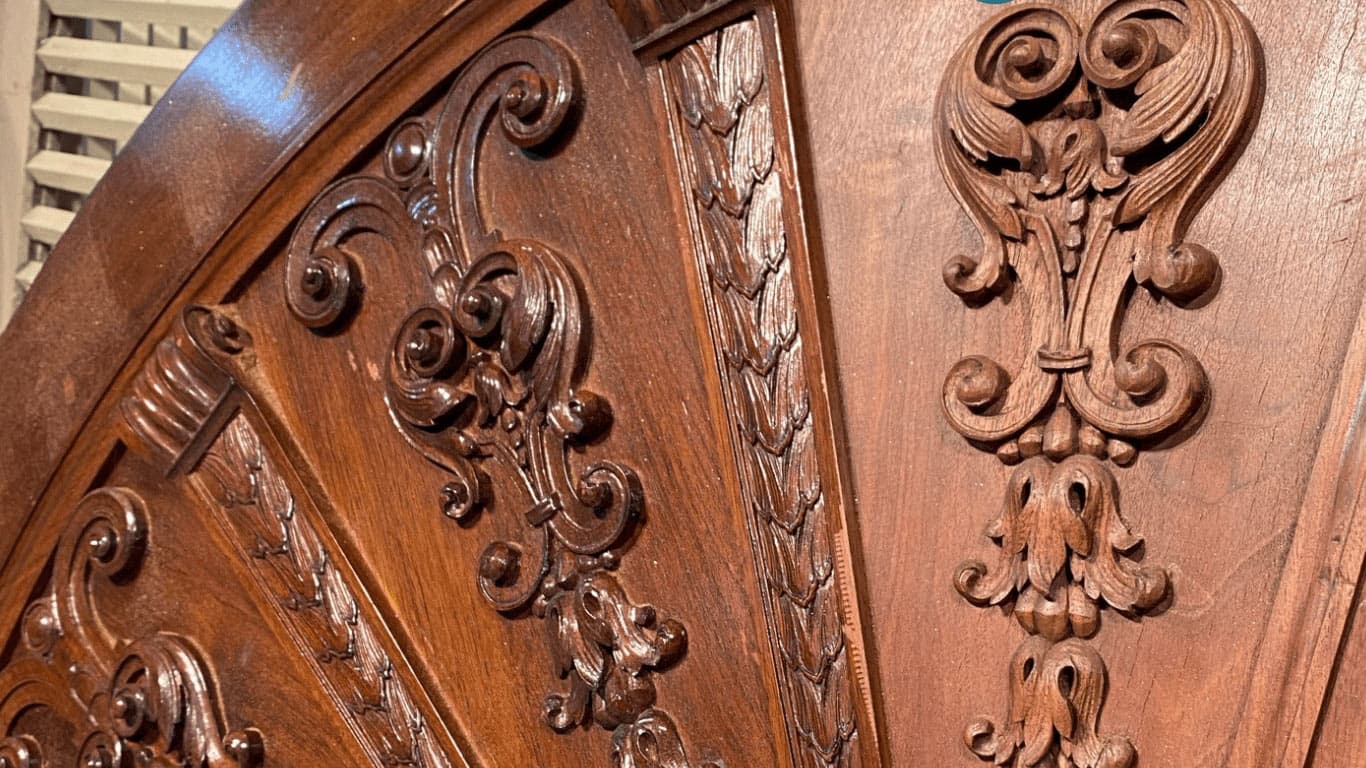
…This laser is amazing at tackling intricate woodwork designs.