


On-Site Demo
Free/ 60 mins
- CoversCoverage SF Bay Area
- Test your material
Discover mobile laser cleaning machine Needle® netalux.com (opens in new tab)
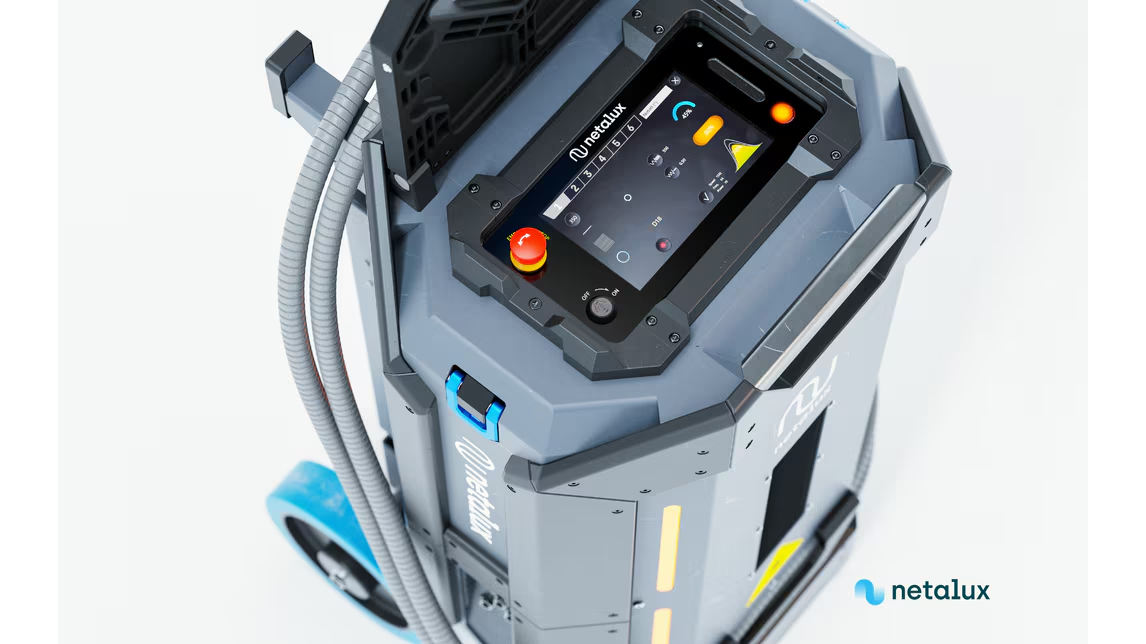
Same 2 mJ ceiling and tunable pulse as the Needle 200, but with 300 W behind it, the Needle 300 spends its extra output on speed instead of harder hits. More shots per second is what makes broad steel rust removal practical from a handheld head.
Published values come from public manufacturer datasheets and product pages. If you represent Netalux and see an error, outdated figure, or missing model, send a short correction with a public source URL and we will review it.
| Fluence at 2 mm spot | 0.0637 J/cm² |
| Fluence at 5 mm spot | 0.0102 J/cm² |
| Overlap (cleaning) | 60–80% |
Entity-fact-cited specifications for the Netalux Needle 300 sourced from the canonical machines entity registry. Each row is anchored to a citation.
| Brand | Netalux |
| Model | Needle 300 |
| Origin | Belgium |
| Laser type | MOPA pulsed ytterbium fiber |
| Wavelength | 1064 nm |
| Average power | 300 W |
| Max pulse energy | 2 mJ |
| Pulse width | 20–500 ns (adjustable) |
| Pulse frequency | 2–4000 kHz |
| Cooling | Air |
| Weight | 43 kg |
| Beam quality (M²) | < 1.6 |
Netalux Needle 300 positioned against other Netalux machines. Orange/blue = this model; slate band = Netalux min–max for that property. Missing properties are omitted.
Needle 300 highlighted among Netalux systems with datasheet max pulse energy (mJ). Color = architecture.
Where the Netalux Needle 300 sits among 52 laser-cleaning machines with published power and pulse energy. Log-scale axes; shape = architecture; orange highlight = this machine.
| Machine | Max Power (W) | Pulse Energy (mJ) |
|---|---|---|
| Netalux Jango® | 200 | 100 |
| cleanLASER CL1000iF | 1000 | 10 |
| PULSAR Laser SHARK P CL 100M | 100 | 1.5 |
| PULSAR Laser SHARK P CL 200M | 200 | 1.5 |
| PULSAR Laser SHARK P CL 300M | 300 | 1.5 |
| PULSAR Laser SHARK P CL 500A | 500 | 1.5 |
| PULSAR Laser SHARK P CL 1000A | 1000 | 1.5 |
| Laserax LXQ-UHP Series (500W–3kW) | 1750 | 100 |
| 4JET JETLASER M200 | 200 | 10 |
| 4JET JETLASER M500 | 500 | 100 |
| 4JET JETLASER M1000 | 1000 | 100 |
| SenFeng SF500HC | 500 | 50 |
| SenFeng SF1000HC | 1000 | 50 |
| Han's Laser HC-PD | 125 | 1.5 |
| P-Laser QF-500 | 500 | 50 |
| P-Laser QF-1000 | 1000 | 100 |
| P-Laser QF-2000 | 2000 | 100 |
| Powerlase Vulcan 500c | 500 | 40 |
| Powerlase FL-C100C | 100 | 5 |
| JNCT Laser 100W Air Cooling Laser Cleaning Machine | 100 | 1 |
| JNCT Laser 200W Air Cooling Laser Cleaning Machine | 200 | 1 |
| Wuhan Sintec STPL-V-i500C | 500 | 60 |
| Wuhan Sintec STPL-V-i1600 | 1600 | 250 |
| Han's Laser HC-PD 50W | 50 | 1.1 |
| Han's Laser HC-PD 100W | 100 | 1.5 |
| Han's Laser HC-PD 200W | 200 | 1.5 |
| Netalux Needle 100 | 100 | 1 |
| Netalux Needle 150 | 150 | 1 |
| Netalux Needle 200 | 200 | 2 |
| Netalux Needle 300 (current) | 300 | 2 |
| cleanLASER CL 500 | 500 | 25 |
| P-Laser QFC-50 | 50 | 1 |
| P-Laser QFC-100 | 100 | 1 |
| P-Laser QFC-200 | 200 | 1 |
| P-Laser QFC-300 | 300 | 1 |
| Laserax LXQ-UHP 500W | 500 | 100 |
| Laserax LXQ-UHP 1000W | 1000 | 100 |
| Laserax LXQ-UHP 2000W | 2000 | 150 |
| Laserax LXQ-UHP 3000W | 3000 | 150 |
| Fortune Laser FL-C200 | 200 | 2 |
| Fortune Laser FL-C300 | 300 | 2 |
| P-Laser ECO-C 200 | 200 | 1 |
| P-Laser ECO-C 500 | 500 | 1.5 |
| Netalux Kamino 300 | 300 | 50 |
| Narran ROD 300 Air | 300 | 15 |
| Narran ROD 500 | 500 | 50 |
| Narran ROD 1000 | 1000 | 50 |
| Narran ROD 2000 | 2000 | 100 |
| Narran ROD 100 Air | 100 | 1.54 |
| Narran ROD 500 Bright+ | 500 | 100 |
| Narran ROD 1000 Bright+ | 1000 | 100 |
| Narran ROD 2000 Bright+ | 2000 | 100 |
The Needle 300 and the Kamino 300 share 300 W[1], but they answer different jobs. The Needle 300 is an air-cooled MOPA head with 2 mJ pulses and tunable width, while the water-cooled Kamino 300 packs far more energy into fewer pulses for thick coatings.
On the Needle 300 the pulse ceiling stays at 2 mJ as on the Needle 200, roughly 0.064 J/cm² on a 2 mm spot, so the extra 100 W goes into covering area faster rather than hitting harder. Move up to the Needle 300 w[1]hen the Needle 200 gives a good finish but too slowly.
On the Needle 300, start at the short end of the 20-500 ns range on heat-sensitive or thin parts, and lengthen the pulse only when the layer resists. Pulse width and repetition rate adjust apart from each other on the Needle 300 MOPA source, so one can be held while the other is tested.
Full 2 mJ pulses are available to about 150 kHz at 300 W[1]. Its 2-4000 kHz band reaches well beyond that, where each pulse shrinks and the beam behaves more like a gentle sweep for light films.
Air cooling handles it, which makes the Needle 300 the most powerful Needle that runs without a chiller. Allow floor space for about 43 kg of equipment on wheels instead.
Check the class printed on the unit and its compliance papers before the first job. Handheld fiber cleaners in this power range normally fall under Class 4 (Laser Photonics guide), which means eyewear rated for 1064 nm, a marked zone and trained operators belong in the plan.