


Stainless Steel 316 Laser Cleaning
Laser cleaning burns off the dark heat marks that welding and grinding leave on 316 stainless, so the metal looks clean again without any chemical dip or sanding. It does not finis...


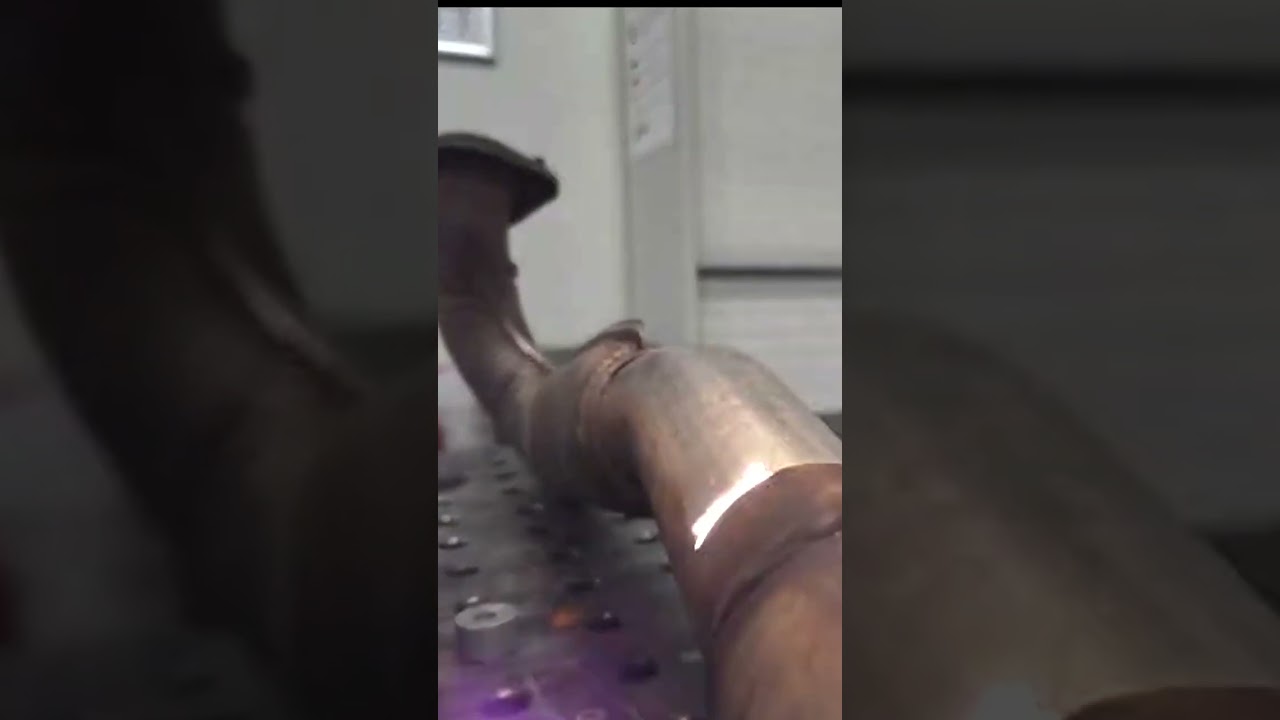
Laser cleaning removes heat tint, baked-on residue, and light surface rust from a Porsche 911 exhaust without abrading thin stainless tubing or undercutting welds. Beam control holds tighter tolerance than media blasting on tucked bends and flange faces, so wall thickness stays intact where stainless steel tubing runs thinnest. It will not straighten a dented pipe, seal a cracked flex joint, or restore heat-tint color once a section reads bare metal; those repairs need welding or replacement first. For a header showing rust pitting near the flanges, treat the surface with the same rust removal approach used on comparable automotive exhaust work, then inspect welds before reinstalling.
Short 4jldodjS3ak shows pulsed laser clearing rust, carbon, and old coating from a Porsche 911 exhaust in 29 seconds without grit.
Laser cleaning burns off the dark heat marks that welding and grinding leave on 316 stainless, so the metal looks clean again without any chemical dip or sanding. It does not finis...

304 is the everyday stainless grade. Laser cleaning removes scale, heat discoloration, and shop residue from 304 tanks, sinks, and fabricated equipment without disturbing the passi...

Laser cleaning removes rust, mill scale, and weld discoloration from steel without media, holding fluence near a 1.5 J/cm² cleaning floor and stopping short of the 4.5 J/cm² mark t...

Rust and mill scale come off iron without abrasive blasting the face. Thickness and moisture in that rust change the job. Cast iron with graphite at the surface does not behave lik...

Across stainless grades, the chromium oxide film starts to leave near 0.41 J/cm² at 1064 nanometers, well below the 5 to 12 J/cm² range where the parent alloy takes thermal damage....

Nickel in the shop is either solid stock or bar, or a thin plated layer bonded to steel for corrosion resistance. Laser cleaning removes oxide, tarnish, and surface contamination f...
Requires a material call before a setting, since carbon-filled EPDM and nitrile gasket residue absorb a 1064 nanometer beam efficiently while Viton and other FKM compounds carry the same dark filler but decompose above roughly 200°C into hydrogen fluoride gas. [Carbon steel](/materials/steel-laser-cleaning) flange faces clear this residue between about 1 and 3 J/cm2, well under the 8 to 15 J/cm2 point where the metal itself starts to take damage, so the margin stays wide once the gasket type is confirmed on a coupon. Peer-reviewed laser surface-prep work on bonding faces shows the same selective-lift pattern a flange land needs when the rubber film must leave and the metal underneath must stay ready for the next gasket.
Requires reading the deposit-substrate pair before setting energy, because a [built-up edge](/materials/aluminum-laser-cleaning) on a carbide insert and the same cold-welded smear on a [tool-steel](/materials/tool-steel-laser-cleaning) die do not clear at the same fluence. The deposit got there by mechanical transfer, pressure welding during machining, adhesive wear between sliding parts, or hot workpiece pickup on a die, not by a chemical reaction with the base metal, so a matching offcut decides the setting rather than a rust or oxide default. Built-up edge on cutting tools forms when chip material pressure-welds to the rake face, work-hardens, and seizes the tip, the same transfer path that shows up as galling on dies and as hot pickup on a [tungsten-carbide](/materials/tungsten-carbide-laser-cleaning) cutting edge.
Laser cleaning removes the chromium-oxide and titanium-oxide scale that post-weld and post-anneal heat treatment grows on stainless steel, titanium, and Inconel, clearing the film without a chemical pickling bath. It will not rebuild the chromium that heat already pulled out of the grain boundaries beneath a dark heat-treated color, will not fix titanium alpha case that has already let oxygen diffuse deep into the metal, and will not stop the bare surface from re-oxidizing once it goes back into service heat.
Laser cleaning removes the straw-to-blue heat tint film from a stainless weld bead and leaves the surrounding parent metal untouched. It is not a substitute for a post-weld corrosion sign-off, and it will not remove heavy slag or mill scale sitting on top of the discoloration.

Laser cleaning removes mill scale, oxide layers, and weld residue from fabricated metal parts without abrasive media or chemical strippers. Shops handling [steel](/materials/steel-...

Laser cleaning removes oxide, sealant, and coating buildup from aircraft skins, engine components, and defense hardware without media blasting or chemical stripping. It works on [a...

Precision surface work requires contact-free cleaning because gauge faces, optical flats, and polished tooling scratch under abrasive pads or chemical baths. Pulsed fiber sources r...

Automotive and EV production lines use pulsed fiber lasers to strip mill scale from stamped [steel](/materials/steel-laser-cleaning) body panels, clear weld-seam oxide ahead of res...

Salt air, not the hourly rate, decides a Bay Area rust job. Laser cleaning takes field [rust](/contaminants/iron-oxide-rust-laser-cleaning) off [steel](/materials/steel-laser-clean...


