FDA
FDA 21 CFR 1040.10 - Laser Product Performance Standards


Aluminum bronze is built around its surface oxide. The Al₂O₃ layer that forms before copper can patina gives it exceptional corrosion resistance in marine and industrial environments. Laser cleaning has to remove contaminants and biological fouling without stripping that protective layer. At 7% light absorption at 1064 nm (similar to pure copper), it takes real power to get cleaning action. The Al₂O₃ layer ablates cleanly at 100 W, 50 kHz, and 1,500 mm/s with 60% overlap in two passes. Preserving the Al₂O₃ passive layer while removing biological fouling is the defining challenge. It is why aluminum bronze cleaning requires a lower energy level ceiling than structural steel, even though it's the harder material.
If you're willing to do the work, the process is incredibly effective.

How reflective is aluminum bronze? Only 7% light absorption at 1064 nm – about the same as pure copper and much lower than steel (40%+). What is the damage threshold? 2.1 J/cm² – higher than most ferrous alloys. How does the oxide help? Al₂O₃ absorbs energy differently than the bulk alloy, so the oxide lifts as a discrete layer rather than mixing with the metal. What is the variable to watch? Fe-rich phases (4% iron in C95400) create localized hot spots. Scan a test area first to see where iron clusters are. The result is a clean surface without heat damage to the alloy.
What makes aluminum bronze different from other copper alloys? It forms a protective Al₂O₃ oxide layer before copper can patina – this is key for its corrosion resistance. How strong is it? Tensile strength of 655 MPa – about 2x stronger than standard bronze. What is the thermal challenge? At 59 W/m·K conductivity, heat spreads moderately – slower than pure copper but faster than stainless steel. What is the cleaning variable in C95400? Fe-rich phases (4% iron) create localized absorption variation on cast surfaces. Verify parameters on a test area before full-surface work. This means laser cleaning must stay below the tin and lead damage threshold.
Laser cleaning aluminum bronze at 100 W, 50 kHz, 1500 mm/s cleaning speed, 60% overlap, and 2 passes removes oxide without melting the surface. Experiment conducted: 2026-03-27. No surface damage – the cleaned surface feels smooth and dry, with no residue or discoloration. These parameters apply to C95400 cast aluminum bronze. Wrought alloys may have different Fe-phase distribution and require test area verification.
What safety standards apply to laser cleaning aluminum bronze? FDA 21 CFR 1040.10 – Laser Product Performance Standards (USA). ANSI Z136.1 – Safe Use of Lasers. IEC 60825 – Safety of Laser Products (international). OSHA 29 CFR 1926.95 – Personal Protective Equipment. These standards cover laser safety eyewear (OD 5+ for 1064 nm) and exhaust ventilation (to remove metal oxide dust).
Aluminum bronze is built around its surface oxide. The Al₂O₃ layer that forms before copper can patina gives it exceptional corrosion resistance in marine and industrial environments. Laser cleaning has to remove contaminants and biological fouling without stripping that protective layer. At 7% light absorption at 1064 nm (similar to pure copper), it takes real power to get cleaning action. The Al₂O₃ layer ablates cleanly at 100 W, 50 kHz, and 1,500 mm/s with 60% overlap in two passes. Preserving the Al₂O₃ passive layer while removing biological fouling is the defining challenge. It is why aluminum bronze cleaning requires a lower energy level ceiling than structural steel, even though it's the harder material.


Effective laser cleaning of aluminum bronze oxidation uses the preferential Al₂O₃ oxide layer for clean separation. Optimal results require precise parameter settings, typically using a 1064 nm laser with a damage threshold of 2.1 J/cm². Due to localized absorption variations from Fe-rich phases in UNS C95400, always verify parameters on a test area before full-surface work.
The best laser cleaning settings for aluminum bronze (UNS C95400) are determined empirically, typically starting with energy levels above its 2.1 J/cm² damage threshold. Given the material's 7% light absorption at 1064 nm and potential localized absorption variations from Fe-rich phases in as-cast parts. Precise parameters like pulse length and repetition rate require validation on a test area first. Always verify settings on a test area.
Optimal laser cleaning settings for Aluminum Bronze (UNS C95400) start around the 2.1 J/cm² damage threshold. Light absorption at 1064 nm is only 7%, so real power is needed. Localized absorption variations from Fe-rich phases require parameter verification on a test area to prevent surface damage.
Laser cleaning costs for aluminum bronze (UNS C95400) vary significantly based on part geometry, contamination, and required throughput. The material's 7% light absorption at 1064 nm and 2.1 J/cm² damage threshold influence energy requirements. As-cast parts with Fe-rich phase distribution may require localized parameter adjustments, impacting overall project cost. A test area verification is crucial for accurate estimation.
Aluminum bronze forms an adherent Al₂O₃ passivation layer on air exposure — typically 3–10 nm thick — that provides its corrosion resistance, classified under ASTM B148 as a high-strength, corrosion-resistant copper alloy. Laser cleaning removes surface contamination above this passivation layer without disrupting the underlying oxide, preserving the alloy's protective mechanism. Heavy selective corrosion requires higher energy level to remove the corroded layer, which may also remove the passivation film; our team advises post-cleaning passivation treatment before returning components to corrosive service environments in those cases.
Oxide scale and corrosion products release cleanly at the 2.1 J/cm² damage threshold, which matches the damage threshold for this alloy. Use 1.5 J/cm² power level at 100 W, 50 kHz, 1500 mm/s cleaning speed with 60% overlap to stay within margin. Al₂O₃ passivation layers aid clean separation of contamination. Fe-rich phases in UNS C95400 cause localized absorption variations — always verify on a test area first.
Aluminum bronze forms a dense Al₂O₃ layer with a narrow onset-to-damage gap — coupon testing with a controlled full settings is mandatory before production cleaning.
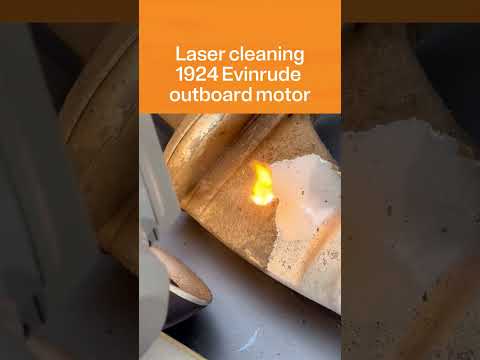
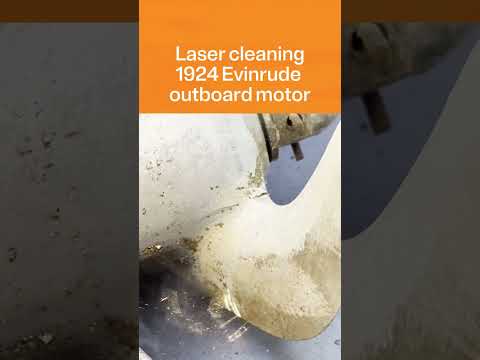
Subject-related laser cleaning video demonstrations from the Z-Beam channel.